Measuring the Equilibrium Spreading Pressure—A Tale of Three Amphiphiles
Boyan Peychev, Dimitrinka Arabadzhieva, Ivan L. Minkov, Iglika M. Dimitrova, Elena Mileva, Stoyan K. Smoukov, Radomir I. Slavchov

TL;DR
This paper explores methods to measure the equilibrium spreading pressure of three different amphiphiles, addressing challenges in experimental protocols and offering practical solutions.
Contribution
The paper introduces practical experimental techniques to measure equilibrium spreading pressure for challenging amphiphiles.
Findings
Using a temporary mechanical barrier reduces disturbances during the spreading of n-dodecanol.
Presaturating the subphase improves measurement accuracy and speeds up equilibration.
A volatile solvent aids in overcoming mass transfer barriers for nonspreading amphiphiles like DPPC.
Abstract
A surfactant’s equilibrium spreading pressure (ESP) is the maximum decrease in surface tension achievable at equilibrium below the Krafft point. Difficulties in measuring the ESP have been noted previously but no well-established experimental protocols to overcome them exist. We present a case study of three solid amphiphiles with different propensities to spread on the air–water interface. Starting with the partially water soluble n-dodecanol (C12H25OH), which spreads instantaneously. The strong Marangoni flows associated with the spreading result in the dislocating of the Wilhelmy plate or crystals attaching to it. A temporary mechanical barrier in front of the spreading crystals mitigates the flows disturbing the plate. Presaturating the subphase with the amphiphile prevents the establishment of dynamic steady states, reduces the standard error by a factor of three and causes faster…
Genes, proteins, chemicals, diseases, species, mutations and cell lines named across the full text — each resolved to its canonical identifier and authoritative record.
Click any figure to enlarge with its caption.
 Figure 1
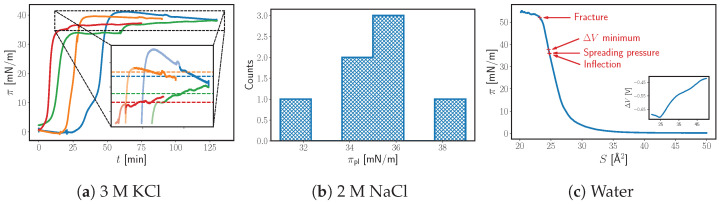 Figure 2
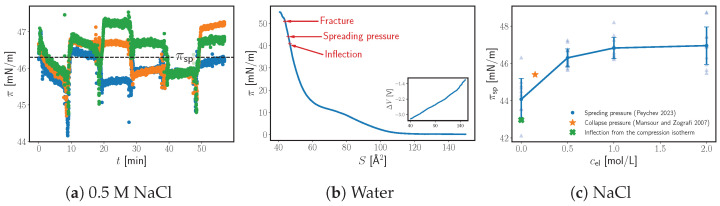 Figure 3
Peer Reviews
No public reviews on file for this paper yet. If you reviewed it on a platform where reviews are public (OpenReview, ICLR, NeurIPS, ICML), you can paste yours below so the community can read it here.
Videos
No videos yet. Explain this paper in a talk, walkthrough, or lecture? Add one.
Taxonomy
TopicsSurfactants and Colloidal Systems · Lipid Membrane Structure and Behavior · Spectroscopy and Quantum Chemical Studies