A Two-Step Approach Using the National Health Institutes of Health Stroke Scale Assessed by Paramedics to Enhance Prehospital Stroke Detection: A Case Report and Concept Proposal
Loric Stuby, Mélanie Suppan, Thibaut Desmettre, Emmanuel Carrera, Matthieu Genoud, Laurent Suppan

TL;DR
This paper proposes a two-step method for paramedics to better detect strokes, especially those with subtle or posterior symptoms, using a detailed stroke scale after a quick initial assessment.
Contribution
The paper introduces a novel two-step prehospital stroke detection approach combining fast and detailed assessments.
Findings
A case where a detailed NIH Stroke Scale assessment by a paramedic identified an ischemic stroke missed by a quick prehospital scale.
Current prehospital practices often miss posterior strokes and subtle symptoms, leading to delayed treatment.
A two-step approach can improve stroke detection without causing unnecessary delays.
Abstract
Background: Prehospital detection and triage of stroke patients mostly rely on the use of large vessel occlusion prediction scales to decrease onsite time. These quick but simplified scores, though useful, prevent prehospital providers from detecting posterior strokes and isolated symptoms such as limb ataxia or hemianopia. Case report: In the present case, an ambulance was dispatched to a 46-year-old man known for ophthalmic migraines and high blood pressure, who presented isolated visual symptoms different from those associated with his usual migraine attacks. Although the assessment advocated by the prehospital guideline was negative for stroke, the paramedic who assessed the patient was one of the few trained in the National Institutes of Health Stroke Scale assessment. Based on this assessment, the paramedic activated the fast-track stroke alarm and an ischemic stroke in the right…
Genes, proteins, chemicals, diseases, species, mutations and cell lines named across the full text — each resolved to its canonical identifier and authoritative record.
Click any figure to enlarge with its caption.
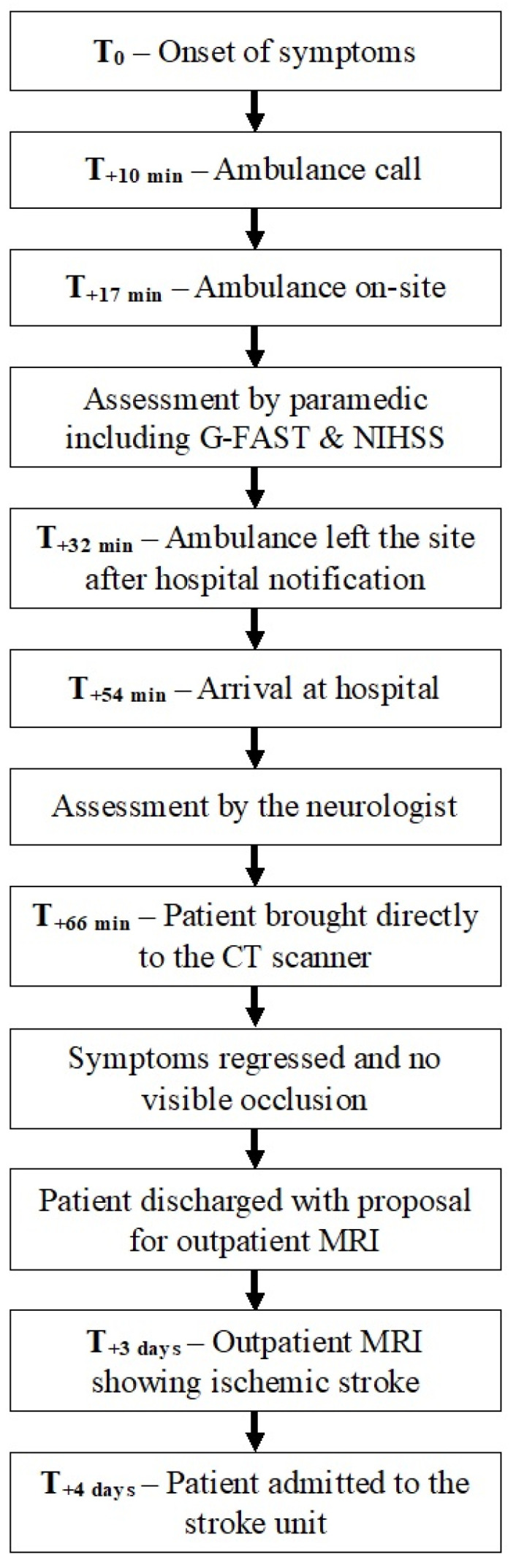 Figure 1
Peer Reviews
No public reviews on file for this paper yet. If you reviewed it on a platform where reviews are public (OpenReview, ICLR, NeurIPS, ICML), you can paste yours below so the community can read it here.
Videos
No videos yet. Explain this paper in a talk, walkthrough, or lecture? Add one.
Taxonomy
TopicsAcute Ischemic Stroke Management · Stroke Rehabilitation and Recovery · Traumatic Brain Injury and Neurovascular Disturbances