OnetoMap Meta-Data: Healthcare Analytics Through Research
Nadayca Mateussi, Haroon Janjua, Emily A Grimsley, Melissa Kendall, Tyler Zander, Ricardo Pietrobon, Paul C Kuo

TL;DR
The OnetoMap meta-data repository is a centralized healthcare data inventory that helps researchers find and use diverse datasets more efficiently.
Contribution
The novel contribution is the creation of a standardized, centralized metadata repository for healthcare datasets with detailed descriptions and collaboration tools.
Findings
The OnetoMap repository currently includes descriptions of 49 datasets with varied data types and sources.
The repository is hosted on GitHub, supporting open access, version control, and collaboration.
It includes data on patient health, socioeconomic factors, hospital structures, and physician practices.
Abstract
Introduction: Big Data has revolutionized healthcare research through the three Vs: volume, veracity, and variety. This study introduces the OnetoMap meta-data repository, a centralized inventory developed in collaboration with the University of South Florida's Department of Surgery. Methods: The repository offers extensive details about each database, including its primary purpose, available variables, and examples of high-impact research utilizing these databases. It aims to create a centralized inventory, enabling researchers to locate and link relevant datasets efficiently. Each dataset is described using standardized criteria to ensure clarity and usability, such as data type, source, collection methods, and potential linkages to other datasets. Results: Currently, the OnetoMap repository contains descriptions of 49 datasets, with ongoing updates to include new datasets and…
Genes, proteins, chemicals, diseases, species, mutations and cell lines named across the full text — each resolved to its canonical identifier and authoritative record.
Click any figure to enlarge with its caption.
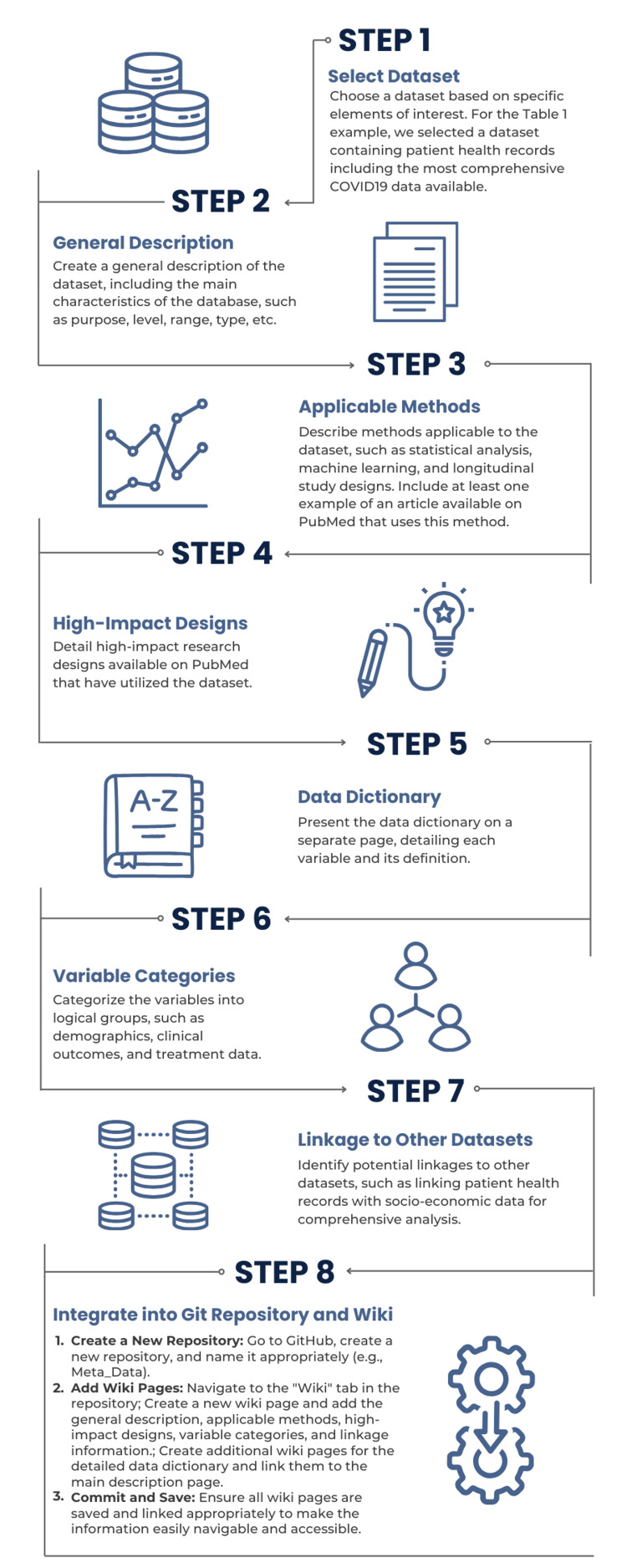 Figure 1
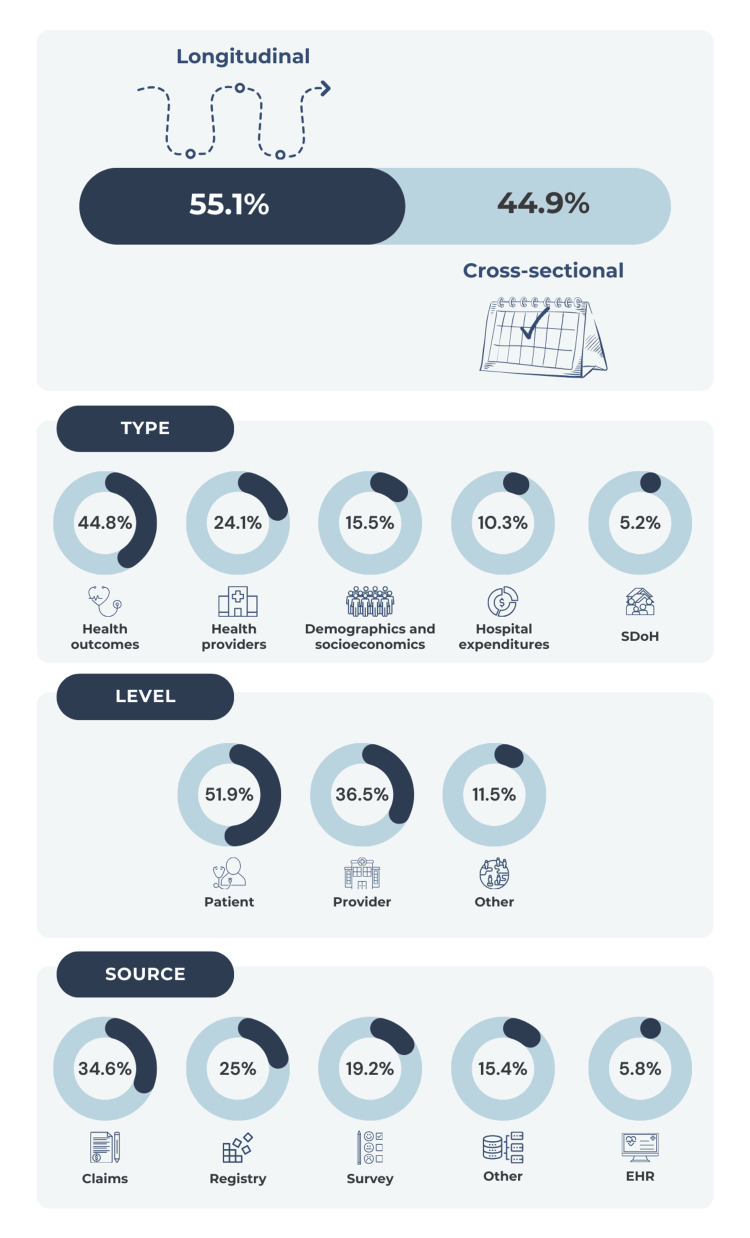 Figure 2
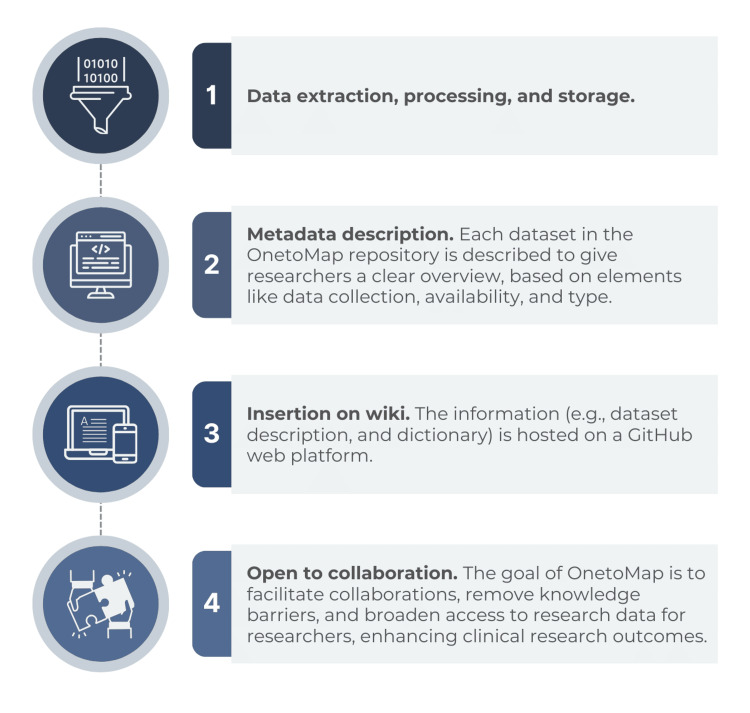 Figure 3
| Field | Description | Example based on N3C database |
| 1. General description | ||
| a. Database primary purpose | The primary purpose of the database | Offer a comprehensive and centralized data resource to enable research teams to study COVID-19 and its associated properties |
| b. Overall data type | Type of document where the data is presented (e.g., hospital expenditures, demographics) | Health outcomes |
| c. Dataset type | Type of register of the dataset considering the focused subject and the period (i.e., longitudinal, cross-sectional) | Longitudinal |
| d. Data source | Type of source from where the data was extracted (e.g., clinical trials, claims) | Electronic health records (EHR) |
| e. Data level | Level of collection of data | Patient level |
| f. Geographic location of the data collection sites | Country and institutions from where data was collected | Currently, 98 institutions [ |
| g. Sponsor, manager, or home institution | Institutions involved in the funding, management, and maintenance of the project | National Center for Advancing Translational Sciences (NCATS) |
| h. Date range | Time interval of data register and/or availability | From January 1, 2018, to the latest data partner extraction date |
| i. Geolocation data | Geographical location information available (e.g., zip codes, ZCTA, county) | Patient zip codes accessible within the limited dataset |
| j. Dates | Dates availability (day, month, year) | Available under the limited dataset |
| k. Hospital identifiers | Any information that identifies the hospitals involved in the dataset | Synthetic data partner ID |
| l. National provider identifier (NPI) | If available | No |
| m. Physician identifiers | Any information that identifies the physician involved in the database | Synthetic provider ID |
| n. Longitudinal tracking | The method employed by the dataset to monitor patients both within and across hospitals, as well as to track providers | Track patients both within and across participating hospitals at office, inpatient, outpatient, and emergency department levels. Additionally, track providers across the hospitals that currently provide the provider ID, occurrences (e.g., visit, procedure), and the IDs mentioned above |
| o. Financial variables | Financial-related information available in the dataset | None |
| p. Clinical areas of interest | OMOP-CDM concepts that classify the database | All clinical areas |
| q. Number of records | The total count of individual entries or data points contained within a dataset | By June 2024, the N3C held information on 22.7 million anonymized patients, with 1.8 billion visits, more than 8.8 million COVID-positive cases, 3.3 billion clinical observations, 16.1 billion lab results, 5.1 billion medication records, and 1.3 billion procedures |
| r. Variables that are uniquely present in this dataset | Unusual type or exclusive information provided by the dataset | COVID-related variables, inpatient medications, general drug information, laboratory results, patient zip codes and dates in the limited dataset, and the linkage between inpatient, outpatient, emergency department, and office data |
| s. Database caveats and limitations | Limitations presented by the database | Hospitals cannot be identified per the Data Use Agreement (DUA); the dataset is restricted to patients who have undergone a COVID test; instances of a condition or procedure may be mapped to different OMOP-CDM concepts; and lab results values may not be consistent across hospitals |
| t. Other | Additional key information about the database | Depending on user and access requirements, three types of datasets are available, differing in content: Limited-Patient data includes PHI such as dates and zip codes; De-identified-PHI is altered to protect patient privacy; Synthetic-Data generated from the limited dataset that statistically resembles patient information but does not represent real patient data |
| 2. Applicable methods | Examples of data science methods applicable to the dataset, as demonstrated in published articles | Regression models, propensity scores, sensitivity analysis, and machine learning |
| 3. High impact designs | Examples of high-impact articles that have utilized the dataset | Evaluate COVID-19 severity and risk factors [ |
| 4. Data dictionary | Detailed description of the content of the dataset's domains | The N3C data dictionary is available in the OnetoMap repository [ |
| 5. Variable categories | Set of variables included in the dataset | COVID-19 test results, patient demographics, death, visits, procedures, drug and device exposure, condition occurrence, measurements, and observations |
| 6. Linkage to other datasets | Recommendations for linking datasets based on their attributes | Linkages can be made for any dataset that might have zip code information |
| Datasets |
| AHA: American Hospital Association Annual Survey Database |
| AMGA: Medical Group Compensation and Productivity |
| Area Deprivation Index (ADI) Neighborhood Atlas |
| AHRF: Area Health Resources File |
| BCSC Hormone Therapy and Breast Cancer Incidence Dataset |
| BCSC Risk Estimation dataset |
| BCSC Risk Factors Dataset-Breast Cancer Surveillance Consortium |
| CBECS: Commercial Buildings Energy Consumption Survey |
| CDC SVI: Social Vulnerability Index |
| CHRR: County Health Rankings and Roadmaps |
| CMS HCRIS Hospital Cost Report |
| CMS Hospital Compare |
| CMS Open Payments |
| CMS Physician Compare |
| CMS Provider Utilization and Payment Data-Physician and Other Supplier Public Use Files |
| Dartmouth Atlas Project Data |
| EIG DCI: Economic Innovation Group Distressed Communities Index Data |
| Feeding America Datasets |
| FL AHCA: Florida Agency for Healthcare Administration Database |
| Gun Violence Archive |
| HCUP KID: Healthcare Cost and Utilization Project, Kids Inpatient Database |
| HCUP NIS: Healthcare Cost and Utilization Project, National (Nationwide) Inpatient Sample |
| HCUP NRD: Healthcare Cost and Utilization Project, Nationwide Readmissions Database |
| HCUP SASD: Healthcare Cost and Utilization Project, State Ambulatory Surgery Database |
| HCUP SEDD: Healthcare Cost and Utilization Project, State Emergency Department Databases |
| HCUP SID: Healthcare Cost and Utilization Project, State Inpatient Database |
| HIMSS IT Data: Healthcare Information and Management Systems Society |
| HSAF: Hospital Service Area Files |
| KHN: Kaiser Health News Data |
| Lown Institute Hospitals Index |
| MBSAQIP: Metabolic and Bariatric Surgery Accreditation and Quality Improvement Program |
| MEPS: Medical Expenditure Panel Survey |
| MIMIC-IV: Medical Information Mart for Intensive Care |
| N3C: National COVID Cohort Collaborative |
| NCDB: National Cancer Database Participant User Files |
| NHATS: National Health and Aging Trends Study |
| NORC: The Nonpartisan and Objective Research Organization NORC at the University of Chicago |
| NPDB: National Practitioner Data Bank Public Use Data File |
| NTDB: National Trauma Data Bank (TQP: Trauma Quality Program) |
| NSQIP: National Surgical Quality Improvement Program |
| NY SPARCS: Statewide Planning and Research Cooperative System |
| RAND-Hospital Data |
| Scottish Health and Social Care Open Data |
| SEER: Surveillance, Epidemiology, and End Results Program |
| STAR: Standard Transplant Analysis and Research Files |
| STS Intermacs de-identified datasets |
| Texas Hospital Discharge Data |
| Vermont Uniform Hospital Discharge Data |
| WRDS-Corporate Bond Database |
Peer Reviews
No public reviews on file for this paper yet. If you reviewed it on a platform where reviews are public (OpenReview, ICLR, NeurIPS, ICML), you can paste yours below so the community can read it here.
Videos
No videos yet. Explain this paper in a talk, walkthrough, or lecture? Add one.
Taxonomy
TopicsArtificial Intelligence in Healthcare and Education · Artificial Intelligence in Healthcare · Machine Learning in Healthcare
Introduction
Big Data has significantly augmented research endeavors across various fields, with healthcare research benefiting greatly. By leveraging the power of Big Data and predictive analytics, researchers can perform sophisticated analyses and generate actionable insights. The three Vs of Big Data (volume, veracity, and variety) have transformed healthcare research to a new level [1]. Massive amounts of data are generated at high frequency, containing an array of attributes. It is no longer surprising that sophisticated data science algorithms can be implemented on open-source platforms, with many free training resources available to the research community [2].
All research projects begin with a research question, which lays the groundwork to develop and implement a detailed and conclusive analysis. In the conception phase, the viability of the research project is determined, and the dataset is chosen. This step also gives us the ability to realize study limitations, which are generally due to the availability of data in terms of timeline, predictors, geography, and other reasons. The conception phase has many implications for the project’s final result, including but not limited to the organization and selection of the suitable dataset, developing a data analysis strategy that encompasses data cleaning, preprocessing, modeling, and ultimately presenting the research findings persuasively [3]. This study aims to introduce the OnetoMap meta-data repository, a centralized inventory developed to enhance healthcare research by providing detailed descriptions of various datasets, enabling efficient dataset linkage, and promoting collaborative research.
Materials and methods
We created a GitHub wiki to describe the databases in order to make the information available to the public. To create the GitHub page and GitHub wiki, we followed the several straightforward steps described in the GitHub documentation [4,5].
Structure of dataset description
To create the OnetoMap Git repository and insert dataset details, we began by selecting datasets of interest based on specific elements, such as the type of data available. We provided an overview of each dataset using information from data documentation, dictionaries, public use files (PUFs), and PubMed entries. We described all datasets following a set of criteria aiming to ensure that researchers have a good overview of the dataset of interest (Figure 1). We defined these criteria based on key elements such as data collection, years available, and variable type. Overall, we used the following fields in the description of the datasets: (1) general description (including data type, source, minimal level of collection of data, and geographic location of the data collection sites), (2) applicable methods, (3) high-impact designs, (4) data dictionary (which we present in details as a separate page), (5) variable categories, and (6) linkage to other datasets. A detailed explanation of each field is available in Table 1.
A step-by-step example showing how a specific dataset is described and integrated into the Git repository
Results
Currently, 49 datasets are described in the OnetoMap™ meta-data repository, owned by OnetoMap LLC, which is constantly updated with new datasets and additional years of data (Table 2) [10]. Included datasets encompass a wide variety of data types, including longitudinal and cross-sectional datasets, gathered from claims, surveys, and electronic health records (EHR), encompassing patient health and socioeconomic demographics, hospital profiles, and physician details (Figure 2).
General characteristics and summary of the OnetoMap meta-data repository contents
Search procedure
The OnetoMap meta-data repository is located on GitHub [11], a web-based platform that provides hosting for software development projects using the Git version control system. GitHub is a powerful tool for developers and researchers alike. It provides access to a wealth of information and resources, including code, commits, issues, discussions, packages, and wikis. However, finding the information you need can be a challenge, especially when the repository or organization is large. Therefore, it is fundamental to know how to search effectively on GitHub.
To refine search results, GitHub allows the use of Boolean terms like “OR,” “AND,” and “NOT.” For example, "expenditures OR demographics OR EHR" will search for any of these concepts, while "claims AND hospital level" will find claims databases containing hospital-level data. The term "NOT" can be used to exclude specific keywords from the search, such as "hospital-level NOT claims," which will locate hospital-level data in all sources except claims. A detailed step-by-step search is available on the README page of the OnetoMap meta-data repository [12].
Findability
In the meta-data repository context, findability refers to the ease with which users can locate information or content on the GitHub repository. The findability of the OnetoMap meta-data repository is constantly being improved, aiming to ensure that users can quickly and easily find the data they are looking for without having to spend excessive time searching or navigating. This encompasses various factors, such as the organization and structure of the repository content, the use of search functionality, the labeling and categorization of content, and the use of descriptive and concise headings and titles.
License
All information in the OnetoMap meta-data repository (e.g., datasets description and dictionaries) is shared under the Creative Commons Attribution-NonCommercial-ShareAlike 4.0 International Public License [13]. However, each dataset listed in the repository retains its own original documentation, license, and Data Use Agreement, meaning they are not openly available. Parties interested in a research collaboration with the OnetoMap group can get in touch through the form available on the OnetoMap meta-data repository README page [12].
Data extraction, processing, and storage
Once data is properly stored, we used the GitHub web platform to host the OnetoMap information (i.e., dataset description and dictionary) (Figure 3). Among the advantages of using GitHub to keep this information is (1) the possibility of version control, GitHub allows users to keep track of changes made to their repositories, making it easy to roll back to previous versions if necessary; (2) its collaborative characteristic, which allows the construction of a synergic network among users to improve the project collectively; and (3) the open-source nature of the repository, meaning information is freely available for anyone to access and potentially contribute.
Diagram showing the workflow from data extraction to potential collaboration with other institutions
Discussion
OnetoMap Analytics strives to elucidate the complexities of healthcare delivery by employing Big Data analytics and advanced machine learning algorithms, thereby providing stakeholders with actionable insights to enhance the quality and efficiency of patient care. The extensive data repository detailed herein encompasses comprehensive records of patient health statuses, socioeconomic demographic profiles, hospital structures, and physician practices. This holistic perspective facilitates the development of nuanced and impactful interventions, effectively addressing the multifaceted needs of healthcare systems and communities.
Strengths
The OnetoMap repository boasts several significant strengths, as discussed in more detail below. Overall, it provides comprehensive dataset descriptions, including detailed data dictionaries and variable categorizations, ensuring researchers have a clear understanding of the available data. Also, its robust linkage capabilities allow researchers to connect various datasets, enhancing the depth and breadth of their analyses. In addition, OnetoMap promotes interdisciplinary research and collaboration, evidenced by the publications resulting from partnerships with the Department of Surgery at the University of South Florida. And finally, OnetoMap facilitates easy data access while ensuring ethical compliance.
Enhancement of collaborative research efforts
Clinical data repositories have demonstrated how centralized data resources can support multi-institutional data sharing and high-performance computing, critical for large-scale collaborative research projects [14]. In this context, by embracing a collaborative ethos, the OnetoMap meta-data repository facilitates collaborations among different research teams. Providing a centralized, comprehensive source of diverse healthcare data enables researchers from various institutions and disciplines to access and analyze shared datasets. This collaborative access promotes interdisciplinary research, accelerates the discovery of novel insights, and fosters the development of innovative solutions to complex healthcare challenges. The repository's shared resources and data standardization also ensure consistency in research methodologies and findings, enhancing the overall impact and reliability of collaborative research efforts [15-17]. Since its inception at Loyola and the University of South Florida, OnetoMap has significantly promoted interdisciplinary research and collaboration, facilitating 112 publications in collaboration with the Department of Surgery [18].
Improvement in data linkage and integration
Of the databases available in the repo, 67% can be linked to another dataset using different sets of variables, such as geolocation and identifiers, depending on the characteristics of the datasets of interest. The integration of distinct datasets offers significant benefits in terms of research comprehensiveness since it allows researchers to analyze multiple aspects of health, socioeconomic status, and other factors simultaneously, providing a more comprehensive understanding of patient populations and healthcare systems, as well as combining data from various sources (e.g., EHR, surveys, genomic data), enabling researchers to draw connections across different domains, enhancing the depth and breadth of their analyses [19,20]. In addition, the dataset integration may improve longitudinal studies by enabling the continuous tracking of individuals across different healthcare settings and over extended periods, which is a crucial capability for studying disease progression, treatment outcomes, and long-term health trends. By integrating data longitudinally, researchers can also identify patterns and trends that emerge over time, facilitating more accurate and dynamic models of health and disease [21]. Furthermore, the linkage of databases uncovers new insights through data merging that isolated datasets cannot provide. Merging data from multiple sources increases the statistical power of analyses, allowing for the detection of subtle effects and interactions that might be missed in isolated datasets [22]. Moreover, integrated datasets can reveal new correlations and causal relationships that are not apparent when data is isolated [23]. Overall, the integration of diverse datasets not only enhances the comprehensiveness of research but also unlocks the potential for more detailed and longitudinal analyses, leading to novel insights and improved healthcare strategies.
Streamlining the ethical review process
Once the DUA is already established between individual datasets and the OnetoMap Analytics, the repository streamlines the ethical review process, leading to reductions in time and/or administrative burden for obtaining ethical approvals. Nevertheless, while this process accelerates research timelines, it still ensures compliance with ethical standards through a careful review process of the projects to be carried out prior to the execution of partnerships.
It is important to note that while dataset descriptions and associated dictionaries are freely accessible, each dataset within the repository maintains its original documentation, license, and DUA. Consequently, the datasets themselves are not openly available without adhering to the specific terms set forth by their respective agreements.
Limitations
Given the descriptive nature of this paper and our stated ambition of enhancing research by lowering barriers to data access, we have no information suggesting that establishing OnetoMap has increased research interest, grants, publications, or abstracts to date.
The current count and coverage of datasets may be limited, potentially restricting the scope of available research data. Also, maintaining and updating the repository poses challenges, requiring continuous effort and resources to ensure data accuracy and relevance. Additionally, ethical and legal considerations related to data sharing and use must be meticulously managed to prevent misuse. Finally, there is also a need for user training and support to ensure that researchers can effectively utilize the repository, as navigating and integrating complex datasets can be challenging without adequate guidance.
Future directions
We have focused on developing and maintaining a high-quality meta-data repository until now. Moving forward, we plan to implement several strategies to ensure the datasets remain current and valuable for researchers.
One of our primary goals is to enable automatic annual updates of existing datasets, which will ensure the available datasets remain up-to-date and relevant to the research community. Additionally, we plan to explore the possibility of automatic dataset linkage, where different datasets can be linked together when allowed to provide a more comprehensive picture of the research topic.
Another area of focus will be to provide monthly updates of published papers by our group and other groups using the datasets on the OnetoMap meta-data repository. The goal is to keep the research community informed about new developments and insights that emerge from the analysis performed using the available datasets.
In addition, to facilitate communication and collaboration among potential users of the OnetoMap meta-data repository and its datasets, we plan to create a chat space for users or subscribers. This space will allow users to exchange ideas, ask questions, and share insights.
Finally, we plan to develop small code applets for easy data analysis. These applets will be designed to simplify the data analysis process, making it more accessible to researchers who may not have extensive programming experience.
In summary, our future directions involve a commitment to ensuring that our OnetoMap meta-data repository remains current, functional, and accessible to the research community. These efforts will help to facilitate new discoveries and insights, ultimately leading to advancements in our understanding of healthcare outcomes.
Conclusions
The OnetoMap meta-data repository contains a curated list of clinical research databases designed to facilitate research collaborations between multiple research groups and the Department of Surgery at the USF, as can be seen from the publications generated by OnetoMap since its inception. Each database entry includes detailed descriptions covering the primary purpose, available variables, and examples of high-impact research and applicable methods. OnetoMap aims to develop a centralized inventory that enables users to efficiently locate datasets with the desired data elements, thereby enhancing the scope and efficiency of their analyses. The repository also highlights datasets with potential linkages to other datasets focused on patients, hospitals, environmental factors, or social determinants of health. By fostering collaborations, OnetoMap seeks to dismantle barriers to knowledge dissemination, making research and information more accessible to improve clinical research. Ultimately, the goal is to enable researchers to evaluate not only specific hospital-related questions but also the broader healthcare environment.
Regarding data access, the repository’s design incorporates several features that make it straightforward and efficient. Firstly, the use of a GitHub-based platform ensures a familiar and user-friendly interface for many researchers, allowing easy navigation and data retrieval. Also, the comprehensive documentation and detailed data dictionaries available on GitHub wikis provide clear guidelines and descriptions for each dataset, reducing the learning curve for new users. By organizing datasets with thorough descriptions, applicable methods, and variable categorizations, researchers can easily understand and utilize the available data. Furthermore, the inclusion of search functionalities and categorization of datasets by type, source, and linkage capabilities help users quickly locate relevant data. Finally, the OnetoMap facilitates ethical compliance by maintaining all necessary documentation. These design and feature choices make the OnetoMap repository an accessible and valuable tool for researchers, promoting efficient data use and collaboration across various studies.
The reference list from the paper itself. Each links out to its DOI / PubMed record.
- 1Understanding Big Data: Analytics for Enterprise Class Hadoop and Streaming Data Zikopoulos P Eaton C New York Mc Graw-Hill Osborne Media 2011 https://dl.acm.org/doi/abs/10.5555/2132803
- 2Big data stream analysis: a systematic literature review J Big Data Kolajo T Daramola O Adebiyi A 4762019
- 3Research Design: Qualitative, Quantitative, and Mixed Methods Approaches Creswell JW Creswell JD Los Angeles SAGE Publications 2018 https://spada.uns.ac.id/pluginfile.php/510378/mod_resource/content/1/creswell.pdf
- 4Quickstart for Git Hub pages 7 2024 2024 https://docs.github.com/en/pages/quickstart
- 5Documenting your project with wikis 7 2024 2024 https://docs.github.com/en/communities/documenting-your-project-with-wikis
- 6Data transfer agreement signatories 6 2024 2024 https://ncats.nih.gov/research/research-activities/n 3c/resources/data-contribution/signatories
- 7Clinical characterization and prediction of clinical severity of SARS-Co V-2 infection among US adults using data from the US National COVID Cohort Collaborative JAMA Netw Open Bennett TD Moffitt RA Hajagos JG 04202110.1001/jamanetworkopen.2021.16901 PMC 827827234255046 · doi ↗ · pubmed ↗
- 8Use of hydroxychloroquine, remdesivir, and dexamethasone among adults hospitalized with COVID-19 in the United States: a retrospective cohort study Ann Intern Med Mehta HB An H Andersen KM 1395140317420213439906010.7326/M 21-0857 PMC 8372837 · doi ↗ · pubmed ↗