Risk Factor Profile for Cardiovascular Diseases Among Farmhouse Residents in Vijayapura District, Karnataka: A Cross-Sectional Study
Sandeep G Yankanchi, Rekha Udgiri, Praveen Ganganahalli, Santosh D Patil

TL;DR
This study examines cardiovascular disease risk factors among residents of farmhouses in Vijayapura district, India.
Contribution
The study provides a risk factor profile specific to rural farmhouse residents in the Vijayapura district.
Findings
A significant proportion of participants had intermediate and behavioral risk factors for cardiovascular diseases.
Male participants showed higher rates of hypertension and diabetes compared to females.
Many residents were illiterate and belonged to a lower socioeconomic class.
Abstract
Background Cardiovascular illnesses are widely regarded as the leading cause of mortality worldwide, with 17.9 million deaths every year. Rheumatic heart disease, coronary heart disease, and cerebrovascular illness are among the conditions relating to the heart and blood vessels together, known as cardiovascular diseases. The main behavioural risk factors for heart disease and stroke include poor diet, inactivity, tobacco use, and excessive alcohol consumption. In contrast, one of the significant environmental risk factors is air pollution. People may experience high blood pressure and high blood sugar due to obesity and overweight as risk factors. Objectives This study aims to find the risk factor profile for cardiovascular diseases among the farmhouse residents of the Vijayapura district, India. Materials and methods A cross-sectional descriptive study was conducted with the…
Genes, proteins, chemicals, diseases, species, mutations and cell lines named across the full text — each resolved to its canonical identifier and authoritative record.
Click any figure to enlarge with its caption.
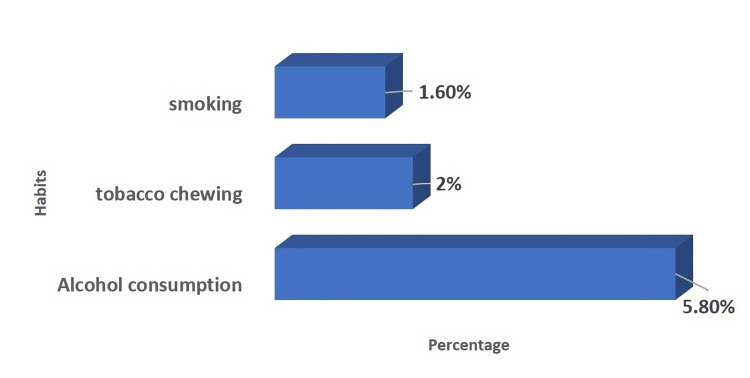 Figure 1
| BMI Status | Males | Females | ||
| N | % | N | % | |
| Underweight | 59 | 24.3 | 24 | 11.6 |
| Normal | 173 | 71.0 | 155 | 74.7 |
| Overweight | 10 | 4.3 | 26 | 12.6 |
| Obese | 1 | 0.5 | 2 | 1.1 |
| Total | 243 | 100 | 207 | 100 |
| Diabetes Mellitus | Male | Female | Total | p-value | |||
| N | % | N | % | N | % | ||
| Normal | 205 | 84.4 | 168 | 81 | 373 | 82.8 | 0.0387* |
| Prediabetic | 26 | 10.8 | 37 | 17.7 | 63 | 14 | |
| Diabetic | 12 | 4.8 | 2 | 1.3 | 14 | 3.2 | |
| Total | 243 | 100 | 207 | 100 | 450 | 100 | |
| Blood Pressure | Male | Female | Total | p-value | |||
| N | % | N | % | N | % | ||
| Normal | 144 | 59.1 | 102 | 49.3 | 246 | 54.6 | 0.0014* |
| Prehypertension | 82 | 33.9 | 102 | 49.3 | 184 | 40.8 | |
| Grade I hypertension | 17 | 7.0 | 3 | 1.4 | 20 | 4.6 | |
| Total | 243 | 100.0 | 207 | 100.0 | 450 | 100.0 | |
| Risk Factors | Present | Absent | ||
| N | % | N | % | |
| Age (41–50 years) | 102 | 23 | 348 | 77 |
| BMI>25 | 39 | 9 | 411 | 91 |
| Alcohol consumption | 26 | 5.80 | 424 | 94.2 |
| Tobacco chewing | 9 | 2 | 441 | 98 |
| Smoking | 7 | 1.6 | 443 | 98.4 |
| Prediabetics | 63 | 14 | 387 | 86 |
| Prehypertension | 184 | 41 | 266 | 59 |
Peer Reviews
No public reviews on file for this paper yet. If you reviewed it on a platform where reviews are public (OpenReview, ICLR, NeurIPS, ICML), you can paste yours below so the community can read it here.
Videos
No videos yet. Explain this paper in a talk, walkthrough, or lecture? Add one.
Taxonomy
TopicsGlobal Public Health Policies and Epidemiology · Cardiovascular Health and Risk Factors
Introduction
Cardiovascular illnesses are widely regarded as the leading cause of mortality worldwide, with 17.9 million deaths every year. Conditions related to the heart and blood vessels are cardiovascular diseases, rheumatic heart disease, coronary heart disease, and cerebrovascular disease. Tobacco use, alcohol consumption, physical inactivity, and a poor diet are the main behavioural risk factors for heart disease and stroke. One significant risk factor for the environment is air pollution. Individuals may have behavioural risk factors such as elevated blood pressure, high blood sugar, obesity, and being overweight. In primary healthcare settings, these "intermediate risk factors" can be assessed and show an elevated risk of heart attack, stroke, heart failure, and other consequences [1].
A "farmhouse" is a dwelling built on a piece of land used for farming, serving as either the residence of the farmer or a storage facility for farming equipment and cattle. The farmer can utilize the house for personal use only; no other individual or organization may use it for their benefit [2].
The health services might not reach the farmhouse workers because they are widely scattered in rural locations. By identifying those at the highest risk of cardiovascular illnesses and ensuring they receive the appropriate care, premature deaths can be prevented. More information on cardiovascular disease risk factors needs to be provided to those who live in farmhouses. Studies based on communities can only capture the whole picture of risk variables within those communities. The current study investigated the risk factors for cardiovascular disease among the farmhouse dwellers of the Vijayapura district.
Materials and methods
Study design and setting
This observational cross-sectional study was conducted in the Vijayapura district in the northern part of Karnataka state [3]. The study was conducted among household members staying in farmhouses for a period of one year (June 2017 to May 2018) using the interview technique with a pretested, semi-structured questionnaire. The questionnaire was prepared and validated by subject experts and pilot-tested in the rural field practice area of the Community Medicine department.
Inclusion criteria
Participants who have lived in farmhouses for more than six months or are permanent residents of the farmhouse and belong to the age group of more than 19 years were included in the study.
Exclusion criteria
The study excluded individuals who were residents of farmhouses but migrated to other places for employment purposes, as well as those who had not given consent for participation and had a documented history of cardiovascular diseases and diabetes mellitus.
Study tool
We gathered data on risk factors such as age, education, alcohol intake, and tobacco use (smoking or chewing) using a standardized questionnaire. Blood glucose, blood pressure, and haemoglobin estimations were done using an Accu-Chek glucometer (Roche Diabetes Care, Inc., Indianapolis, Indiana) [4], a Mission Plus Hb meter (ACON Laboratories, San Diego, California) [5], and a digital blood pressure monitor [6].
The Institutional Ethics Committee approval (BLDE(DU)/IEC/61/2016) and informed consent from the participants were obtained before we began the data collection.
Study method
Household selection was done at different stages within each taluka (total of five taluka), using villages as a primary sampling unit (PSU) [7]. The villages with less than five farmhouse families were excluded from the list. There are two stages of household selection. Five households within each PSU were chosen randomly after PSUs were chosen using probability proportional to size (PPS) sampling. The government primary health centre provided a list of the households residing on the farm, and chits with the name of the family head were made. Five chits from each village were chosen randomly for the study. Prestructured questionnaires were used to randomly ask four participants in each household, aged over 19 years, regarding the risk factor profile for cardiovascular diseases among the farmhouse residents.
Sample size calculation
The sample size was determined using the formula n= z2pq/d2. The calculation was predicated on a 50% prevalence assumption because insufficient data were available regarding the risk factor profile for cardiovascular illnesses among farm dwellers in the research area. With a 95% confidence level and 5% accuracy assumption, 384 farm residents represented the total sample size, but the total enrollment was 450.
Statistical analysis
The chi-square (χ2) test was used to determine the significance of differences between groups for categorical data. Data were analyzed using Microsoft Excel (Microsoft Corporation, Redmond, Washington) and IBM SPSS Statistics for Windows, Version 23 (Released 2015; IBM Corp., Armonk, New York) with a 95% confidence interval, and a p-value of less than 0.05 was considered significant.
Results
A total of 450 participants were included in the study; 50.9% were men, and 49.1% were women. The age range of 21.4% of the male participants was between 41 and 50 years old, whereas 21.7% of the female participants belonged to the 41 to 50-year age group. The study showed that the majority of them had the habit of alcohol consumption (5.8%), followed by chewing tobacco (2%) and smoking (1.6%), as depicted in Figure 1.
Distributions of participants according to habits (N=450)
More than 70% of male and female participants were within the normal range of 18.5 to 24.99 body mass index (BMI) range. Compared to female participants (24, 11.6%), the majority of male participants (59, 24.3%) were underweight (<18.5). Out of all the participants, more women, 26 (12.6%) vs. 2 (1.1%), were overweight or obese than males, 10 and 1 (4.3%, 0.5%), respectively (Table 1).
Table 1: Distribution of participants according to body mass index (BMI) (N=450)χ2-value = 17.885, at a 5% level of significance (p<0.05)
Following a random blood sugar test, 373 (82.8%) had normal blood sugar levels, whereas 14 (3.2%) already had diabetes mellitus (males more than females). During the investigation, 63 (14%) were found in the prediabetic range (females more than males). The proportion distribution was found to be statistically significant (Table 2).
*Table 2: Distribution of participants based on blood sugar level (N=450)Significantχ2-value = 6.503, at a 5% level of significance (p<0.05)
Following a blood pressure examination, it was seen that 20 (4.6%) of participants had Grade 1 hypertension (males more than females), whereas 40.8% (females more than males) were found in the pre-hypertension range. The distribution of the proportions was found to be statistically significant (p<0.05) (Table 3).
*Table 3: Distribution of participants based on blood pressure level (N=450)Significantχ2-value = 13.074, at a 5% level of significance (p<0.05)
When haemoglobin estimation was done, the majority of the participants, 284 (63.1%), had normal haemoglobin levels (>11 g%), but surprisingly, the majority of male participants, 117 (48.3%), had mild anaemia (9-11 g%) compared to females. However, none of them had severe anaemia (<7 g%). The proportion of distribution was found to be statistically significant (p<0.05). According to Table 4, the most common risk factor among farmhouse residents was the prehypertension stage (41%), followed by their age of more than 40 years (23%).
Discussion
Agricultural workers are exposed to numerous risk factors. However, this fact is sometimes overlooked due to the pervasive belief that occupational health issues are primarily related to industry and developed nations. As a result, there are extremely few study articles about farmhouse residents.
According to the results of the current study, 1.6% of the farmhouse residents were smokers, 2% chewed tobacco, and 5.8% of them were alcoholics. In a rural area of Vijayapura, the majority of participants were smokers (18.8%) and alcoholics (23.5%), according to the District Level Household and Facility Survey (DLHS-4) study [8]. According to Karmakar et al., smoking (31.2%) was the most prevalent addiction in rural areas. By contrast, 12.7% of them suffered from alcohol addiction, and 13.8% of them smoked tobacco (chewable varieties such as gutkha and khaini) [9]. Compared to earlier investigations, the current study revealed reduced levels of addictive behaviour, which may have been caused by less access to alcohol and lower socioeconomic status.
According to the results of the current study, compared to female participants (11.6%), the majority of male participants, aged 41 to 50, were underweight (24.3%). Women were more likely than men to be overweight (12.6%) and obese (1.1%), with rates of 4.3% and 0.5%, respectively. According to the National Family Health Survey (NFHS-4) (Karnataka) study, the majority of female participants (24.3%) were underweight compared to male participants (17.6%). Of the participants, 35% of children under the age of five were underweight, and the majority of men (17.1%) were overweight and obese compared to girls (16.6%) [10]. This disparity between the current study and another investigation could result from participant changes in lifestyle, ignorance, or a lack of awareness regarding nutritional status in farming settings. According to the study conducted by Hameed et al., females had significantly greater rates of arthritis, anaemia, and obesity than male participants [11].
A total of 3.2% of the participants in the current study had diabetes mellitus. Compared to female participants (1.3%), the majority of male participants (4.8%) had diabetes mellitus, and 4.4% had Grade 1 hypertension. Compared to female participants (1.3%), the majority of male individuals, 13 (7%), had Grade I hypertension. Agarwal et al. estimated that 7% of rural Agra residents have diabetes mellitus [12]. According to Gupta et al.'s findings, 5.99% of those surveyed in rural Tamil Nadu had diabetes [13]. Similar results were found by Satheesh et al. in rural Karnataka's coastal areas, where the percentage of people with hypertension was higher and the overall prevalence of hypertension was 18% [14]. According to Raja et al., 26.2% of adults in Tamil Nadu's rural Kanchipuram region had hypertension. Men were at a higher risk than women (OR=1.390) [15]. The discrepancy between the results of the current study and those of previous studies may be explained by the farmers' hard work, higher levels of physical exercise, and their stress-free work environment.
Strength of the study
There is a severe lack of research articles regarding the health status of the residents living in farmhouses. Therefore, our study contributes to filling the existing research gap in this field.
Limitation of the study
The present research was conducted in a secluded area within the northern part of Karnataka state. Therefore, the study findings cannot be generalizable to all farmhouse residents in the remaining parts of the states and the country.
Conclusions
Agriculture is a longstanding and crucial sector in our country, with 80% of the population residing in rural areas where agriculture is the primary occupation. Farmhouse labourers are a unique population widely distributed in rural locations, making it difficult for them to get health treatments. The scientific literature contains very little realistic data on the risk factors for cardiovascular disease among farmhouse residents. The current study of farm dwellers in the rural area of Vijayapura district found that the majority were illiterate, from a lower socioeconomic level, and had behavioural risk factors such as alcohol intake, tobacco chewing, and smoking. The majority of the participants had intermediate risk factors, such as prediabetic and prehypertension stages and obesity. Limited access to primary healthcare services may contribute to increased risk factors for cardiovascular diseases among farmhouse residents.
The reference list from the paper itself. Each links out to its DOI / PubMed record.
- 1Cardiovascular diseases 7 2024 2024 https://www.who.int/health-topics/cardiovascular-diseases
- 2The Karnataka Land Revenue (Amendment) Act, 2015 8 2018 2018 http://kredlinfo.in/solargrid/land% 20revenue %20act.pdf
- 3Demographics and agriculture Internet 8 2018 2018 https://en.wikipedia.org/wiki/Bijapur.
- 4What Is a blood glucose test? 8 2018 2022 https://www.healthline.com/health/glucose-test-blood
- 5Mission® hemoglobin 8 2018 https://www.aconlabs.com/intl/hemoglobin/mission-hb/
- 6The seventh report of the joint national committee on prevention, detection, evaluation, and treatment of high blood pressure 8 2018 Alving BM 2004 https://www.nhlbi.nih.gov/files/docs/guidelines/jnc 7full.pdf 20821851 · pubmed ↗
- 7Census (2011), Registrar General of India 9 2016 Census(2011 2016 http://www.censusindia.gov.in
- 8District Level Household and Facility Survey-4 state fact sheet Karnataka 8 2018 2014 https://nhm.karnataka.gov.in/storage/pdf-files/Demography/DLHS-4-2012-2013.pdf