Seeing others suffer and enjoying it? The Model of Individual and Social Appraisals of Misfortunes of others in media reception
Lilian Suter, Katrin Döveling

TL;DR
This paper explores how people feel pleasure or sympathy when they see others suffer in the media, and introduces a model to explain these emotional responses.
Contribution
The paper introduces the MISAM model, integrating psychological theories to explain schadenfreude and sympathy in media reception.
Findings
The MISAM model identifies intrapersonal and social factors influencing schadenfreude and sympathy.
The model integrates Affective Disposition Theory and social psychology to explain emotional responses to misfortunes in media.
The model highlights the importance of appraisal processes in understanding and regulating these emotions.
Abstract
Suffering and misfortunes of other people are often portrayed in the media. Recipients react to these portrayals with different emotions. This article elucidates and clarifies schadenfreude (pleasure at the misfortune of others) and sympathy (feeling concern or sorrow over another person’s distress) in media experiences. A thorough literature review provides in-depth insights into the formation of affective dispositions and schadenfreude from various psychological perspectives. This conceptual analysis leads to the “Model of Individual and Social Appraisals of Misfortunes of Others” (MISAM) which first reveals the determining intrapersonal factors within the emotional experience of schadenfreude and sympathy. Second, it discloses the social component vital for understanding the construction and regulation of these emotions. The model combines individual and social appraisal processes…
Genes, proteins, chemicals, diseases, species, mutations and cell lines named across the full text — each resolved to its canonical identifier and authoritative record.
Click any figure to enlarge with its caption.
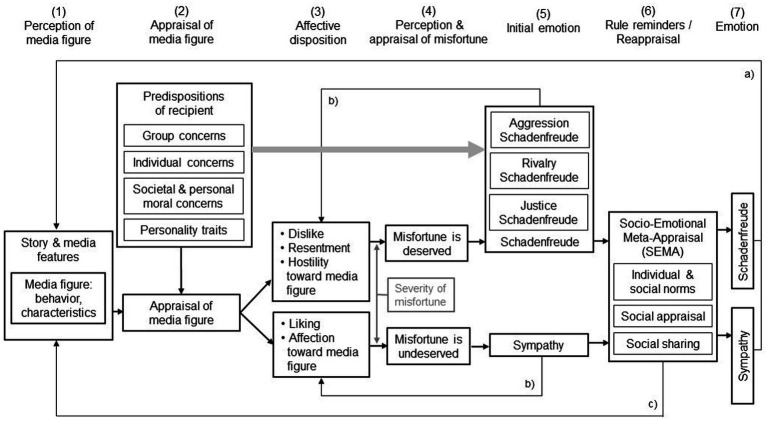 Figure 1
Peer Reviews
No public reviews on file for this paper yet. If you reviewed it on a platform where reviews are public (OpenReview, ICLR, NeurIPS, ICML), you can paste yours below so the community can read it here.
Videos
No videos yet. Explain this paper in a talk, walkthrough, or lecture? Add one.
Taxonomy
TopicsEmotions and Moral Behavior · Communication in Education and Healthcare · Humor Studies and Applications