The daily association between positive affect and psychotic experiences in individuals along the early stages of the psychosis continuum
Sara van der Tuin, Lorna Staines, Larisa Morosan, Esdras Raposo-Almeida, David van den Berg, Sanne H. Booij, Albertine J. Oldehinkel, Johanna T. W. Wigman

TL;DR
The study found that daily positive emotions and psychotic experiences are linked in people at early risk for psychosis, especially those at ultra-high risk.
Contribution
This is the first study to show a bidirectional daily relationship between positive affect and psychotic experiences in early psychosis stages.
Findings
Current-day positive affect predicts current-day psychotic experiences and vice versa.
Higher positive affect over 90 days is associated with fewer psychotic experiences.
The relationship between positive affect and psychotic experiences is stronger in ultra-high-risk individuals.
Abstract
Psychosis often develops gradually along a continuum of severity. Little is known about the role of protective factors such as positive affect (PA) in the development of psychotic experiences (PEs). This study investigated i) the temporal (between-day) and contemporaneous (within-day) daily associations between PA and PEs in individuals at different early clinical stages for psychosis and ii) whether these associations differed per clinical stage. Daily diary data for 90 days came from 96 individuals at risk for psychosis, distributed over four subgroups defined according to the clinical staging model (stages 0–1b). We constructed multilevel models with PA as a predictor of PEs and vice versa. We investigated within- and between-person temporal and contemporaneous associations and tested whether these associations differed among early stages with multilevel moderation analyses. We…
Genes, proteins, chemicals, diseases, species, mutations and cell lines named across the full text — each resolved to its canonical identifier and authoritative record.
Click any figure to enlarge with its caption.
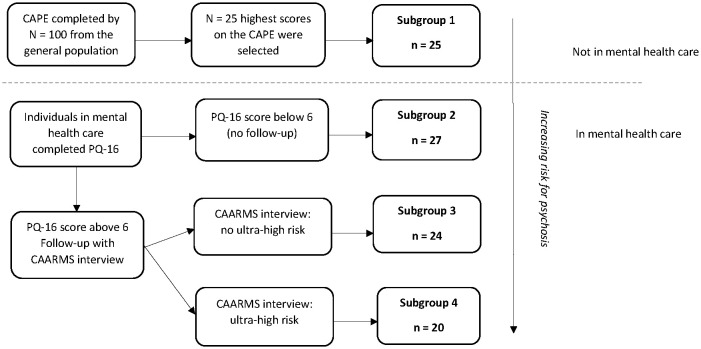 Figure 1
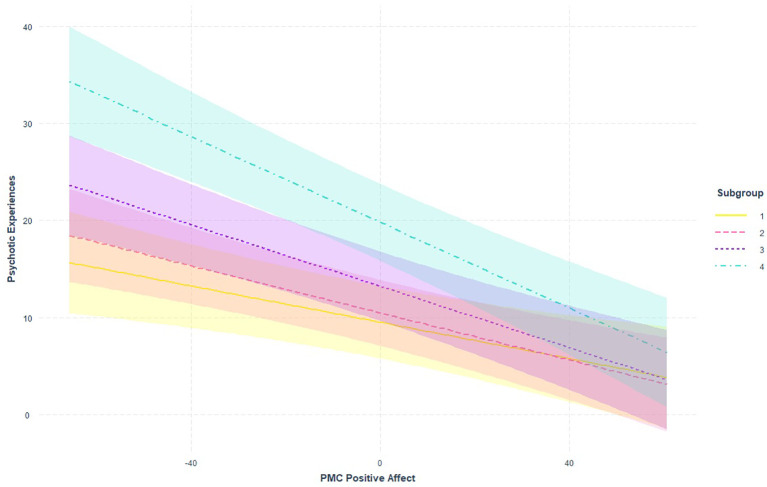 Figure 2
Peer Reviews
No public reviews on file for this paper yet. If you reviewed it on a platform where reviews are public (OpenReview, ICLR, NeurIPS, ICML), you can paste yours below so the community can read it here.
Videos
No videos yet. Explain this paper in a talk, walkthrough, or lecture? Add one.
Taxonomy
TopicsMental Health Research Topics · Schizophrenia research and treatment · Tryptophan and brain disorders