Dynamic atomic observations in electrochemical interfaces
Hao Zhang, Yu Zhang, Zhenhai Wen

Abstract
Genes, proteins, chemicals, diseases, species, mutations and cell lines named across the full text — each resolved to its canonical identifier and authoritative record.
Click any figure to enlarge with its caption.
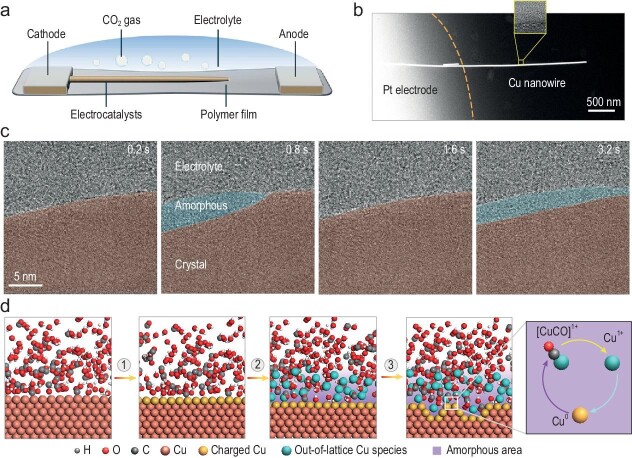 Figure 1
Peer Reviews
No public reviews on file for this paper yet. If you reviewed it on a platform where reviews are public (OpenReview, ICLR, NeurIPS, ICML), you can paste yours below so the community can read it here.
Videos
No videos yet. Explain this paper in a talk, walkthrough, or lecture? Add one.
Taxonomy
TopicsElectronic and Structural Properties of Oxides · Force Microscopy Techniques and Applications · Electrochemical Analysis and Applications
Direct detection of the solid-liquid electrochemical interface (ESLI) dynamics at the atomic scale is crucial for understanding and optimizing electrochemical reactions [1], yet traditional imaging techniques struggle with capturing these details due to the masking effects of liquid environments and the complexity of dynamic processes [2]. In recent years, researchers have been able to achieve real-time observation and analysis of ESLI structural changes and behaviors during electrochemical reactions at high resolution, facilitated by advancements in in-situ liquid cell technology integrated with advanced imaging and theoretical computational methods, especially in-situ transmission electron microscopy (TEM) [3]. These developments are crucial for understanding the behavior of materials in batteries and other electrochemical systems at the atomic scale, which can lead to better performance and longevity.
Zheng's group, through the development of an advanced electrochemical liquid cell with polymer electrolyte (Fig. 1a), has for the first time directly observed ESLI atomic dynamics by using TEM (Fig. 1b and c), and proposes a mechanism of amorphous interphase formation [4]. Their study reveals a fluctuating liquid amorphous intermediate phase in the copper-catalyzed CO_2_ electroreduction reaction (CO_2_ER), which appears and disappears under electrochemical bias, influencing the restructuring and mass loss of crystalline copper surfaces. High-resolution imaging, along with EDS and EELS analyses, identifies the amorphous intermediate phase composed of copper, oxygen, and hydrogen, exhibiting dynamic behaviors including flow along the crystalline copper surface and mutual transformation with crystalline copper. Density functional theory (DFT) calculations elucidate the mechanism of copper atom removal during the electrochemical reaction (Fig. 1d). These findings provide crucial experimental and theoretical insights for further research and optimization of electrocatalysts.
The paper integrates various methods including TEM imaging, EDS, and EELS analyses to comprehensively characterize the composition and structure of the amorphous intermediate phase, ensuring the reliability and accuracy of the results. Compared to other recent works, such as studies focusing on the static observation of ESLI or those using less advanced imaging techniques, Zhang et al.’s approach offers a more detailed and dynamic understanding of the interface. The ability to monitor changes at the atomic level in real-time provides a significant advantage in tailoring materials for specific electrochemical applications, potentially leading to breakthroughs in catalyst design and battery technology. This research not only pushes the boundaries of what can be observed using in-situ TEM but also opens up new avenues for improving electrochemical systems by considering the previously overlooked dynamics of the amorphous interphase.
However, challenges remain in TEM-based observation of electrochemical reactions: the experimental setup and techniques are highly complex, requiring advanced equipment and operational skills, which limits widespread adoption and application; precise control of environmental conditions (e.g. temperature, pressure) remains challenging, potentially affecting the reproducibility and reliability of experimental results; the study primarily focuses on copper-catalyzed CO_2_ electroreduction, necessitating further validation of applicability across other electrochemical reactions and material systems [5].
Improvements in TEM-based observation methods for electrochemical reactions are suggested as follows: develop simpler and more user-friendly experimental setups to reduce dependency on advanced equipment and operational skills, thereby promoting wider applications of the method; enhance experimental setups to improve precision in environmental condition control, ensuring reproducibility and reliability of experimental results; expand research to include different electrochemical reactions and material systems to verify method applicability and explore various electrochemical interface phenomena; increase observation of long-term dynamic behaviors during electrochemical reactions to investigate time-evolution patterns and stability issues in depth; integrate macroscopic and microscopic scale analysis methods, such as in-situ electrochemical analysis techniques, to comprehensively understand the characteristics and mechanisms of electrochemical reactions.
The reference list from the paper itself. Each links out to its DOI / PubMed record.
- 1Kim JS, Lagrange T, Reed BW et al. Science 2008; 321: 1472–5.10.1126/science.116151718787163 · doi ↗ · pubmed ↗
- 2Nielsen MH, Aloni S, De Yoreo JJ. Science 2014; 345: 1158–62.10.1126/science.125405125190792 · doi ↗ · pubmed ↗
- 3Wang X, Liu Z, He Y et al. Nat Nanotechnol 2022; 17: 737–45.10.1038/s 41565-022-01126-z 35606442 · doi ↗ · pubmed ↗
- 4Zhang Q, Song Z, Sun X et al. Nature 2024; 630: 643–7.10.1038/s 41586-024-07479-w 38898295 · doi ↗ · pubmed ↗
- 5Boston R, Schnepp Z, Nemoto Y et al. Science 2024; 344: 623–6.10.1126/science.125159424812400 · doi ↗ · pubmed ↗