Impact of COVID-19 on Characteristics and Funding of U.S. Healthcare Startups: Retrospective Review
Smitha Ganeshan, Joshua Goldstein, Young-Jin Sohn, Amie Pollack, Russell S Phillips, Lisa Rotenstein

TL;DR
This study shows that after the first year of the pandemic, more healthcare startups focused on AI and software, while fewer focused on diagnostics.
Contribution
The study reveals how the pandemic's steady-state phase shifted startup focus toward AI and software, with reduced emphasis on diagnostics.
Findings
Pandemic-era startups received significantly more annual funding than prepandemic ones.
Post-first-year pandemic startups were more likely to focus on AI, software, and insurance.
Pre-pandemic startups had more founders compared to those during the pandemic.
Abstract
The rise of telehealth and telemedicine during the pandemic allowed patients and providers to develop a sense of comfort with telehealth, which may have increased the demand for virtual-first care solutions with spillover effects into venture capital funding. We aimed to understand the size and type of digital health investments occurring in the prepandemic and pandemic periods. We examined health care companies founded from March 14, 2019, to March 14, 2020 (prepandemic) versus those founded from March 15, 2020, to March 14, 2022, after pandemic onset. Data were obtained from Crunchbase, a publicly available database that catalogs information about venture capital investments for companies. We also compared companies founded prepandemic to those founded after the first year of the pandemic (pandemic steady-state). We performed a Wilcoxon rank sum test to compare median funding…
Genes, proteins, chemicals, diseases, species, mutations and cell lines named across the full text — each resolved to its canonical identifier and authoritative record.
Click any figure to enlarge with its caption.
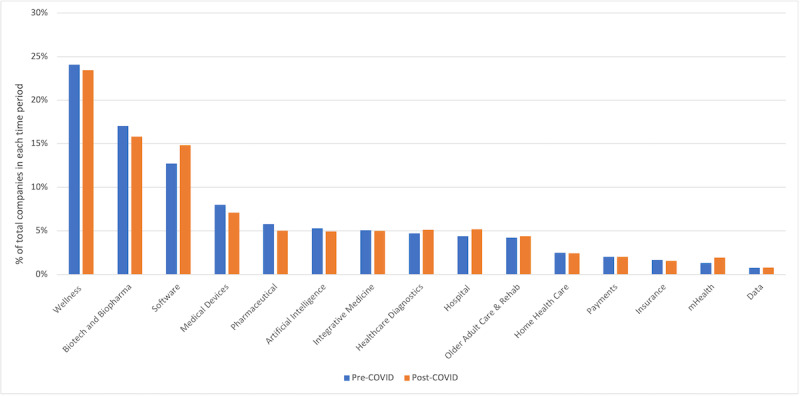 Figure 1
| Characteristic | Prepandemic: March 15, 2019, to March 14, 2020 (n=2714) | During the pandemic: March 15, 2020, to March 14, 2022 (n=2218) | ||||||
|
| .46 | |||||||
|
| Northeast | 697 (25.68) | 526 (23.72) |
| ||||
|
| Midwest | 300 (11.05) | 248 (11.18) |
| ||||
|
| South | 770 (28.37) | 650 (29.30) |
| ||||
|
| West | 947 (34.89) | 794 (35.80) |
| ||||
|
| <.001 | |||||||
|
| Seed | 586 (69) | 618 (80) |
| ||||
|
| Early stage | 173 (20) | 113 (15) |
| ||||
|
| Private equity | 11 (1.3) | 8 (1.0) |
| ||||
|
| IPOb | 16 (1.9) | 14 (1.8) |
| ||||
|
| M&Ac | 57 (6.7) | 17 (2.2) |
| ||||
|
| Late stage | 8 (0.9) | 1 (0.1) |
| ||||
| Total funding per year since founding (US $), mean (SD)d | 10,832,252 (45,669,417) | 20,970,037 (119,295,457) | <.001 | |||||
| Number of founders, mean (SD)e | 1.75 (0.96) | 1.72 (0.93) | .32 | |||||
| Health care category | Prepandemic: March 14, 2019, to March 14, 2020 (n=2714) | During the pandemic: March 15, 2020, to March 14, 2022 (n=2218) | ||||
|
| Median total funding per year (US $) | Companies with available data, n (%) | Median total funding per year (US $) | Companies with available data, n (%) |
| |
| Wellness | 2,000,000 | 219/749 (29.2) | 1,311,250 | 184/588 (31.3) | .27 | |
| Integrative medicine | 1,750,000 | 51/165 (30.9) | 1,556,000 | 36/124 (29.0) | .91 | |
| Care for older adults and rehabilitation | 1,400,000 | 19/132 (14.4) | 1,000,000 | 21/110 (19.1) | .66 | |
| Mobile health | 1,000,000 | 17/41 (41.5) | 1,500,000 | 21/49 (42.9) | >.99 | |
| Artificial intelligence | 1,425,000 | 73/147 (49.7) | 1,000,000 | 62/129 (48.1) | .60 | |
| Software | 2,000,000 | 172/396 (43.4) | 1,000,000 | 147/372 (39.5) | .12 | |
| Payments | 10,050,000 | 26/77 (33.8) | 3,500,000 | 25/61 (41.0) | .19 | |
| Insurance | 2,436,500 | 18/52 (34.6) | 1,500,000 | 19/39 (48.7) | .73 | |
| Data | 11,000,000 | 9/24 (37.5) | 800,000 | 12/20 (60.0) | .29 | |
| Pharmaceutical | 6,684,975.50 | 80/180 (44.4) | 4,812,500 | 48/126 (38.1) | .88 | |
| Fertility | 1,485,000 | 6/10 (60.0) | 2,803,500 | 5/9 (55.6) | .72 | |
| Health care diagnostics | 3,000,000 | 53/158 (33.5) | 2,116,750 | 50/125 (40.0) | .98 | |
| Biotech and biopharma | 6,000,000 | 265/530 (50.0) | 10,000,000 | 195/397 (49.1) | .14 | |
| Health systems | 3,271,673 | 26/137 (19.0) | 2,200,000 | 31/130 (23.8) | .86 | |
| Medical device | 1,370,000 | 105/249 (42.2) | 1,440,000 | 87/178 (48.9) | .63 | |
| Home health care | 2,900,000 | 18/63 (28.6) | 630,000 | 15/51 (29.4) | .29 | |
| Characteristic | Prepandemic: March 14, 2019, to March 14, 2020 (n=2714) | Pandemic steady-state: March 14, 2021, to March 14, 2022 (n=581) | |||
|
|
|
| .71 | ||
|
| Northeast | 697 (25.68) | 136 (23.41) |
| |
|
| Midwest | 300 (11.05) | 64 (11.02) |
| |
|
| South | 770 (28.37) | 171 (29.43) |
| |
|
| West | 947 (34.89) | 210 (36.14) |
| |
|
| <.001 | ||||
|
| Seed | 586 (69) | 200 (86.6) |
| |
|
| Early stage | 173 (20) | 26 (11.3) |
| |
|
| Private equity | 11 (1.3) | 0 (0) |
| |
|
| IPOb | 16 (1.9) | 2 (0.9) |
| |
|
| M&Ac | 57 (6.7) | 3 (1.3) |
| |
|
| Late stage | 8 (0.9) | 0 (0) |
| |
| Total funding per year since founding (US $), mean (SD)d | 10,832,252 (45,669,417) | 14,348,739 (52,119,919) | .34 | ||
| Number of founders, mean (SD)e | 1.75 (0.96) | 1.62 (0.88) | .02 | ||
Peer Reviews
No public reviews on file for this paper yet. If you reviewed it on a platform where reviews are public (OpenReview, ICLR, NeurIPS, ICML), you can paste yours below so the community can read it here.
Videos
No videos yet. Explain this paper in a talk, walkthrough, or lecture? Add one.
Taxonomy
TopicsCOVID-19 and healthcare impacts · Health Systems, Economic Evaluations, Quality of Life
Introduction
The COVID-19 pandemic rapidly shifted priorities for health care delivery. Patients and providers gained comfort with telehealth [1] and increasingly relied on this modality of care delivery [2]. Pressures related to social distancing created an increased focus on home-based care and new diagnostic methods to test for COVID-19, which may have impacted the types of companies founded [2-6].
Unlike stock markets, venture capital is less impacted by individual investors and can assess the reallocation of capital in response to major events [7]. Industry and published research have shown significant venture activity in health-related areas of healthtech, biopharma, devices, and diagnostic tools; however, there has been relatively less exploration on changes in investments between prepandemic and pandemic periods [8-11]. One study on the impact of COVID-19 on venture investments found that venture capitalists invested up to 44% more capital in pandemic-related fields. Another study found that half of venture capitalists reported a positive impact of COVID-19 on investments. However, another white paper found that early stage venture capitalist activity declined by 38% [12,13].
Although these studies inform our understanding, little data exist on the impact of the COVID-19 pandemic on the specific types of health care investments in the United States where overall venture spending has increased [14]. Our objective was to understand the types of health care companies founded before versus after the COVID-19 pandemic.
Categorizations of venture-backed healthcare companies pre- and post-pandemic.
Methods
Data Source
We obtained data on US health care companies from Crunchbase, a web-based database cataloging startup information about company variables and health care subcategories from users, public data, and other data partners. Companies and users self-classify into preexisting subcategory tags and can use multiple similar or overlapping tags. We investigated US companies founded from March 14, 2019, to March 14, 2022.
Outcomes
We extracted data on geography, profit structure, funding round, amount of total funding, and number of founders. We grouped Crunchbase’s health care subcategories into broader groupings (see Multimedia Appendix 1). Using the companies’ total funding to date and founding dates, we calculated the total funding per year for comparison across companies.
Analysis Approach
In our primary analysis, we compared the characteristics of US health care companies founded from March 14, 2019, to March 14, 2020 (prepandemic period) to those founded from March 15, 2020, to March 14, 2022 (pandemic period). In a secondary analysis, we compared the characteristics of companies founded prepandemic to those founded from March 14, 2021, to March 14, 2022, when the initial pandemic peak subsided (pandemic steady-state period).
We used descriptive statistics to describe the characteristics of companies founded in the prepandemic, during pandemic, and steady-state pandemic periods. We used chi-square tests to compare categorical variables and Wilcoxon rank sum tests to compare continuous variables. P<.05 was used to assess statistical significance.
Ethical Considerations
As this study used publicly available data and did not involve human subjects, institutional review board review was not required. We have adhered to local, national, regional, and international law and regulations regarding the protection of personal information, privacy, and human rights [15].
Results
According to Crunchbase, there were 2714 companies founded prepandemic and 2218 companies founded after the start of the pandemic (characteristics summarized in Table 1).
The mean funding per year by health care category did not significantly differ prepandemic and during the pandemic (Table 2).
When data from the first year of the pandemic were excluded, there were 581 companies founded in the pandemic steady-state period (Table 3). Data on geographic distribution, funding rounds, and number of founders were similar between time points. However, in contrast to analyses including the period from March 15, 2020, to March 14, 2021, in analyses comparing the prepandemic period to the pandemic steady-state period, there was no significant difference in the total funding per year since founding (Table 3).
The most common types of health care companies both prepandemic and during the pandemic included wellness (24.1% prepandemic and 23.4% during the pandemic), biotech/biopharma (17.0% prepandemic and 15.8% during the pandemic), and software (12.7% prepandemic and 14.8% during the pandemic). Data companies (0.7% prepandemic and 0.8% during the pandemic) and fertility companies (0.3% prepandemic and 0.3% during the pandemic) had a lower proportion of investments. The distributions of companies across health care subcategories were not significantly different before versus during the pandemic.
However, when data from the first year of the pandemic were excluded, there were significant differences. Companies founded during the pandemic were significantly more likely to be classified as artificial intelligence (7.3% in the pandemic steady-state vs 4.7% prepandemic; P=.005), software (17.3% in the pandemic steady-state vs 12.7% prepandemic; P=.002), and insurance (3.3% in the pandemic steady-state vs 1.7% prepandemic; P=.003), and significantly less likely to be classified as health care diagnostics (2.4% in the pandemic steady-state vs 5.1% prepandemic; P=.002).
Discussion
In this national cross-sectional study of startup companies, we demonstrate significant differences in total funding per year since founding of US 20.9 million per year during the pandemic. We also demonstrate a significant increase in the proportion of companies in the seed stage during the pandemic. Our results did not reveal significant differences in the types of companies founded prepandemic and during the first 2 years of the pandemic. However, we found a significant difference in the types of companies founded prepandemic versus during the pandemic steady-state, with a 55.3% relative increase in the proportion of companies classified as dealing with artificial intelligence, a 36.2% relative increase in the proportion of companies classified as software, and a 52.9% relative decrease in the proportion of companies labeled as health care diagnostics. Overall, wellness, biotech/biopharma, and software companies accounted for the highest proportions of founded companies overall, with relatively less activity in the fertility category.
The significant increase in total funding per year prepandemic compared to that during the pandemic is supported by existing data demonstrating an increase in global venture funding from 2020 to 2022 compared to 2019 [16]. This may suggest that the pandemic spurred increased activity in innovation; however, to our knowledge, no research to date has compared differences in venture capital investments specifically before and after the start of the pandemic [17,18].
Our results did not reveal significant differences in the types of companies founded prepandemic and during the first 2 years of the pandemic. Given the significant lead time needed for founders to move from idea generation to founding a company and raising money, we hypothesized that the first year of the pandemic may have been more reflective of prepandemic trends and may not have captured shifts in the market from the pandemic itself. When we compared prepandemic companies to those founded during the pandemic steady-state, we did find significant increases in artificial intelligence, software, and biotech investments, although this may also be influenced by longer-standing market trends [18,19]. While we did not find a significant increase in the proportion of mobile health (mHealth) companies, despite the rise of virtual care during the pandemic, this expected trend may have been captured by the increase in the proportion of software companies, which includes many mHealth companies. Industry research supports our finding of high levels of venture investment in the areas of artificial intelligence, biotech, and software/digital health/healthtech [20-22].
The significant relative decrease in health care diagnostic companies despite the increase of at-home COVID-19 testing is surprising. It is possible that diagnostics were largely being developed by larger, traditional companies rather than newer startups. It is also possible that the pandemic period coincided with a higher inflationary environment that made investors and founders more conservative in more capital-intensive areas such as diagnostics [23-25]. A study published in 2020 from the National Bureau of Economic Research found that from 1974 to 2019, during economic downturns, venture capital firms changed their investment focus toward less innovative startups [13].
Some Crunchbase data are directly derived from site users, which may contribute to selective reporting bias. Further, there are no standard definitions of health care subcategories for users to base their categorizations on. Companies can be tagged to multiple relevant health care categories, which may overcome some ambiguity in definition. Nevertheless, Crunchbase represents one of the only publicly available repositories of startup company data, and our study is the first to leverage these data to understand the trends in the founding of health care companies.
In conclusion, we demonstrate no changes in the distribution of focus areas for companies founded before after the start of the COVID-19 pandemic; however, when we isolate pandemic steady-state data, we see significantly increased activity related to the fields of artificial intelligence and software and significantly less activity in health care diagnostics. This may reflect the impacts of the COVID-19 pandemic on investing patterns. As health care venture capital investments more actively shape the health care delivery landscape, real-time efforts to aggregate information on company establishment and venture capital investments would allow health system researchers to better understand innovation trends and the flow of capital in health care.
The reference list from the paper itself. Each links out to its DOI / PubMed record.
- 1Medicare beneficiaries' use of telehealth in 2020: trends by beneficiary characteristics and location Office of the Assistant Secretary for Planning and Evaluation 2022-12-12 https://aspe.hhs.gov/reports/medicare-beneficiaries-use-telehealth-2020
- 2Demeke HB Merali S Marks S Pao LZ Romero L Sandhu P Clark H Clara A Mc Dow KB Tindall E Campbell S Bolton J Le X Skapik JL Nwaise I Rose MA Strona FV Nelson C Siza C Trends in use of telehealth among health centers during the COVID-19 pandemic - United States, June 26-November 6, 2020 MMWR Morb Mortal Wkly Rep 2021021970724024410.15585/mmwr.mm 7007 a 33360038533600385 PMC 7891688 · doi ↗ · pubmed ↗
- 3Tabacof L Wood J Mohammadi N Link KE Tosto-Mancuso J Dewil S Breyman E Nasr L Kellner C Putrino D Remote patient monitoring identifies the need for triage in patients with acute COVID-19 infection Telemed J E Health 20220428449550010.1089/tmj.2021.01013429276834292768 · doi ↗ · pubmed ↗
- 4Aalam AA Hood C Donelan C Rutenberg A Kane EM Sikka N Remote patient monitoring for ED discharges in the COVID-19 pandemic Emerg Med J 2021032038322923110.1136/emermed-2020-21002233472870 emermed-2020-21002233472870 · doi ↗ · pubmed ↗
- 5Safavi KC Cohen AB Ting DY Chaguturu S Rowe JS Health systems as venture capital investors in digital health: 2011-2019 NPJ Digit Med 202008043110310.1038/s 41746-020-00311-53280296831132802968 PMC 7403411 · doi ↗ · pubmed ↗
- 6Vandenberg O Martiny D Rochas Ovan Belkum A Kozlakidis Z Considerations for diagnostic COVID-19 tests Nat Rev Microbiol 20210314193171183 10.1038/s 41579-020-00461-z 3305720310.1038/s 41579-020-00461-z 33057203 PMC 7556561 · doi ↗ · pubmed ↗
- 7Bellucci A Borisov A Gucciardi G Zazzaro A The reallocation effects of COVID-19: evidence from venture capital investments around the world J Bank Financ 202302147106443 10.1016/j.jbankfin.2022.10644335221458 S 0378-4266(22)00043-735221458 PMC 8856752 · doi ↗ · pubmed ↗
- 8Gompers PA Gornall W Kaplan SN Strebulaev IA Venture capitalists and COVID-19National Bureau of Economic Research 2020092022-12-12 https://www.nber.org/papers/w 27824