Complete genome sequence of a Salimicrobium sp. PL1-032A isolated from the pink hypersaline Pearse Lakes, Rottnest Island, Western Australia
Crystal E. Young, Hussain Alattas, Colin Scott, Daniel V. Murphy, Ravi Tiwari, Wayne G. Reeve

TL;DR
Scientists sequenced the genome of a new salt-loving microbe from a hypersaline lake in Western Australia.
Contribution
This study provides the complete genome sequence of a new Salimicrobium species from an extreme hypersaline environment.
Findings
The genome is a single chromosome of 2,705,688 base pairs with 47.2% GC content.
The isolate contributes to understanding extremophiles and the Pearse Lakes ecosystem.
Abstract
Salimicrobium sp. PL1-032A was isolated from Pearse Lakes, Western Australia. The sequenced genome consists of a single chromosome (2,705,688 bp) with a GC content of 47.2%. The isolation of Salimicrobium sp. PL1-032A contributes to the collection of culturable extremophiles and offers potential insight into the Pearse Lakes biome.
Genes, proteins, chemicals, diseases, species, mutations and cell lines named across the full text — each resolved to its canonical identifier and authoritative record.
Click any figure to enlarge with its caption.
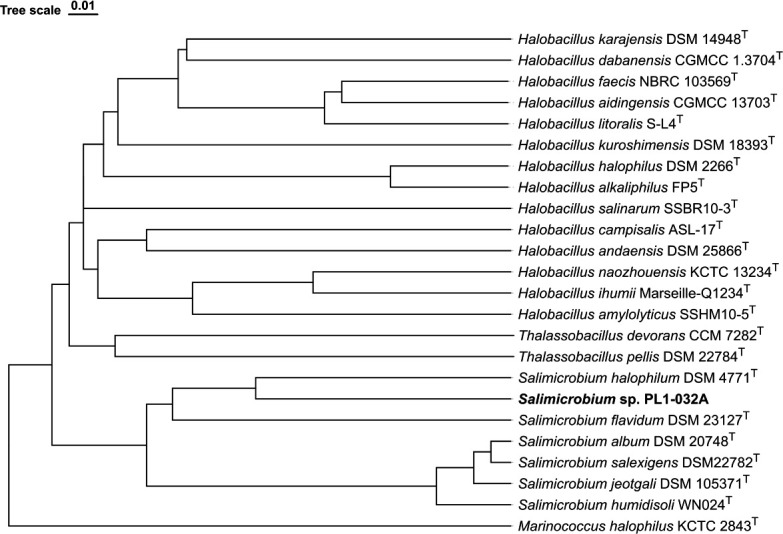 Fig 1
Fig 1| Data from | |
|---|---|
| Feature | GenBank annotation |
| Total no. of genes | 2,795 |
| No. protein-coding sequences | 2,506 |
| No. of rRNA operons | 7 |
| 5s | 7 |
| 16s | 7 |
| 23s | 7 |
| No. of tRNA genes | 67 |
| No. of other RNA genes | 4 |
| Locus tag prefix | U0355_ |
Peer Reviews
No public reviews on file for this paper yet. If you reviewed it on a platform where reviews are public (OpenReview, ICLR, NeurIPS, ICML), you can paste yours below so the community can read it here.
Videos
No videos yet. Explain this paper in a talk, walkthrough, or lecture? Add one.
Taxonomy
TopicsMicrobial Community Ecology and Physiology · Genomics and Phylogenetic Studies · Legume Nitrogen Fixing Symbiosis
ANNOUNCEMENT
Salimicrobium are typically Gram-positive, non-motile cocci, endospore-forming, moderate halophiles found in hypersaline lakes (1, 2). Rottnest Island (~30.4 km offshore from Perth, Western Australia) hosts athalassic soda-hypersaline lakes, including Pearse Lakes (3). Here, we report the complete genome sequence of a Salimicrobium sp. PL1-032A, isolated from Pearse Lakes in May 2022, when the lakes had a pH of 8.0 ± 0.01 and salinity of 20.1% ± 1.44%.
Water samples were collected (S 32° 0′ 22.281″ E 115° 30′ 44.484″) and stored at 4°C before cultivation. Water samples (1,500 mL) were centrifuged at 4,500 × g for 10 minutes and streaked from the cell pellet on adapted lysogeny broth containing (per liter) 10.0 g bacto-tryptone, 5.0 g bacto-yeast extract, 150.0 g NaCl, and 2.4 g HEPES (pH 7.8) (4). Single colonies were re-streaked until pure cultures were obtained and cryopreserved (15% glycerol, −80°C). Genomic DNA (gDNA) was extracted from stationary-phase culture using the CTAB (2%) (5) and was sequenced using Oxford Nanopore Technology (ONT). The ONT library was prepared according to the ONT ligation native barcoding gDNA library protocol (SQK-NBD114.24) (https://nanoporetech.com/protocols) with a FLO-PRO114M flow cell (R10.4.1) on the PromethION 2 platform. Guppy [v6.5.7 (6)] was used for base-calling sequenced data with a read-pass-filter quality score cutoff value of 9 and a minimum length of 1,500 bp. Nineteen thousand two hundred twenty-seven reads were generated (146,068,268 bp) providing an average coverage of 54× and a N50 value of 14,731 bp determined with NanoStat [v1.6.0 (7)]. ONT long reads were assembled using Flye [v2.9.2 (8)] using default parameters, with nine iterations to provide a single circular chromosome (2,705,688 bp with 47.2% GC content). A quantitative genome assembly assessment was performed using BUSCO [v5.4.6 (9)] and CheckM [v1.2.2 (10)], providing a completeness score of 91.5% and 99.78% (0.22% contamination), respectively. Average nucleotide identity analysis using BLAST (ANIb) showed below the cutoff value (>95%) with the closest relative (83.4%) Salimicrobium halophilum DSM 4771^T^ (GCF_900100295.1) (11–13) (Fig. 1).
Dendro-unweighted pair group method with arithmetic mean (UPGMA) tree displaying the relatedness of Salimicrobium sp. PL1-032A to related species based on ANIb values. The ANIb values were generated using JSpeciesWS (11) and imported into DendroUPGMA, and the tree was constructed using a similarity matrix (Pearson’s correlation coefficient) within the algorithm (14). The tree was exported from MEGA11 in Newick format and imported into tvBOT (https://www.tvBOT.html) (15). The superscript T indicates type strains and Marinococcus halophilus KCTC 2843T used as an outgroup (16).
Gene calling and annotation of the generated chromosomal sequence were performed using the NCBI Prokaryotic Genome Annotation Pipeline (Table 1) [v6.6 (17)]. The isolation of Salimicrobium sp. PL1-032A and completion of the genome could provide knowledge about the extreme Pearse Lakes biome (18).
The reference list from the paper itself. Each links out to its DOI / PubMed record.
- 1Yoon J-H, Kang S-J, Oh K-H, Oh T-K. 2009. Salimicrobium flavidum sp. nov., isolated from a marine solar saltern. Int J Syst Evol Microbiol 59:2839–2842. doi:10.1099/ijs.0.010215-019628596 · doi ↗ · pubmed ↗
- 2de la Haba RR, Yilmaz P, Sánchez-Porro C, Birbir M, Ventosa A. 2011. Salimicrobium salexigens sp. nov., a moderately halophilic bacterium from salted hides. Syst Appl Microbiol 34:435–439. doi:10.1016/j.syapm.2011.04.00221596507 · doi ↗ · pubmed ↗
- 3Playford PE, Leech R, Kendrick GW. 1977. Geology and hydrology of Rottnest Island. Vol. 6. Geological survey of Western Australia.
- 4Lennox ES. 1955. Transduction of linked genetic characters of the host by bacteriophage P 1. Virol (Auckl) 1:190–206. doi:10.1016/0042-6822(55)90016-713267987 · doi ↗ · pubmed ↗
- 5William S, Feil H, Copeland A. 2012. Bacterial genomic DNA isolation using CTAB. Sigma 50:6876.
- 6Wick RR, Judd LM, Holt KE. 2019. Performance of neural network basecalling tools for Oxford Nanopore sequencing. Genome Biol 20:129. doi:10.1186/s 13059-019-1727-y 31234903 PMC 6591954 · doi ↗ · pubmed ↗
- 7De Coster W, D’Hert S, Schultz DT, Cruts M, Van Broeckhoven C. 2018. Nano Pack: visualizing and processing long-read sequencing data. Bioinformatics 34:2666–2669. doi:10.1093/bioinformatics/bty 14929547981 PMC 6061794 · doi ↗ · pubmed ↗
- 8Kolmogorov M, Yuan J, Lin Y, Pevzner PA. 2019. Assembly of long, error-prone reads using repeat graphs. Nat Biotechnol 37:540–546. doi:10.1038/s 41587-019-0072-830936562 · doi ↗ · pubmed ↗