Draft genome sequence of Ruoffia tabacinasalis isolated from a bovine nasal swab: a novel member of the bovine nasal microbiota
Samantha Howe, Xiaoyuan Wei, Jasna Kovac, Jiangchao Zhao

TL;DR
Scientists discovered a new bacteria in cow noses and sequenced its genome.
Contribution
The isolation and draft genome sequencing of Ruoffia tabacinasalis, a new bovine nasal microbiota member.
Findings
The draft genome is 90.5% complete with one contig of 2,363,349 bp.
The GC content of the genome is 36.66%.
Abstract
We report the isolation and draft genome sequence of Ruoffia tabacinasalis, a novel member of the bovine nasal microbiota. The genome, which is estimated to be 90.5% complete, is composed of one contig comprising 2,363,349 bp with a GC content of 36.66%.
Genes, proteins, chemicals, diseases, species, mutations and cell lines named across the full text — each resolved to its canonical identifier and authoritative record.
Click any figure to enlarge with its caption.
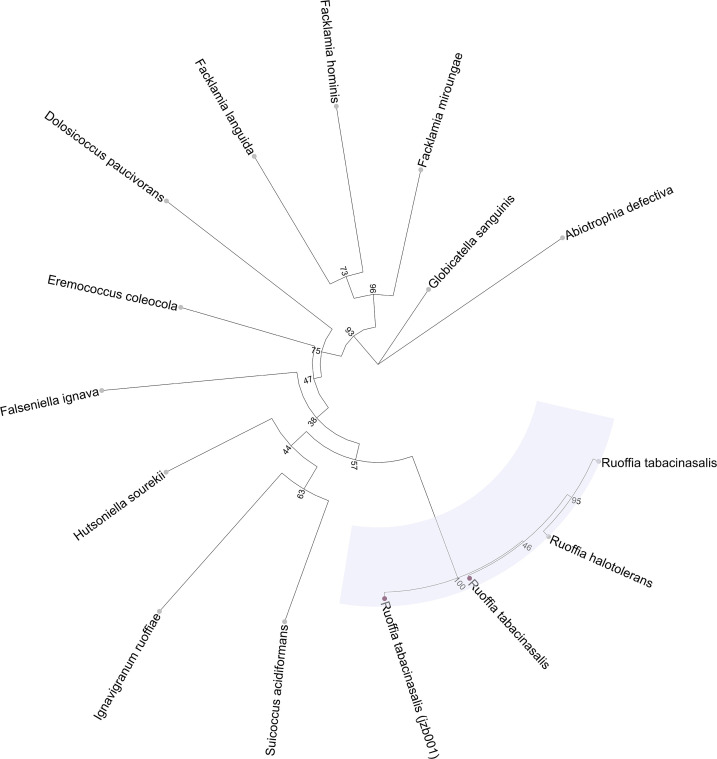 Fig 1
Fig 1| Metric | Result | Tool | |
|---|---|---|---|
| Number of contigs | 1 | QUAST | |
| GC content | 36.66% | QUAST | |
| Total size | 2,363,349 bp | QUAST | |
|
| 2,363,349 bp | QUAST | |
| Coverage/depth | 89× | Flye | |
| Estimated completeness | 90.5% | Busco | |
| Predicted genes | 2,307 CDS (total), 49 tRNA, 15 rRNA, 4 ncRNA, | PGAP | |
| Virulence factors | None detected | VFDB | |
| Antimicrobial resistance (AMR) genes | tet(M), ANT (6)-Ia | CARD | |
- —U.S. Department of Agriculture (USDA)https://doi.org/10.13039/100000199
Peer Reviews
No public reviews on file for this paper yet. If you reviewed it on a platform where reviews are public (OpenReview, ICLR, NeurIPS, ICML), you can paste yours below so the community can read it here.
Videos
No videos yet. Explain this paper in a talk, walkthrough, or lecture? Add one.
Taxonomy
TopicsProbiotics and Fermented Foods · Oral microbiology and periodontitis research · Genomics and Phylogenetic Studies
ANNOUNCEMENT
Bovine respiratory disease (BRD) is the most devastating disease affecting American cattle producers, and research has illustrated a strong connection between the respiratory microbiota and BRD. Regardless, historically, most research regarding BRD and the respiratory microbiota has focused on the four major opportunistic pathogens (1). Commensal members of the bovine respiratory microbiota were isolated from nasal swabs. jzb001 was isolated from the nasal swab of a healthy steer from a research feedlot in West Texas (34.966086647966726,–101.80246082318041). A 1:10 dilution of swab buffer was plated onto Mycoplasma base agar (Criterion, Hardy Diagnostics, Santa Maria, CA, USA) + Mycoplasma supplement (Difco, BD, Sparks, MD, USA) inside a BSL-2 certified BioSafety Cabinet, and jzb001 was isolated after 72 hours of aerobic incubation at 37°C. Ruoffia tabacinasalis (formerly Facklamia tabacinasalis) was initially isolated and identified as a tobacco powder contaminant (2) and was recently reclassified as R. tabacinasalis (3). To our knowledge, this is the first time R. tabacinasalis has been isolated from the bovine nasal cavity.
For whole-genome sequencing, jzb001 was cultured overnight at 37°C on brain heart infusion agar. Three loops of overnight culture (originating from a single colony) were suspended in phosphate-buffered saline and vortexed in a bead beater at 3,500 rpm for 2 minutes for genomic DNA isolation using the Qiagen QIAamp DNA Blood Mini Kit (Qiagen, Hilden, Germany) following the manufacturer’s instructions. Next, the Rapid Barcoding Library Preparation Kit and AMPure XP beads were used to prepare the sequencing library (Oxford Nanopore Technologies). Sequencing was performed using the Oxford Nanopore MinION Mk1C sequencer with the flow cell R9.4.1 (FLO-MIN106D) for 30 hours. Guppy (version 6.1.2) was used for basecalling and trimming of DNA sequencing data obtained from the sequencer (4). The circular genome was assembled with Flye (version 2.9) (5) and polished with Racon (version 1.5.0) (6). Quality was assessed using QUAST (version 5.0.2) (7). The estimated N50 for jzb001 was 2.36 Mb (Table 1), and one contig was generated. Default parameters were used unless otherwise noted.
jzb001’s genome was annotated using the NCBI Prokaryotic Genome Annotation Pipeline (version 6.6) (8) (Table 1), and GTDBtk (version 2.1.0), along with its database (R207_v2), was used for taxonomic classification (9). jzb001 was identified as R. tabacinasalis [fastani_reference: GCF_005864045.1; average nucleotide identity (ANI): 96.5; alignment fraction: 0.82] using only ANI. As the above genome was not the R. tabacinasalis type strain, taxonomic assignment was confirmed by comparing jzb001 to the R. tabacinasalis type strain (GCF_015863285.1) using fastANI (version 1.33) (10) (ANI: 95.7). Busco (version 5.5) (11) (lineage: Lactobacillales_odb10) was used to estimate genome completeness (Table 1). PhaME (version 1.0.5) (12) was used to calculate the core genome SNPs of jzb001 and members of the Aerococcaceae family [reference: Globicatella sanguinis (GCF_002847845.2)]. The SNP alignment was used to reconstruct an unrooted phylogenetic tree using IQ-TREE (version 2.2.5) (13, 14), which was visualized using the ggtree R package (version 3.6.2) (15) (Fig. 1). Virulence factors were detected using the Virulence Factor Database (accessed 13 December 2023) (16, 17). AMR genes were detected using the Comprehensive Antibiotic Resistance Database (version 3.2.8) (18, 19) (Table 1).
SNP-based unrooted phylogenetic tree of jzb001 and select members of the Aerococcaceae family. A consensus tree was constructed based on 100 bootstraps. Node labels indicate bootstrap values. Other sequences were acquired from NCBI RefSeq. Light purple indicates Ruoffia clade. Purple tip point indicates jzb001 and its closest match according to GTDBTk. Best fit model: GTR+F+I+G4; consensus tree log-likelihood: −15,106.811.
The reference list from the paper itself. Each links out to its DOI / PubMed record.
- 1Chai J, Capik SF, Kegley B, Richeson JT, Powell JG, Zhao J. 2022. Bovine respiratory microbiota of feedlot cattle and its association with disease. Vet Res 53:4. doi:10.1186/s 13567-021-01020-x 35022062 PMC 8756723 · doi ↗ · pubmed ↗
- 2Collins MD, Hutson RA, Falsen E, Sjödén B. 1999. Facklamia tabacinasalis sp. nov., from powdered tobacco. Int J Syst Bacteriol 49 Pt 3:1247–1250. doi:10.1099/00207713-49-3-124710425787 · doi ↗ · pubmed ↗
- 3Fotedar R, Sankaranarayanan K, Caldwell ME, Zeyara A, Al Malki A, Kaul R, Al Shamari H, Ali M, Al Marri M, Lawson PA. 2021. Reclassification of Facklamia ignava, Facklamia sourekii and Facklamia tabacinasalis as Falseniella ignava gen. nov., comb. nov., Hutsoniella sourekii gen. nov., comb. nov., and Ruoffia tabacinasalis gen. nov., comb. nov., and description of Ruoffia halotolerans sp. nov., isolated from hypersaline Inland Sea of Qatar. Antonie Van Leeuwenhoek 114:1181–1193. doi:10.1007/s 1048 · doi ↗ · pubmed ↗
- 4Wick RR, Judd LM, Holt KE. 2019. Performance of neural network basecalling tools for Oxford Nanopore sequencing. Genome Biol 20:129. doi:10.1186/s 13059-019-1727-y 31234903 PMC 6591954 · doi ↗ · pubmed ↗
- 5Kolmogorov M, Yuan J, Lin Y, Pevzner PA. 2019. Assembly of long, error-prone reads using repeat graphs. Nat Biotechnol 37:540–546. doi:10.1038/s 41587-019-0072-830936562 · doi ↗ · pubmed ↗
- 6Vaser R, Sović I, Nagarajan N, Šikić M. 2017. Fast and accurate de novo genome assembly from long uncorrected reads. Genome Res 27:737–746. doi:10.1101/gr.214270.11628100585 PMC 5411768 · doi ↗ · pubmed ↗
- 7Gurevich A, Saveliev V, Vyahhi N, Tesler G. 2013. QUAST: quality assessment tool for genome assemblies. Bioinformatics 29:1072–1075. doi:10.1093/bioinformatics/btt 08623422339 PMC 3624806 · doi ↗ · pubmed ↗
- 8Tatusova T, Di Cuccio M, Badretdin A, Chetvernin V, Nawrocki EP, Zaslavsky L, Lomsadze A, Pruitt KD, Borodovsky M, Ostell J. 2016. NCBI prokaryotic genome annotation pipeline. Nucleic Acids Res 44:6614–6624. doi:10.1093/nar/gkw 56927342282 PMC 5001611 · doi ↗ · pubmed ↗