Correction to: Evidence‑Based Recommendations for the Pharmacological Treatment of Women with Schizophrenia Spectrum Disorders
Bodyl A. Brand, Elske J. M. Willemse, Iris M. H. Hamers, Iris E. Sommer

Abstract
Genes, proteins, chemicals, diseases, species, mutations and cell lines named across the full text — each resolved to its canonical identifier and authoritative record.
Click any figure to enlarge with its caption.
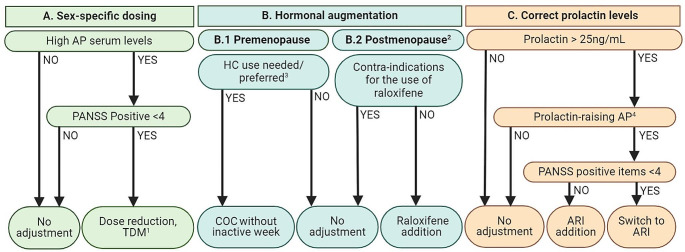 Figure 1
Peer Reviews
No public reviews on file for this paper yet. If you reviewed it on a platform where reviews are public (OpenReview, ICLR, NeurIPS, ICML), you can paste yours below so the community can read it here.
Videos
No videos yet. Explain this paper in a talk, walkthrough, or lecture? Add one.
Taxonomy
TopicsSchizophrenia research and treatment
Correction to: Current Psychiatry Reports (2023) 25:723–733.
10.1007/s11920-023-01460-6
The original version of this article unfortunately contained a mistake in the image of Fig. 1. Specifically, in section C. of this figure, the cut-off limit of prolactin is defined as 15 ng/L. The correct value of prolactin should be 25 ng/mL. The correct image is the following.
Fig. 1. Evidence-based recommendations for female-specific pharmacotherapy, based on three pillars: sex-specific dosing, hormonal replacement, and correction of prolactin levels. Abbreviations: AP, antipsychotic; PANSS, Positive and Negative Syndrome Scale; TDM, therapeutic drug monitoring; COC, combined oral contraceptive; HC, hormonal contraceptive; ARI, aripiprazole. Footnotes: 1Based on Schoretsanitis et al. [77•]. 2Based on the Stages of Reproductive Aging Workshop (STRAW + 10). 3Should be based on shared decision, primarily led by preference and/or current use of the participant. 4Amisulpride, asenapine, chlorpromazine, haloperidol, lurasidone, olanzapine, paliperidone, and risperidone
The original version of this paper has been corrected.