The DPY-14 cuticle collagen regulates left-right asymmetric neuronal migration in Caenorhabditis elegans
Erik Lundquist

TL;DR
This study shows that the cuticle collagen DPY-14 helps control left-right asymmetry in the migration of Q neuroblasts in C. elegans.
Contribution
The paper identifies DPY-14 as a new extracellular matrix component involved in neuronal migration asymmetry.
Findings
DPY-14 genetically interacts with DPY-17 and SQT-3 in regulating Q neuroblast migration.
DPY-14 may contribute to left-right asymmetry in the extracellular matrix.
No classical secreted paracrine growth factor was previously identified for this process.
Abstract
Nervous systems of bilaterally-symmetric animals display left-right asymmetries in development. In Caenorhabditis elegans , the Q neuroblasts display left-right asymmetry of migration, with QR on the right migrating anteriorly and QL on the left migrating posteriorly. Previous worked showed that a group of transmembrane receptor molecules including UNC-40 /DCC and PTP-3 /LAR control direction of initial Q migration. However, no classical secreted paracrine growth factor has been identified. Previous work showed that molecules in the extracellular matrix are involved, including UNC-52 /Perlecan and the cuticle collagens DPY-17 and SQT-3 . This report shows that the cuticle collagen DPY-14 is also involved, and genetically acts with DPY-17 and SQT-3 , possibly in a collagen trimer. DPY-14 might be a component of an inherent left-right chirality in the extracellular matrix that directs…
Genes, proteins, chemicals, diseases, species, mutations and cell lines named across the full text — each resolved to its canonical identifier and authoritative record.
Click any figure to enlarge with its caption.
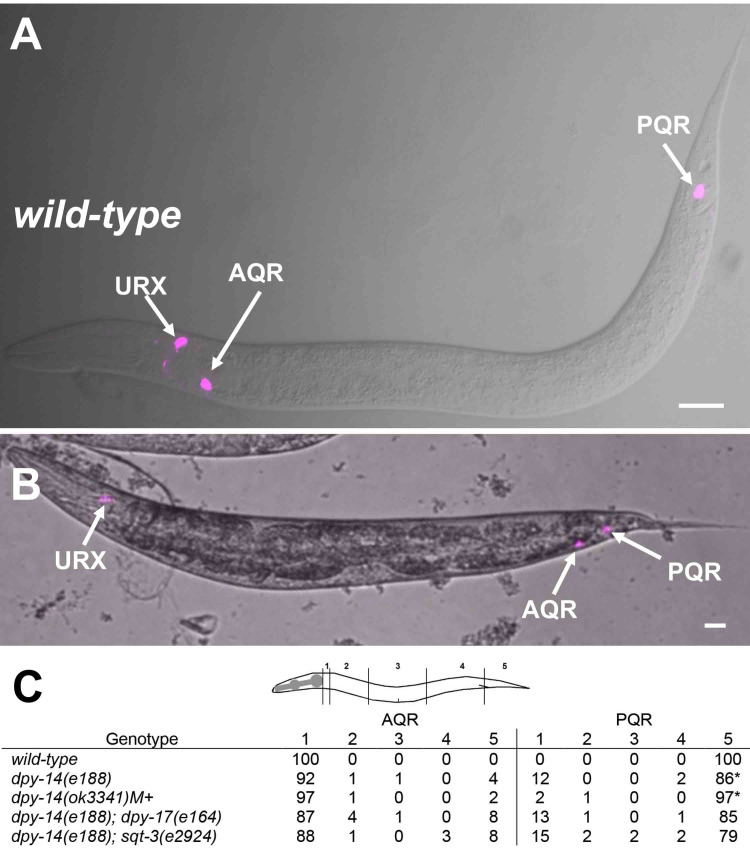 Figure 1
|
Strain |
Genotype |
Origin |
|
|
|
CGC |
|
|
|
CGC/this work |
|
|
|
CGC/this work |
|
|
|
CGC/this work |
|
|
|
CGC/this work |
- —National Institutes of Health (United States)https://ror.org/01cwqze88
Peer Reviews
No public reviews on file for this paper yet. If you reviewed it on a platform where reviews are public (OpenReview, ICLR, NeurIPS, ICML), you can paste yours below so the community can read it here.
Videos
No videos yet. Explain this paper in a talk, walkthrough, or lecture? Add one.
Taxonomy
TopicsSpine and Intervertebral Disc Pathology
Description
The bilateral Q neuroblasts are sisters of the V5 seam cells and are born during embryogenesis (Sulston and Horvitz 1977; Chapman
- et al.* 2008; Middelkoop and Korswagen 2014). At larval hatching, QR on the right protrudes and migrates anteriorly over the V4 seam cell, and QL on the left protrudes and migrates posteriorly over the V5 seam cell (Chapman
- et al.* 2008). QR and QL then undergo an identical pattern of cell division, cell death, and neuronal differentiation to produce three neurons each. QR produces AQR, AVM, and SDQR, and QL produces PQR, PVM, and SDQL. QR daughters migrate anteriorly, including AQR which migrates the longest distance to the deirid ganglion near the pharynx ( Figure 1A ). QL daughters migrate posteriorly, with PQR migrating the longest distance to the phasmid ganglion posterior to the anus ( Figure 1A ).
A group of transmembrane receptor molecules act together to control the initial migration of QR and QL, including UNC-40 /DCC, PTP-3 /LAR, MIG-21 , and the Cadherins CDH-3 and CDH-4 (Middelkoop
- et al.* 2012; Sundararajan and Lundquist 2012; Sundararajan
- et al.* 2014; Ebbing
- et al.* 2019). In QL, UNC-40 /DCC and PTP-3 /LAR act redundantly in parallel to drive posterior protrusion and migration. In QR, UNC-40 and PTP-3 mutually inhibit one another's posterior migration activity, resulting in anterior protrusion and migration. Defects in the direction of initial migration affects the subsequent migration of AQR and PQR (Chapman
- et al.* 2008).
unc-40 , ptp-3 , mig-21 , * and * cdh-4 * mutants each have misdirected AQR and PQR migration, with AQR sometimes migrating posteriorly and PQR sometimes migrating anteriorly.
Previous studies indicate that the cuticle collagen genes * dpy-17 * and * sqt-3 * result in initial QL and QR migration defects similar to * unc-40 , ptp-3 , mig-21 , * and * cdh-4 * (Lang and Lundquist 2021) . * dpy-17 * and * sqt-3 * encode similar single collagen repeat molecules of the collagen IV family (Novelli
- et al.* 2006; Fotopoulos
- et al.* 2015). Work described here shows that the
dpy-14 * is also required AQR and PQR migration similar to * dpy-17 * and * sqt-3 . * * dpy-14 ( e188 ) * has a morphological phenotype similar to * dpy-17 * and * sqt-3 * : a spindle-shaped Dpy that is very severe in early larval development and that gets less severe as the animals develop to adulthood (Gallo
- et al.* 2006).
dpy-14 * encodes a cuticle collagen with a single collagen repeat similar to DPY-17 and SQT-3 (Gallo
- et al.* 2006).
dpy-14 ( e188 ) * mutants displayed defects in AQR and PQR migration, with reversals of direction of migration of both cells: 6% of AQRs migrated posteriorly to the normal position of PQR ( Figure 1B and C); and 11% of PQR migrated anteriorly to the normal position of AQR ( Figure 1C ). This is similar to the level of defects observed in * dpy-17 * and * sqt-3 * mutants (Lang and Lundquist 2021) . A deletion of the * dpy-14 * gene, * dpy-14 ( ok3341 ) * , resulted in sterile Dpy adults. * dpy-14 ( ok3341 ) * animals with wild-type maternal * dpy-14 * activity also displayed AQR and PQR migration reversals, with AQR migration significantly less severe than * dpy-14 ( e188 ) * ( Figure 1C ). This difference could be due to wild-type maternal * dpy-14 * activity in * dpy-14 ( ok3341 ). * However, * dpy-14 ( e188 ) * is a missense mutation that changes glycine 139 to arginine in the first collagen Gly–X–Y region (Gallo
- et al.* 2006). Gly–X–Y repeats are required for trimerization of collagen monomers to form the collagen triple-helix (Bella
- et al.* 1994; Bella
- et al.* 2006). These data suggest that
dpy-14 ( e188 ) * might not be a simple loss of function of * dpy-14 * and might have some dominant interfering activity, possibly with * dpy-17 * and/or * sqt-3 . *
Double mutants of * dpy-17 * and * sqt-3 * were no more severe than single mutants alone (Lang and Lundquist 2021) . * sqt-3 ; dpy-14 ( e188 ) * and * dpy-17 ; dpy-14 ( e188 ) * double mutants were also no more severe than either single alone (Table 1). The triple mutant could not be constructed and is likely inviable. In any event, these results suggest that DPY-14 , DPY-17 , and SQT-3 all act together to regulate AQR and PQR migration. DPY-17 and SQT-3 are thought to act together in a trimer (Novelli
- et al.* 2006). One attractive hypothesis is that each of these three Collagen monomers form a Collagen triple helix molecule that acts in AQR and PQR migration.
No classical secreted paracrine factor has been identified that regulates the left-right asymmetry of Q neuroblast migration, although the basement membrane heparan sulfate proteoglycan UNC-52 /Perlecan is involved (Ochs
- et al.* 2022), and this work and previous work (Lang and Lundquist 2021) suggests that the collagen extracellular matrix is involved. Possibly, the Q neuroblasts are responding to inherent left-right chirality that is present in extracellular matrices including the cuticle (Bergmann
- et al.*
- to migrate anteriorly on the right and posteriorly on the left. UNC-52 /Perlecan and a DPY-17 / SQT-3 / DPY-14 collagen trimer might be part of this extracellular matrix left-right chirality to which the Q neuroblasts respond.
Methods
Standard * C. elegans * genetics and culture techniques at 20°C were utilized (Brenner 1974) . AQR and PQR were visualized using Pgcy-32::cfp transgenes (Chapman
- et al.* 2008; Josephson
- et al.* 2016). AQR and PQR position along the body was noted using a five-position scale as previously described (Josephson
- et al.* 2016; Lang and Lundquist 2021) (see Figure 1C ): position 1 is the normal position of AQR in the deirid ganglion in the anterior; position 2 is posterior to the normal position of AQR but anterior to the vulva; position three is around the vulva; position four if the birthplace of the Q neuroblasts in the posterior; and position 5 is the normal final position of PQR in the tail in the phasmid ganglion behind the anus.
Reagents
The following * C. elegans * mutants and variants were used: LGI, * dpy-14 ( e188 ), dpy-14 ( ok3341 ), tmC20 ; * LGII, * lqIs244 [Pgcy-32::cfp]; * LGIII, * dpy-17 ( e164 ); * LGV, * sqt-3 ( e2924 ) * . The * tmC20 * balancer (Dejima et al., 2018) was used to maintain * dpy-14 ( ok3341 ) * heterozygotes *. * The following strains were analyzed:
**: **
The reference list from the paper itself. Each links out to its DOI / PubMed record.
- 1Bella J Eaton M Brodsky B Berman HM 1994107 Crystal and molecular structure of a collagen-like peptide at 1.9 A resolution.Science 26651820036-8075758110.1126/science.76956997695699 · doi ↗ · pubmed ↗
- 2Bella J Liu J Kramer R Brodsky B Berman HM 2006715 Conformational effects of Gly-X-Gly interruptions in the collagen triple helix.J Mol Biol 36220022-283629831110.1016/j.jmb.2006.07.01416919298 · doi ↗ · pubmed ↗
- 3Bergmann DC Crew JR Kramer JM Wood WB 1998 Cuticle chirality and body handedness in Caenorhabditis elegans.Dev Genet 2330192-253X 16417410.1002/(SICI)1520-6408(1998)23:3<164::AID-DVG 2>3.0.CO;2-C 9842711 · doi ↗ · pubmed ↗
- 4Brenner S 197451 The genetics of Caenorhabditis elegans.Genetics 7710016-6731719410.1093/genetics/77.1.714366476 PMC 1213120 · doi ↗ · pubmed ↗
- 5Chapman JO Li H Lundquist EA 2008924 The MIG-15 NIK kinase acts cell-autonomously in neuroblast polarization and migration in C. elegans.Dev Biol 32420012-160624525710.1016/j.ydbio.2008.09.01418840424 PMC 2642615 · doi ↗ · pubmed ↗
- 6Dejima K Hori S Iwata S Suehiro Y Yoshina S Motohashi T Mitani S 201812 An Aneuploidy-Free and Structurally Defined Balancer Chromosome Toolkit for Caenorhabditis elegans.Cell Rep 22123224110.1016/j.celrep.2017.12.02429298424 · doi ↗ · pubmed ↗
- 7Ebbing A Middelkoop TC Betist MC Bodewes E Korswagen HC 2019925 Partially overlapping guidance pathways focus the activity of UNC-40/DCC along the anteroposterior axis of polarizing neuroblasts.Development 146180950-199110.1242/dev.18005931488562 PMC 7376761 · doi ↗ · pubmed ↗
- 8Fotopoulos P Kim J Hyun M Qamari W Lee I You YJ 2015427 DPY-17 and MUA-3 Interact for Connective Tissue-Like Tissue Integrity in Caenorhabditis elegans: A Model for Marfan Syndrome.G 3 (Bethesda)571371137810.1534/g 3.115.01846525917920 PMC 4502371 · doi ↗ · pubmed ↗