Procedural risk factors for deep and organ/space surgical site infection post-coronary artery bypass graft surgery
Abarna Pearl, Patrick S. Gordon, Baevin S. Feeser, Dana E. Pepe, Preeti Mehrotra, Sharon B. Wright

TL;DR
This study explores how surgical techniques and dressings affect infection risks after heart surgery.
Contribution
The study identifies specific procedural factors linked to higher infection risks after coronary artery bypass graft surgery.
Findings
Bilateral internal mammary artery grafts increase infection odds.
Negative pressure wound therapy is associated with higher infection rates.
Abstract
In this study, we examined the impact of the number and type of arterial grafts, and surgical dressing type, on deep and organ/space surgical site infection following coronary artery bypass graft procedures. Bilateral internal mammary artery grafts and negative pressure wound therapy were associated with higher odds of infection.
Genes, proteins, chemicals, diseases, species, mutations and cell lines named across the full text — each resolved to its canonical identifier and authoritative record.
Click any figure to enlarge with its caption.
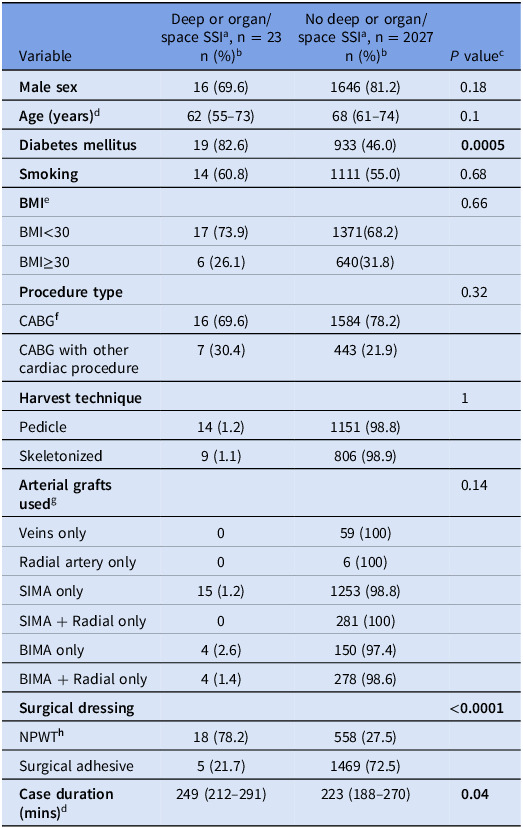 Figure 1
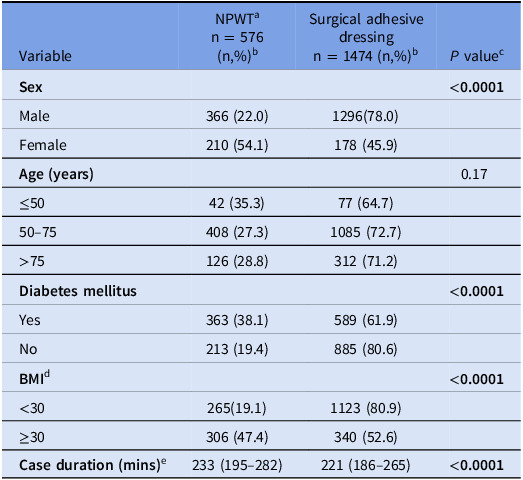 Figure 2
Peer Reviews
No public reviews on file for this paper yet. If you reviewed it on a platform where reviews are public (OpenReview, ICLR, NeurIPS, ICML), you can paste yours below so the community can read it here.
Videos
No videos yet. Explain this paper in a talk, walkthrough, or lecture? Add one.
Taxonomy
TopicsSurgical site infection prevention · Cardiac and Coronary Surgery Techniques · Reconstructive Surgery and Microvascular Techniques
Introduction
Advances in coronary artery bypass graft (CABG) techniques have improved graft patency and survival, however, little is known about the impact of the number and type of arterial grafts used on post-CABG surgical site infections (SSIs).^ 1 ^ Literature suggests that even for the same number of arterial grafts used, specific artery types may impact SSI incidence. Surgical dressing method, ie surgical adhesive versus negative pressure wound therapy (NPWT), may also impact SSI risk. Previously, we found no difference in SSI incidence related to harvest technique (skeletonized versus pedicled) or use of single versus bilateral internal mammary (BIMA) graft.^ 2 ^ Here we explore modifiable procedural SSI risk factors, including artery type and surgical dressing method.
Methods
We conducted a retrospective cohort study of patients over 18 years old who underwent CABG at an academic tertiary care center from 1/2019 through 12/2022. Variables abstracted from hospital data marts and the Division of Cardiac Surgery database included demographics, comorbidities, surgical technique, surgical dressing, and surgeon. Post-CABG deep and organ/space SSIs occurring within 90 days were identified by infection preventionists during routine surveillance using National Healthcare Safety Network definitions.^ 3 ^
Surgical dressing was recorded as “NPWT,” “surgical adhesive,” “missing” or “both.” Data were validated by review of provider notes of a random sample of 10% of the entire cohort. Sensitivity analyses regarding the effect of NPWT on the odds of SSI were performed, classifying patients with “missing” or “both” dressings into other categories or in separate categories.
Univariate associations between exposures and SSI were analyzed using Wilcoxon’s rank sum for continuous variables and Fisher’s exact or Chi-square tests for categorical variables. A sub-analysis evaluated the risk of SSI in patients with two arterial grafts by type of artery used, specifically BIMA versus single internal mammary artery plus radial (SIMA-Radial) graft. Exploratory univariate analyses were conducted to identify potential confounding variables between SSI and arterial graft type and between SSI and surgical dressing method.
Propensity score logistic regression was used to find the adjusted effect of NPWT on the odds of SSI, with diabetes mellitus (DM), smoking status, age > 75, body mass index (BMI) > = 30, and sex as input variables for the propensity score.
SAS 9.4 was used for all statistical analyses. Extreme values of BMI were excluded from all analyses (e.g., BMI > 70 (5 patients) or BMI < 13 (11 patients)).
Results
Of the 2050 included patients, 23 developed an SSI (12 deep and 11 organ/space). Characteristics of patients with and without SSI are shown in Table 1. In univariate analyses, DM (P < .001), NPWT (P < .001), and longer case duration (P = .04) were associated with SSI. There was no significant association between SSI and the total number of arterial grafts, combination of grafts used, harvest technique, surgeon, or surgery year.
Table 1.Select characteristics of coronary artery bypass graft (CABG) patients with and without surgical site infection (SSI)VariableDeep or organ/space SSI^ a ^, n = 23n (%)^ b ^ No deep or organ/space SSI^ a ^, n = 2027n (%)^ b ^
P value^ c ^
Male sex 16 (69.6)1646 (81.2)0.18 Age (years) ^ d ^ 62 (55–73)68 (61–74)0.1 Diabetes mellitus 19 (82.6)933 (46.0) 0.0005
Smoking 14 (60.8)1111 (55.0)0.68 BMI ^ e ^ 0.66BMI<3017 (73.9)1371(68.2)BMI≥306 (26.1)640(31.8) Procedure type 0.32CABG**^f^**16 (69.6)1584 (78.2)CABG with other cardiac procedure7 (30.4)443 (21.9) Harvest technique 1Pedicle14 (1.2)1151 (98.8)Skeletonized9 (1.1)806 (98.9) Arterial grafts used ^ g ^ 0.14Veins only059 (100)Radial artery only06 (100)SIMA only15 (1.2)1253 (98.8)SIMA + Radial only0281 (100)BIMA only4 (2.6)150 (97.4)BIMA + Radial only4 (1.4)278 (98.6) Surgical dressing
<0.0001 NPWT**^h^**18 (78.2)558 (27.5)Surgical adhesive5 (21.7)1469 (72.5) Case duration (mins) ^ d ^ 249 (212–291)223 (188–270) 0.04
a Surgical site infection. b Column percentages are shown. c Fisher’s exact or Chi-square for categorical variables; Wilcoxon’s rank sum for continuous variables. d Variable expressed as median and interquartile range. e Body mass index. f Coronary artery bypass graft. g With or without venous grafts. h Negative pressure wound therapy.
Among patients with two arterial grafts, 281 patients underwent SIMA-Radial and 154 underwent BIMA. None of the SIMA-Radial versus four of the BIMA, developed SSI (P = .02). In the BIMA group, there was a greater proportion of skeletonized (versus pedicled) arterial harvest (OR 2.19, P = .016). These patients also had younger ages (63 vs 68 years, P < .001), lower BMI (26.6 vs 27.8, P = .02), and longer case duration (238 vs 217 minutes, P = .003).
On validation using provider notes, 90% of the patients with “both” dressings were found to have NPWT, therefore these patients were included in the “NPWT” category. For patients with “surgical adhesive” recorded, there was no mention of the dressing type in 63% of patients. Similarly, on review of patients with “missing” dressing, 42% had neither dressing type recorded and 30% had surgical adhesive listed. Surgical adhesive likely represents the default and therefore may not be specifically recorded. Thus, patients found to have “missing” dressing were categorized as having “surgical adhesive” in the analysis.
In total, 576 and 1474 patients of the total were categorized as “NPWT” (376 “NPWT”; 200 “both”) versus “surgical adhesive” (1231 “surgical adhesive”; 243 “missing”) respectively. The odds ratio (OR) of SSI in patients with NPWT versus surgical adhesive was 9.48 (3.50–25.65). The OR of SSI remained significantly higher in patients with NPWT compared to those with surgical adhesive in all sensitivity analyses. In exploratory analyses of characteristics in patients with NPWT versus surgical adhesive, patients with female sex, DM, and BMI ≥ 30 were more likely to receive NPWT dressings. Patients with NPWT also had a longer median case duration. There was no significant association between dressing type and either smoking status, number of arteries used, combination of arterial grafts used, or surgical year. Table 2 shows select patient characteristics by surgical dressing type.
Table 2.Select characteristics of coronary artery bypass graft (CABG) patients, according to surgical dressing typeVariableNPWT^ a ^ n = 576 (n,%)^ b ^ Surgical adhesive dressingn = 1474 (n,%)^ b ^
P value^ c ^
Sex
<0.0001 Male366 (22.0)1296(78.0)Female210 (54.1)178 (45.9) Age (years) 0.17≤5042 (35.3)77 (64.7)50–75408 (27.3)1085 (72.7)>75126 (28.8)312 (71.2) Diabetes mellitus
<0.0001 Yes363 (38.1)589 (61.9)No213 (19.4)885 (80.6) BMI ^ d ^
<0.0001 <30265(19.1)1123 (80.9)≥30306 (47.4)340 (52.6) Case duration (mins) ^ e ^ 233 (195–282)221 (186–265) <0.0001
a Negative pressure wound therapy. b Row percentages are shown. c Fisher’s exact or Chi-square for categorical variables; Wilcoxon’s rank sum for continuous variables. d Body mass index. e Variable expressed as median and interquartile range.
In the propensity score regression, the adjusted OR of SSI in those who had NPWT compared to surgical adhesive was 10.45 (3.62–30.16).
Discussion
The post-CABG SSI rate was 1.1%, which is within the expected range.^ 4 ^ Our study found no significant association between post-CABG SSI and the number of arterial grafts or harvest technique. Amongst a subset of CABG patients who had two arterial grafts, those with BIMA were more likely to have SSI than those with SIMA-Radial. Additionally, NPWT was associated with a higher odds of SSI than surgical adhesive.
BIMA graft has been associated with a higher risk of SSI than SIMA in randomized controlled trials.^ 5 ^ This could be related to artery location and increased de-vascularization of the sternum when both internal mammary arteries are used.
It is unclear why NPWT was associated with a higher odds of SSI than surgical adhesive. NPWT has historically been associated both with reduction in SSIs when used prophylactically on surgical wounds and with improved outcomes after post-sternotomy mediastinitis, compared to standard surgical dressing and closure methods.^ 6–9 ^ At our institution NPWT is typically applied after closure of the sternotomy wound in patients deemed to be at high SSI risk using a literature-based scoring system including age, sex, extreme BMI, DM, smoking, and other comorbidities.^ 4 ^ Thus, our results could be due to confounding by indication, whereby those who are selected by surgeons to have NPWT are inherently at higher risk for SSI. However, further investigation via propensity score regression to account for potential confounding did not support this hypothesis. This may be explained by additional factors considered by surgeons when deciding to employ NPWT (eg, structural factors observed during procedure like sternal thickness), not captured in our study.^ 10 ^ Variability in the application of NPWT, including establishment of a secure seal, may also affect its effectiveness in SSI prevention.
Limitations of our study include the inability to perform multivariable regression to simultaneously adjust for multiple confounding variables, due to the low number of deep and organ/space SSIs. For surgical dressing type, confounding was partly overcome using propensity score regression, which adjusts for known factors for choosing NPWT in a single, composite covariate. Additionally, the surgical dressing data may have been subject to misclassification, though a sample was validated and sensitivity analyses were performed. In these analyses, incorporation of “missing” data in the “NPWT” category only strengthened our findings.
Overall, potentially modifiable procedural risk factors, including use of BIMA and surgical dressing type, could affect the odds of SSI post-CABG surgery. An unexpected finding was the higher SSI odds with use of NPWT in our population. Additional research across multiple centers, including prospective collection of reasons for surgeon dressing selection, would be important to further understand our results.
The reference list from the paper itself. Each links out to its DOI / PubMed record.
- 1Loop FD , Lytle BW , Cosgrove DM , et al. J. Maxwell Chamberlain memorial paper. Sternal wound complications after isolated coronary artery bypass grafting: early and late mortality, morbidity, and cost of care. Ann Thorac Surg 1990;49:179–186.2306138 10.1016/0003-4975(90)90136-t · doi ↗ · pubmed ↗
- 2van den Berg PH , Fesser B , Senthilnathan V , Khabbaz KR , Wright SB. Impact of surgical approach on development of surgical-site infection following internal mammary-artery, coronary-artery bypass graft procedures. Infect Control Hosp Epidemiol 2023;44:1889–1890.10.1017/ice.2023.88PMC 1066587237129037 · doi ↗ · pubmed ↗
- 3Surgical Site Infection. National Healthcare Safety Network. Published 2022. Accessed January 1, 2024. https://www.cdc.gov/nhsn/pdfs/pscmanual/9pscssicurrent.pdf
- 4Dohmen PM , Markou T , Ingemansson R , et al. Use of incisional negative pressure wound therapy on closed median sternal incisions after cardiothoracic surgery: clinical evidence and consensus recommendations. Med Sci Monit 2014;20:1814–1825.25280449 10.12659/MSM.891169 PMC 4199398 · doi ↗ · pubmed ↗
- 5Taggart DP , Benedetto U , Gerry S , et al. Bilateral versus single internal-thoracic-artery grafts at 10 years. N Engl J Med 2019;380:437–446.30699314 10.1056/NEJ Moa 1808783 · doi ↗ · pubmed ↗
- 6Norman G , Shi C , Goh EL , et al. Negative pressure wound therapy for surgical wounds healing by primary closure. Cochrane Wounds Group, ed. Cochrane Database Syst Rev 2022. doi: 10.1002/14651858.CD 009261.pub 7 PMC 904071035471497 · doi ↗ · pubmed ↗
- 7Akbayrak H , Tekumit H. Comparison between vacuum-assisted closure technique and conventional approach in patients with mediastinitis after isolated coronary artery bypass graft surgery. Braz J Cardiovasc Surg 2023;38:353–359.36692043 10.21470/1678-9741-2022-0317 PMC 10159076 · doi ↗ · pubmed ↗
- 8Yu AW , Rippel RA , Smock E , Jarral OA. In patients with post-sternotomy mediastinitis is vacuum-assisted closure superior to conventional therapy? Interact Cardiovasc Thorac Surg 2013;17:861–866.23912622 10.1093/icvts/ivt 326PMC 3805210 · doi ↗ · pubmed ↗