Ramsay Hunt Syndrome Associated With Etanercept Treatment for Rheumatoid Arthritis: A Case Report and a Review of Literature
Sarah E Robinson, Rahul Varman

TL;DR
A woman with rheumatoid arthritis developed Ramsay Hunt syndrome after treatment with etanercept, a drug that weakens the immune system.
Contribution
This is one of the first reported cases linking etanercept treatment to Ramsay Hunt syndrome.
Findings
The patient developed a vesicular rash and facial nerve paralysis after using etanercept.
Ramsay Hunt syndrome was diagnosed as a reactivation of the varicella zoster virus.
Etanercept's immunosuppressive effects may have contributed to the syndrome.
Abstract
A 38-year-old woman with rheumatoid arthritis treated with etanercept presented with complaints of ear pain. Over four days, the pain progressed to a vesicular rash and then facial nerve paralysis. The patient was diagnosed with Ramsay Hunt syndrome (RHS), a reactivation of the varicella zoster virus that specifically affects the seventh cranial nerve (CN VII). Etanercept is an anti-tumor necrosis factor (anti-TNF) agent that has known immunosuppressive effects. RHS occurs more commonly in immunocompromised states, such as the one induced by etanercept. To the best of our knowledge, this is one of the first reported cases of RHS with etanercept treatment.
Genes, proteins, chemicals, diseases, species, mutations and cell lines named across the full text — each resolved to its canonical identifier and authoritative record.
Click any figure to enlarge with its caption.
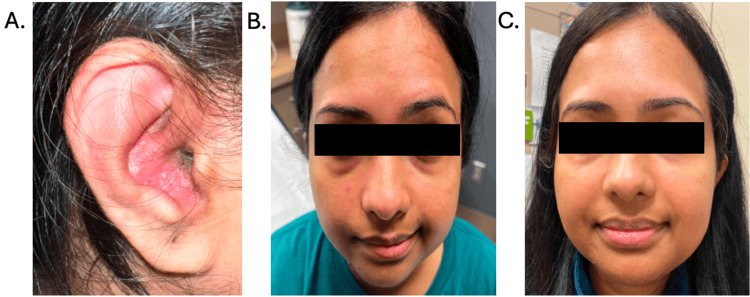 Figure 1
Peer Reviews
No public reviews on file for this paper yet. If you reviewed it on a platform where reviews are public (OpenReview, ICLR, NeurIPS, ICML), you can paste yours below so the community can read it here.
Videos
No videos yet. Explain this paper in a talk, walkthrough, or lecture? Add one.
Taxonomy
TopicsFacial Nerve Paralysis Treatment and Research · Herpesvirus Infections and Treatments · Orthopedic Surgery and Rehabilitation