Characterization of a valproic acid-sensitive mutant allele of the Golgi GDP-mannose transmembrane transporter Vrg4 in Schizosaccharomyces pombe
Teruaki Takasaki, Minami Yamada, Haruka Ikeda, Yue Fang, Reiko Sugiura

TL;DR
This study identifies a mutant yeast strain sensitive to valproic acid, revealing a link between a glycosylation transporter and drug sensitivity.
Contribution
A new valproic acid-sensitive mutant allele of the GDP-mannose transporter Vrg4 is identified and characterized in fission yeast.
Findings
A missense mutation (T256I) in Vrg4 causes valproic acid sensitivity and impaired glycosylation.
Overexpression of Vrg4 negatively affects cell growth in fission yeast.
Impaired glycosylation is suggested as a potential mechanism for valproic acid sensitivity.
Abstract
Valproic acid (VPA) is a widely used drug for epilepsy. However, precise molecular mechanisms relevant to VPA's side effects remain elusive. This study identifies a VPA-sensitive mutant strain ( vas21 ) in fission yeast with a missense mutation (T256I) in the nucleotide sugar-binding motif of the GDP-mannose transporter Vrg4 . This mutation impairs protein glycosylation, as evidenced by altered acid phosphatase mobility. We also found that Vrg4 overexpression deteriorates cell growth. Our results highlight the role of Vrg4 in glycosylation and implicate impaired glycosylation as a potential mechanism underlying VPA sensitivity. The new allele of vrg4 will be useful in glycobiology and pharmacology.
Genes, proteins, chemicals, diseases, species, mutations and cell lines named across the full text — each resolved to its canonical identifier and authoritative record.
Click any figure to enlarge with its caption.
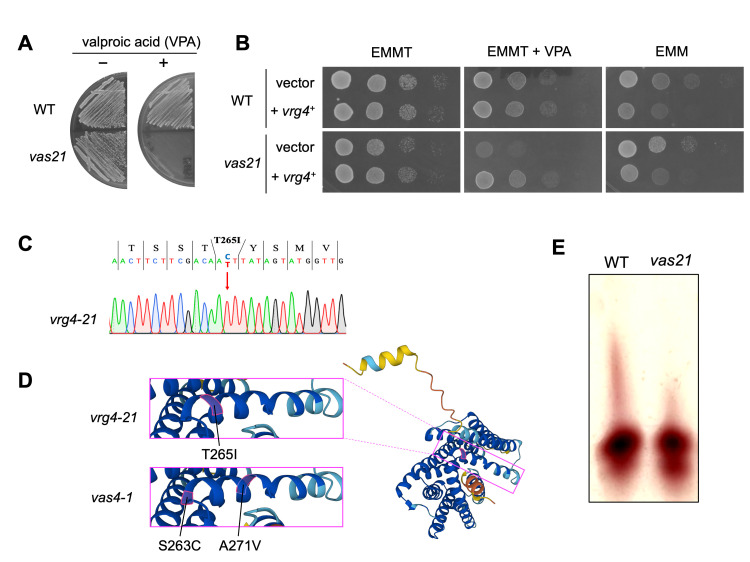 Figure 1
Peer Reviews
No public reviews on file for this paper yet. If you reviewed it on a platform where reviews are public (OpenReview, ICLR, NeurIPS, ICML), you can paste yours below so the community can read it here.
Videos
No videos yet. Explain this paper in a talk, walkthrough, or lecture? Add one.
Taxonomy
TopicsGenetics and Neurodevelopmental Disorders · Adenosine and Purinergic Signaling · Pancreatic function and diabetes