Are children of key population individuals at higher risk of HIV than other children? Results from a multi-country analysis of routine program data
Caterina Casalini, Sarah Yeiser, Hanna Amanuel, Amy Gottlieb, Chris Akolo, Madje Koffivi Toovi, Dismas Gashobotse, Pablo Mabanza, Bernard Ogwang, Sandra Georges, Natasha Mack, Meena Srivastava

TL;DR
Children of key population individuals are at higher risk of HIV and are more likely to be diagnosed through index testing, highlighting the need for family-centered HIV programs.
Contribution
This study provides multi-country evidence on the higher HIV risk among children of key populations using routine program data.
Findings
Case finding for HIV was 17% among children of key populations compared to 8% among others.
Treatment initiation rates were high (97% for children of key populations and 94% for others).
Index testing was more effective in identifying HIV cases among children of key populations.
Abstract
Children of key population individuals (CPK) often face the same stigma and discrimination as their parents, limiting their access to HIV services. The Meeting Targets and Maintaining Epidemic Control project analyzed pediatric HIV testing data from project-supported sites to better understand risk among CKP and improve comprehensive prevention, testing, and treatment for KP families. We conducted a retrospective analysis of routine program data collected October 1, 2021–September 30, 2022, in project-supported sites in Burundi, Côte d’Ivoire, Democratic Republic of Congo, Tanzania, and Togo. We compared HIV case finding (defined as the percentage of children diagnosed with HIV among those who were tested) and treatment initiation (defined as the percentage of children diagnosed with HIV who were initiated on antiretroviral therapy) data for children <15 years disaggregated by index…
Genes, proteins, chemicals, diseases, species, mutations and cell lines named across the full text — each resolved to its canonical identifier and authoritative record.
Click any figure to enlarge with its caption.
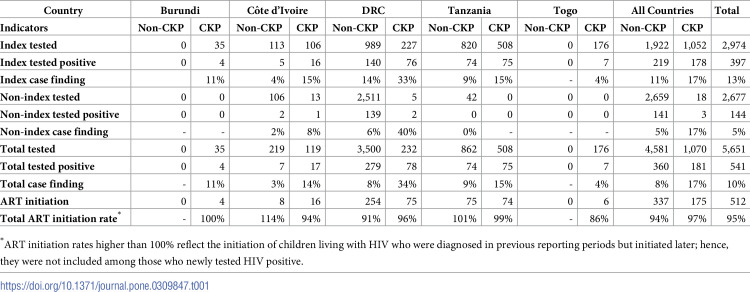 Figure 1
 Figure 2
Peer Reviews
No public reviews on file for this paper yet. If you reviewed it on a platform where reviews are public (OpenReview, ICLR, NeurIPS, ICML), you can paste yours below so the community can read it here.
Videos
No videos yet. Explain this paper in a talk, walkthrough, or lecture? Add one.
Taxonomy
TopicsHIV/AIDS Research and Interventions · Sex work and related issues · HIV, Drug Use, Sexual Risk