Wengen’s hidden powers: ROS triggers a TNFR-dependent tissue regenerative pathway in Drosophila
Ditte S Andersen, Julien Colombani

TL;DR
A study finds that a protein in fruit flies, Wengen, helps regenerate tissue after damage without relying on typical inflammation pathways.
Contribution
The study reveals a new, TNF-independent role for Wengen in promoting tissue regeneration in Drosophila.
Findings
Wengen, a Drosophila TNFR, mediates tissue regeneration independently of TNF.
The pathway is activated in response to apoptosis and supports survival during regeneration.
Abstract
While the role of the Tumor necrosis factor-α (referred to as TNF here) as a key mediator of pro-inflammatory and immune responses is well-established, non-pathological functions of the TNF-TNF receptor (TNFR) signaling are less explored. In this issue of The EMBO Journal, Esteban-Collado et al, (2024) describe a TNF independent, pro-survival role of the Drosophila TNFR Wengen during damage-induced tissue regeneration. Recent study identifies the Drosophila TNF receptor Wengen as a TNF-independent mediator of tissue regeneration in response to apoptosis.
Genes, proteins, chemicals, diseases, species, mutations and cell lines named across the full text — each resolved to its canonical identifier and authoritative record.
Click any figure to enlarge with its caption.
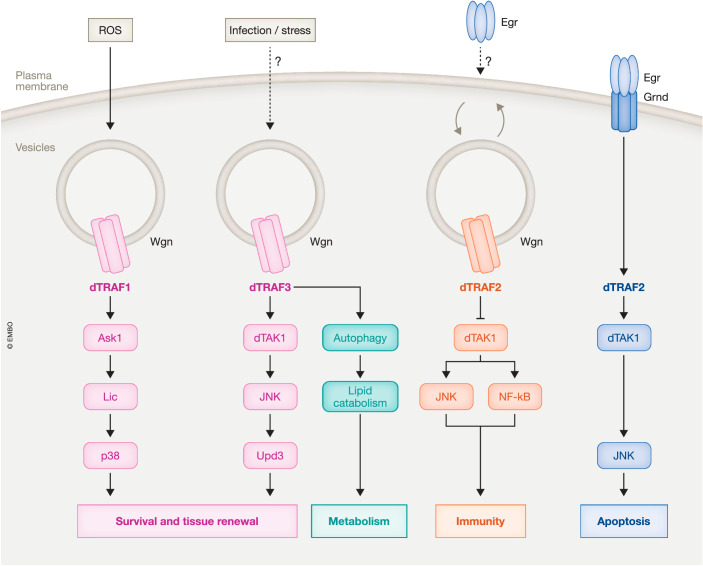 Figure 1
 Figure 2
Peer Reviews
No public reviews on file for this paper yet. If you reviewed it on a platform where reviews are public (OpenReview, ICLR, NeurIPS, ICML), you can paste yours below so the community can read it here.
Videos
No videos yet. Explain this paper in a talk, walkthrough, or lecture? Add one.
Taxonomy
TopicsInvertebrate Immune Response Mechanisms · Neurobiology and Insect Physiology Research · Ubiquitin and proteasome pathways