Duplex Reverse-Transcription Real-Time Polymerase Chain Reaction Assay Targeting 23S rRNA Single Nucleotide Polymorphisms for the Detection of Flea-Borne Rickettsioses
William S. Probert, Alexa C. Quintana, Anne M. Kjemtrup, Jill K. Hacker

TL;DR
A new RT-rtPCR test was developed to detect two rickettsial agents causing flea-borne diseases in California, showing improved sensitivity over existing methods.
Contribution
A novel duplex RT-rtPCR assay targeting 23S rRNA SNPs for R. felis and R. typhi was developed and validated.
Findings
The new assay is 1,000-fold more sensitive for R. felis and 10-fold more sensitive for R. typhi than existing methods.
R. typhi was identified as the primary cause of flea-borne rickettsioses in California through retrospective testing.
Abstract
Flea-borne spotted fever and flea-borne (murine) typhus are rickettsioses caused by Rickettsia felis and Rickettsia typhi, respectively, and typically present as undifferentiated febrile illnesses. The relative contribution of these agents to flea-borne rickettsioses in California is unclear. We have developed a duplex reverse transcription real-time polymerase chain reaction (RT-rtPCR) assay targeting R. felis– and R. typhi–specific 23S ribosomal RNA single nucleotide polymorphisms to better understand the respective roles of these agents in causing flea-borne rickettsioses in California. This assay was compared with an established duplex R. felis– and R. typhi–ompB rt-PCR assay and was shown to have 1,000-fold and 10-fold greater analytical sensitivity for the detection of R. felis and R. typhi, respectively. Retrospective testing of clinical specimens with both assays established R.…
Genes, proteins, chemicals, diseases, species, mutations and cell lines named across the full text — each resolved to its canonical identifier and authoritative record.
Click any figure to enlarge with its caption.
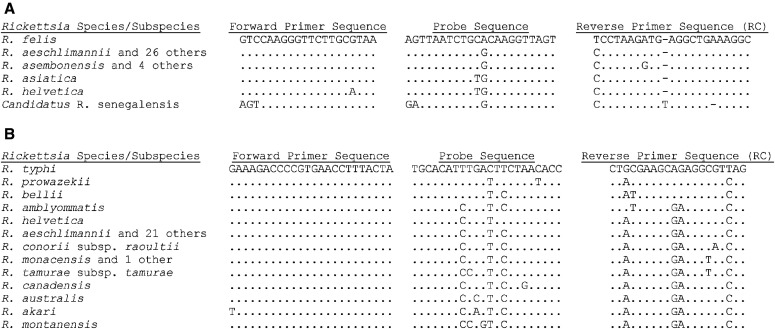 Figure 1
Peer Reviews
No public reviews on file for this paper yet. If you reviewed it on a platform where reviews are public (OpenReview, ICLR, NeurIPS, ICML), you can paste yours below so the community can read it here.
Videos
No videos yet. Explain this paper in a talk, walkthrough, or lecture? Add one.
Taxonomy
TopicsVector-borne infectious diseases · Yersinia bacterium, plague, ectoparasites research · Viral Infections and Vectors