Improving post-injury follow-up survey response: incorporating automated modalities
Hannah Scheuer, Kelsey M. Conrick, Brianna Mills, Esther Solano, Saman Arbabi, Eileen M. Bulger, Danae Dotolo, Christopher St. Vil, Monica S. Vavilala, Ali Rowhani-Rahbar, Megan Moore

TL;DR
This study shows that using automated methods like email and text can improve follow-up survey responses from trauma patients, helping track outcomes better.
Contribution
The study introduces and validates a low-cost automated follow-up system to improve survey response rates in trauma care.
Findings
Response rates increased by 17.9 percentage points when automated methods were used.
Email and text became the primary response modalities in the second protocol.
Automated follow-up is feasible for collecting longitudinal data in trauma registries.
Abstract
Incorporating post-discharge data into trauma registries would allow for better research on patient outcomes, including disparities in outcomes. This pilot study tested a follow-up data collection process to be incorporated into existing trauma care systems, prioritizing low-cost automated response modalities. This investigation was part of a larger study that consisted of two protocols with two distinct cohorts of participants who experienced traumatic injury. Participants in both protocols were asked to provide phone, email, text, and mail contact information to complete follow-up surveys assessing patient-reported outcomes six months after injury. To increase follow-up response rates between protocol 1 and protocol 2, the study team modified the contact procedures for the protocol 2 cohort. Frequency distributions were utilized to report the frequency of follow-up response…
Genes, proteins, chemicals, diseases, species, mutations and cell lines named across the full text — each resolved to its canonical identifier and authoritative record.
Click any figure to enlarge with its caption.
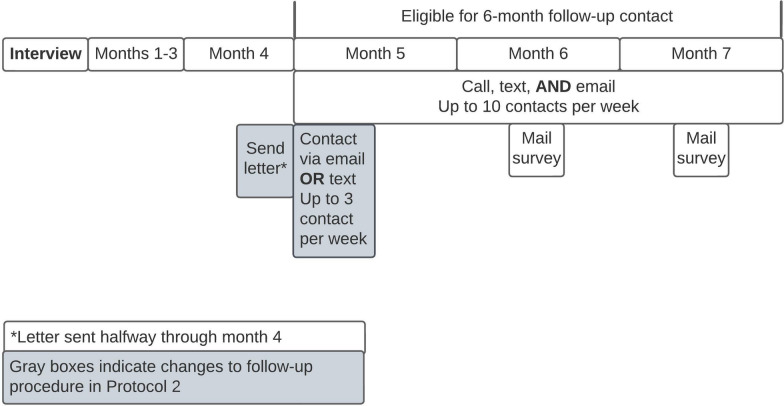 Figure 1
Peer Reviews
No public reviews on file for this paper yet. If you reviewed it on a platform where reviews are public (OpenReview, ICLR, NeurIPS, ICML), you can paste yours below so the community can read it here.
Videos
No videos yet. Explain this paper in a talk, walkthrough, or lecture? Add one.
Taxonomy
TopicsTrauma and Emergency Care Studies · Emergency and Acute Care Studies · Healthcare Systems and Technology