Leveraging Quadratic Polynomials in Python for Advanced Data Analysis
Rostyslav Sipakov, Olena Voloshkina, Anastasiia Kovalova, Qiao Wang, Rostyslav Sipakov, Selim Molla, Rostyslav Sipakov, Rostyslav Sipakov

TL;DR
This paper explains how quadratic polynomials can be used in Python for modeling and analyzing data patterns, with practical examples and code.
Contribution
The paper provides accessible Python-based examples for applying quadratic polynomials in data analysis, emphasizing practical implementation.
Findings
Quadratic polynomials can effectively model curvature in data using Python libraries like NumPy and Matplotlib.
The coefficient of determination (R-squared) is useful for evaluating the fit of quadratic models to data.
Practical examples demonstrate the adaptability of quadratic models across various analytical fields.
Abstract
This study aims to provide a comprehensive overview of the role of quadratic polynomials in data modeling and analysis, particularly in representing the curvature of natural phenomena. We begin with a fundamental explanation of quadratic polynomials and describe their general forms and theoretical significance. We then explored the application of these polynomials in regression analysis, detailing the process of fitting quadratic models to the data using Python libraries NumPy and Matplotlib. The methodology also included calculation of the coefficient of determination (R-squared) to evaluate the polynomial model fit. This study utilizes illustratively generated data to demonstrate the application of quadratic polynomials in Python for robust data analysis. Using practical examples accompanied by Python scripts, this study demonstrated the application of quadratic polynomials to…
Genes, proteins, chemicals, diseases, species, mutations and cell lines named across the full text — each resolved to its canonical identifier and authoritative record.
Click any figure to enlarge with its caption.
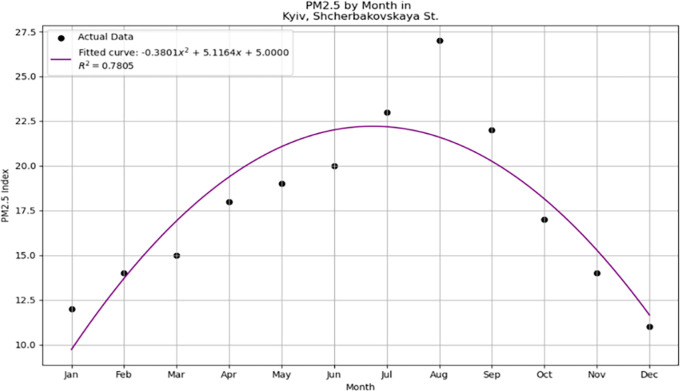 Figure 1
Peer Reviews
No public reviews on file for this paper yet. If you reviewed it on a platform where reviews are public (OpenReview, ICLR, NeurIPS, ICML), you can paste yours below so the community can read it here.
Videos
No videos yet. Explain this paper in a talk, walkthrough, or lecture? Add one.
Taxonomy
TopicsComputational Physics and Python Applications · Multidisciplinary Science and Engineering Research