Seeing invisible objects with intelligent optics
Isaac Nape, Andrew Forbes

TL;DR
This paper introduces a new method using machine learning and diffractive optics to make transparent objects visible with regular cameras.
Contribution
The novelty is performing optical transformations directly using intelligent optics, bypassing complex digital processing.
Findings
Transparent objects can be imaged directly using conventional cameras with intelligent optics.
Machine learning and diffractive optics enable in-situ measurement without interferometry.
This approach simplifies imaging of transparent objects compared to traditional methods.
Abstract
Transparent objects are invisible to traditional cameras because they can only detect intensity fluctuations, necessitating the need for interferometry followed by computationally intensive digital image processing. Now it is shown that the necessary transformations can be performed optically by combining machine learning and diffractive optics, for a direct in-situ measurement of transparent objects with conventional cameras.
Click any figure to enlarge with its caption.
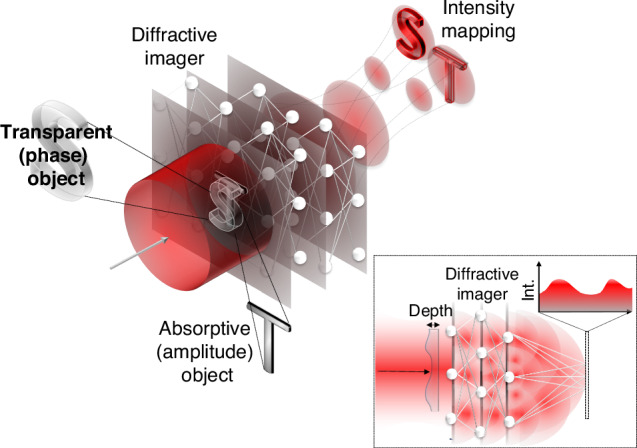 Figure 1
Peer Reviews
No public reviews on file for this paper yet. If you reviewed it on a platform where reviews are public (OpenReview, ICLR, NeurIPS, ICML), you can paste yours below so the community can read it here.
Videos
No videos yet. Explain this paper in a talk, walkthrough, or lecture? Add one.
Taxonomy
TopicsNeural Networks and Reservoir Computing · Random lasers and scattering media · Optical Polarization and Ellipsometry