Inhibitory immune checkpoints suppress the surveillance of senescent cells promoting their accumulation with aging and in age-related diseases
Antero Salminen

TL;DR
The paper suggests that immune checkpoints like PD-L1 help senescent cells avoid immune detection, leading to their accumulation during aging and age-related diseases.
Contribution
The paper proposes that inhibitory immune checkpoints may be a novel mechanism for senescent cell immune evasion.
Findings
Senescent cells express PD-L1 and other inhibitory checkpoint ligands.
PD-L1 on senescent cells suppresses cytotoxic T and NK cell activity.
Immune checkpoint signaling may prevent elimination of senescent cells.
Abstract
The accumulation of pro-inflammatory senescent cells within tissues is a common hallmark of the aging process and many age-related diseases. This modification has been called the senescence-associated secretory phenotype (SASP) and observed in cultured cells and in cells isolated from aged tissues. Currently, there is a debate whether the accumulation of senescent cells within tissues should be attributed to increased generation of senescent cells or to a defect in their elimination from aging tissues. Emerging studies have revealed that senescent cells display an increased expression of several inhibitory immune checkpoint ligands, especially those of the programmed cell death protein-1 (PD-1) ligand-1 (PD-L1) proteins. It is known that the PD-L1 ligands, especially those of cancer cells, target the PD-1 receptor of cytotoxic CD8+ T and natural killer (NK) cells disturbing their…
Genes, proteins, chemicals, diseases, species, mutations and cell lines named across the full text — each resolved to its canonical identifier and authoritative record.
Click any figure to enlarge with its caption.
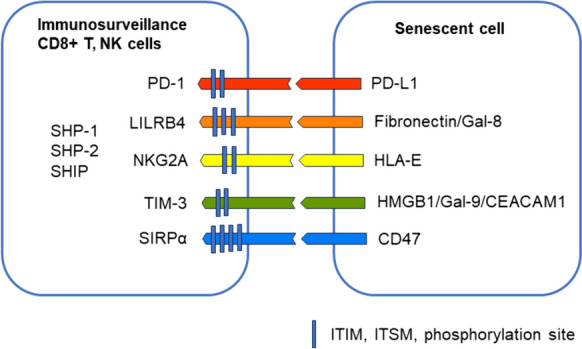 Figure 1
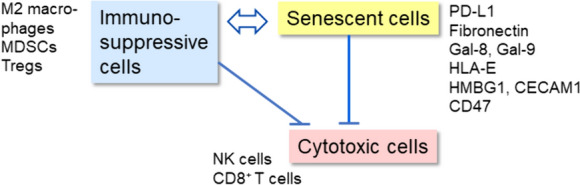 Figure 2
Peer Reviews
No public reviews on file for this paper yet. If you reviewed it on a platform where reviews are public (OpenReview, ICLR, NeurIPS, ICML), you can paste yours below so the community can read it here.
Videos
No videos yet. Explain this paper in a talk, walkthrough, or lecture? Add one.
Taxonomy
TopicsLegal processes and jurisprudence · Comparative constitutional jurisprudence studies · Comparative International Legal Studies