Global centers of a family of cubic systems
Raul Felipe Appis, Jaume Llibre

TL;DR
This paper identifies which equilibrium points in a specific type of cubic differential system are global centers, meaning their neighborhoods are filled with periodic orbits.
Contribution
The paper provides a classification of global centers within a family of cubic systems previously studied by Lloyd and Pearson.
Findings
The paper classifies which centers in the cubic system are global centers.
It builds on prior work by Lloyd and Pearson to determine when the origin is a global center.
Abstract
Consider the family of polynomial differential systems of degree 3, or simply cubic systems \documentclass[12pt]{minimal} \usepackage{amsmath} \usepackage{wasysym} \usepackage{amsfonts} \usepackage{amssymb} \usepackage{amsbsy} \usepackage{mathrsfs} \usepackage{upgreek} \setlength{\oddsidemargin}{-69pt} \begin{document}\end{document}x′=y,y′=-x+a1x2+a2xy+a3y2+a4x3+a5x2y+a6xy2+a7y3,in the plane \documentclass[12pt]{minimal} \usepackage{amsmath} \usepackage{wasysym} \usepackage{amsfonts} \usepackage{amssymb} \usepackage{amsbsy} \usepackage{mathrsfs} \usepackage{upgreek} \setlength{\oddsidemargin}{-69pt} \begin{document}\end{document}R2. An equilibrium point \documentclass[12pt]{minimal}…
Click any figure to enlarge with its caption.
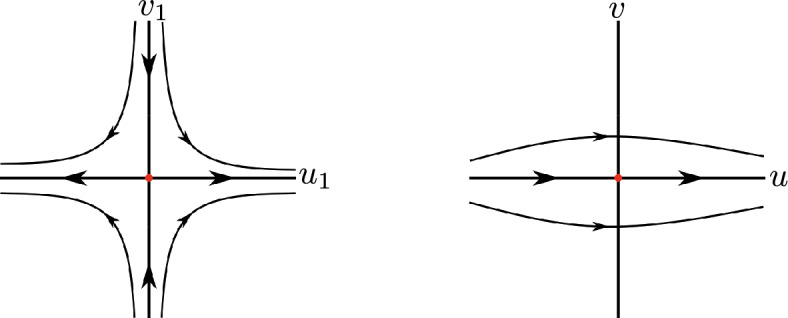 Figure 1
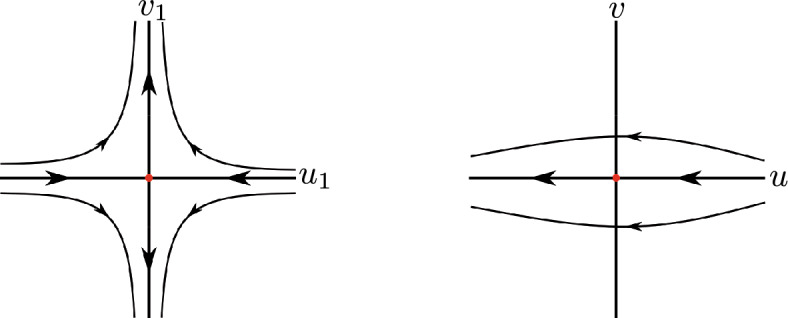 Figure 2
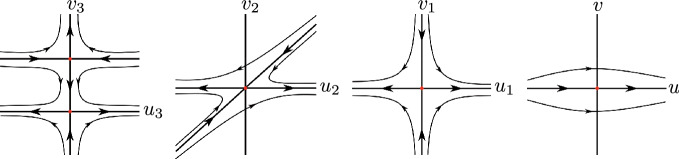 Figure 3
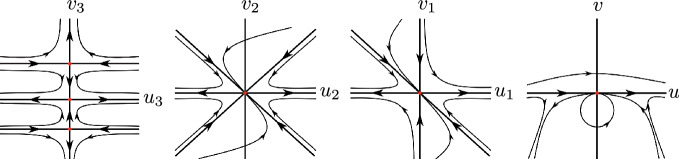 Figure 4
Peer Reviews
No public reviews on file for this paper yet. If you reviewed it on a platform where reviews are public (OpenReview, ICLR, NeurIPS, ICML), you can paste yours below so the community can read it here.
Videos
No videos yet. Explain this paper in a talk, walkthrough, or lecture? Add one.
Taxonomy
TopicsAdvanced Differential Equations and Dynamical Systems · Advanced Topics in Algebra · Nonlinear Waves and Solitons