Innovate! Accelerate! Evaluate! Harnessing the RE-AIM framework to examine the global dissemination of parenting resources during COVID-19 to more than 210 million people
Jamie M. Lachman, Nisso Nurova, Angelique Nicole Chetty, Zuyi Fang, Alison Swartz, Lorraine Sherr, Helen Mebrahtu, Kasonde Mwaba, Ohad Green, Isang Awah, Yuanling Chen, Inge Vallance, Lucie Cluver

TL;DR
This study used the RE-AIM framework to evaluate how parenting resources were globally disseminated during the pandemic, reaching over 210 million people and showing positive impacts on parenting and child well-being.
Contribution
The study introduces a novel application of the RE-AIM framework to assess the global dissemination of parenting resources during a public health crisis.
Findings
Parenting resources reached over 212 million people and were adopted by 697 agencies and organizations.
Dissemination via social media had the highest reach, followed by radio, text messages, and in-person outreach.
Surveys showed improved parenting self-efficacy and reduced child abuse, with sustained use reported by 44 organizations.
Abstract
Parents were at the forefront of responding to the needs of children during the COVID-19 pandemic. This study used the RE-AIM framework to examine the Reach, Effectiveness, Adoption, Implementation, and Maintenance of a global inter-agency initiative that adapted evidence-based parenting programs to provide immediate support to parents. Data were collected via short surveys sent via email, online surveys, and analysis of social media metrics and Google Analytics. Retrospective surveys with 1,303 parents and caregivers in 11 countries examined impacts of the resources on child maltreatment, positive relationship building, parenting efficacy, and parenting stress. The parenting resources were translated into over 135 languages and dialects; reached an estimated minimum 212.4 million people by June 2022; were adopted by 697 agencies, organizations, and individuals; and were included in…
Genes, proteins, chemicals, diseases, species, mutations and cell lines named across the full text — each resolved to its canonical identifier and authoritative record.
Click any figure to enlarge with its caption.
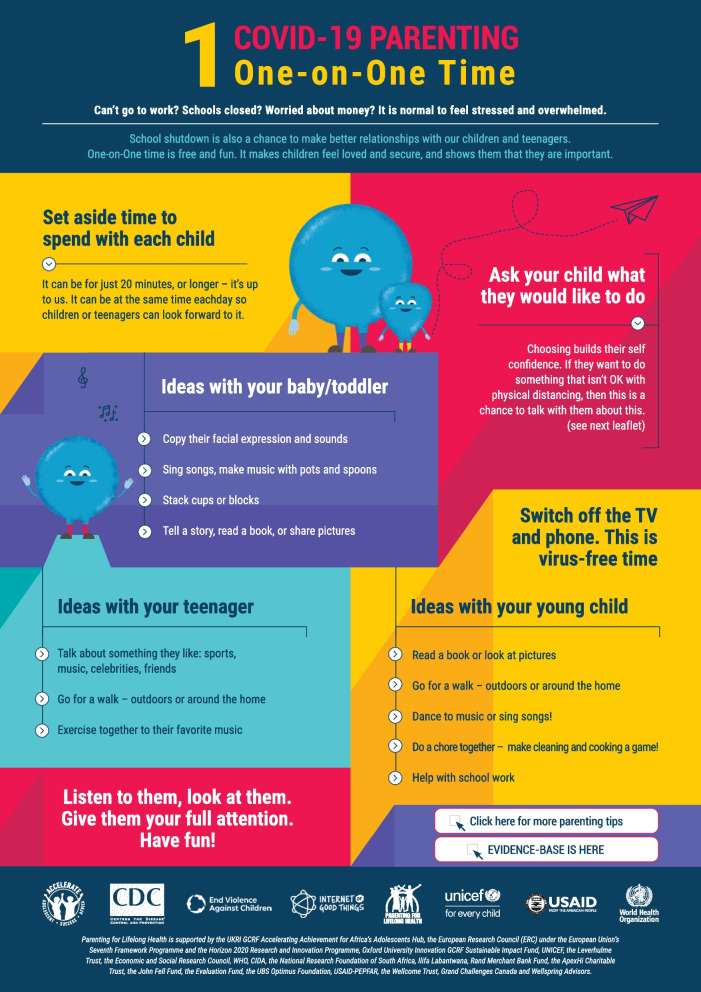 Figure 1
Peer Reviews
No public reviews on file for this paper yet. If you reviewed it on a platform where reviews are public (OpenReview, ICLR, NeurIPS, ICML), you can paste yours below so the community can read it here.
Videos
No videos yet. Explain this paper in a talk, walkthrough, or lecture? Add one.
Taxonomy
TopicsFamily and Patient Care in Intensive Care Units · Infant Development and Preterm Care · COVID-19 and Mental Health