The effect of lumbar medial branch radiofrequency neurotomy on cobb angle progression in individuals with adult scoliosis compared to natural history: A cross-sectional study
Marc Caragea, Austin Le, Tim Curtis, Amelia Ni, Tyler Clark, Andrew Joyce, Colton Hickman, Brandon Lawrence, Zane Randell, Perry Goodman, Addisyn Poduska, Michella Rasmussen, Amanda Cooper, Masaru Teramoto, Allison Glinka Przybysz, Taylor Burnham, Aaron Conger

TL;DR
This study finds that a procedure to treat back pain does not significantly affect the progression of spinal curvature in adults with scoliosis.
Contribution
The study provides the first evidence that LRFN does not accelerate Cobb angle progression in adult scoliosis patients.
Findings
The average Cobb angle progression after LRFN was 0.54 ± 3.03° per year.
This rate was not significantly different from the natural progression rate of 0.83 ± 1.1° per year.
Covariates like BMI or number of denervated levels did not influence Cobb angle progression.
Abstract
Lumbar radiofrequency neurotomy (LRFN) effectively alleviates zygapophyseal joint-mediated pain by coagulating medial branch nerves to disrupt nociceptive signaling pathways. The concomitant denervation of multifidus fibers has led to concern that LRFN may increase segmental instability and accelerate degenerative changes in patients with certain pre-existing spinal pathologies. There is a paucity of literature evaluating whether LRFN increases the progression of spinal curvature in patients with adult scoliosis. Compare the lumbosacral Cobb angle progression rate in patients with adult scoliosis who underwent LRFN to the annual progression rate of 0.83 ± 1.1° expected by natural history. Cross-sectional study. Consecutive patients diagnosed with adult scoliosis who underwent LRFN to treat zygapophyseal joint-related low back pain were identified. Patient demographics, LRFN procedure…
Genes, proteins, chemicals, diseases, species, mutations and cell lines named across the full text — each resolved to its canonical identifier and authoritative record.
Click any figure to enlarge with its caption.
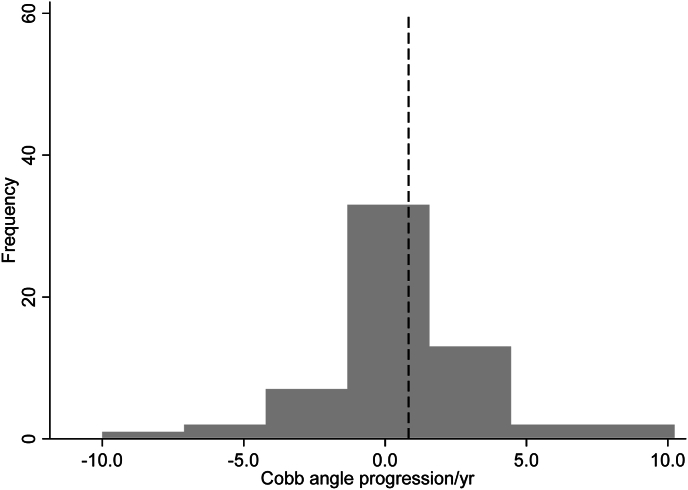 Figure 1
Peer Reviews
No public reviews on file for this paper yet. If you reviewed it on a platform where reviews are public (OpenReview, ICLR, NeurIPS, ICML), you can paste yours below so the community can read it here.
Videos
No videos yet. Explain this paper in a talk, walkthrough, or lecture? Add one.
Taxonomy
TopicsSpine and Intervertebral Disc Pathology · Scoliosis diagnosis and treatment · Musculoskeletal pain and rehabilitation