Selective Histopathology Examination for Circumcision Specimens: A Retrospective Observational Study
Baidar Khalabazyane, Rahel Rashid, Laura Mclaren, Roza Salah, Israa Kadhmawi, Joshua Philips

TL;DR
This study finds that routine histopathology for circumcision specimens is unnecessary for most cases, as malignancies are rare and typically already suspected clinically.
Contribution
Demonstrates that selective histopathological examination based on clinical suspicion is sufficient, reducing unnecessary testing.
Findings
Only 0.9% of 334 circumcision specimens showed malignancy, all in clinically suspicious cases.
Routine histopathology for non-suspicious cases did not detect malignancies.
Selectively examining suspicious cases could save resources without compromising care.
Abstract
Background Circumcision is a widely performed surgical procedure all over the globe. This can be for religious, cultural, or medical reasons. Routine histological examination of circumcision specimens is a standard practice in many healthcare systems, despite the relatively low incidence of premalignant or malignant lesions. The primary objective of this study was to evaluate the necessity of routine histopathological examination of foreskin specimens following adult circumcision. Secondary objectives included determining the frequency of malignancy in these specimens, comparing malignancy rates between clinically suspicious and non-suspicious cases, and assessing the correlation between preoperative clinical suspicion and histopathological findings. Aim This study aimed to evaluate the necessity of routine histopathological evaluation for the foreskin after circumcision. We…
Genes, proteins, chemicals, diseases, species, mutations and cell lines named across the full text — each resolved to its canonical identifier and authoritative record.
Click any figure to enlarge with its caption.
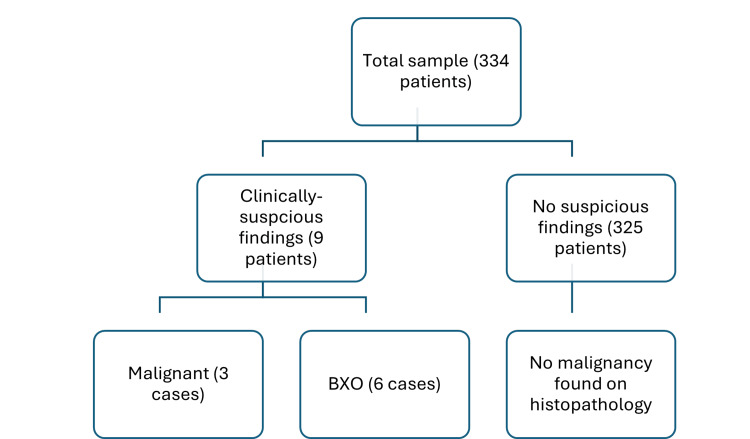 Figure 1
Peer Reviews
No public reviews on file for this paper yet. If you reviewed it on a platform where reviews are public (OpenReview, ICLR, NeurIPS, ICML), you can paste yours below so the community can read it here.
Videos
No videos yet. Explain this paper in a talk, walkthrough, or lecture? Add one.
Taxonomy
TopicsGenital Health and Disease · Urologic and reproductive health conditions · Urological Disorders and Treatments