Differences in neuroinflammation in people who started antiretroviral treatment during primary versus chronic HIV infection: an 18kDa Translocator protein (TSPO) positron emission tomography (PET) study
Jasmini Alagaratnam, John P. Thornhill, Zhen Fan, Jaime H. Vera, Jonathan Underwood, Rebecca Hall, Graham Searle, David Owen, Paul Edison, Sarah Fidler, Alan Winston

TL;DR
This study used PET imaging to compare brain inflammation in HIV patients who started treatment early versus later, finding no significant differences but a trend suggesting early treatment may reduce inflammation.
Contribution
The study is the first to use [11C]PBR28 PET to compare neuroinflammation in people who initiated ART during acute versus chronic HIV.
Findings
No significant differences in neuroinflammation were found between the three groups using [11C]PBR28 PET.
cPWH showed a trend towards higher [11C]PBR28 binding compared to aPWH and controls.
aPWH and controls showed a trend towards lower [11C]PBR28 binding, suggesting early ART may reduce neuroinflammation.
Abstract
Persistent inflammation is described in people with HIV (PWH) on antiretroviral treatment (ART). Early ART initiation is associated with reduced inflammation. We aimed to evaluate neuroinflammation, using translocator protein (TSPO) [11C]PBR28 PET neuroimaging in PWH who initiated ART during acute HIV (aPWH) versus chronic HIV infection (cPWH) versus a control population. This was a cross-sectional, observational study. All participants underwent [11C]PBR28 PET-CT neuroimaging. Using a two-tissue compartment model, total volume of distribution (VT) and distribution volume ratios (DVR) using cortical grey matter as a pseudo-reference region at 20 regions of interest (ROIs) were calculated. Differences in VT and DVR were compared between groups using the Kruskall-Wallis test. Seventeen neuro-asymptomatic male PWH on ART (9 aPWH, 8 cPWH) and 8 male control participants (CPs) were included.…
Genes, proteins, chemicals, diseases, species, mutations and cell lines named across the full text — each resolved to its canonical identifier and authoritative record.
Click any figure to enlarge with its caption.
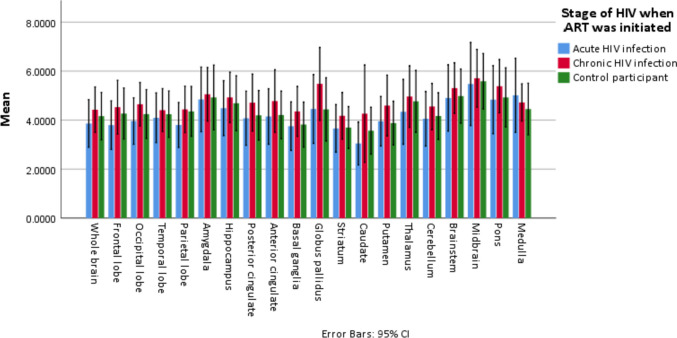 Figure 1
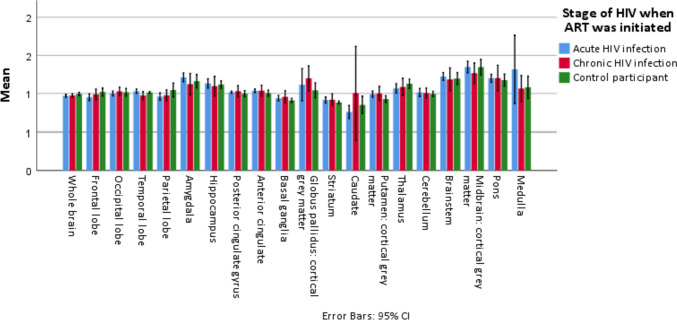 Figure 2
Peer Reviews
No public reviews on file for this paper yet. If you reviewed it on a platform where reviews are public (OpenReview, ICLR, NeurIPS, ICML), you can paste yours below so the community can read it here.
Videos
No videos yet. Explain this paper in a talk, walkthrough, or lecture? Add one.
Taxonomy
TopicsHIV Research and Treatment · HIV-related health complications and treatments · HIV/AIDS Research and Interventions