Deriving the cone fundamentals: a subspace intersection method
Brian A. Wandell, Thomas Goossens, David H. Brainard

TL;DR
This paper introduces a new computational method to estimate human cone fundamentals using only data from dichromatic observers in color matching experiments.
Contribution
A novel computational method to estimate cone fundamentals without requiring trichromatic data or knowledge of primary lights.
Findings
Cone fundamentals can be estimated using only dichromatic observer data.
The method works even when primary lights in experiments are unknown.
The approach has potential applications in modern image color management.
Abstract
Two ideas, proposed by Thomas Young and James Clerk Maxwell, form the foundations of colour science: (i) three types of retinal receptors encode light under daytime conditions, and (ii) colour matching experiments establish the critical spectral properties of this encoding. Experimental quantification of these ideas is used in international colour standards. However, for many years, the field did not reach consensus on the spectral properties of the biological substrate of colour matching: the spectral sensitivity of the cone fundamentals. By combining auxiliary data (thresholds, inert pigment analyses), complex calculations, and colour matching from genetically analysed dichromats, the human cone fundamentals have now been standardized. Here, we describe a new computational method to estimate the cone fundamentals using only colour matching from the three types of dichromatic…
Genes, proteins, chemicals, diseases, species, mutations and cell lines named across the full text — each resolved to its canonical identifier and authoritative record.
Click any figure to enlarge with its caption.
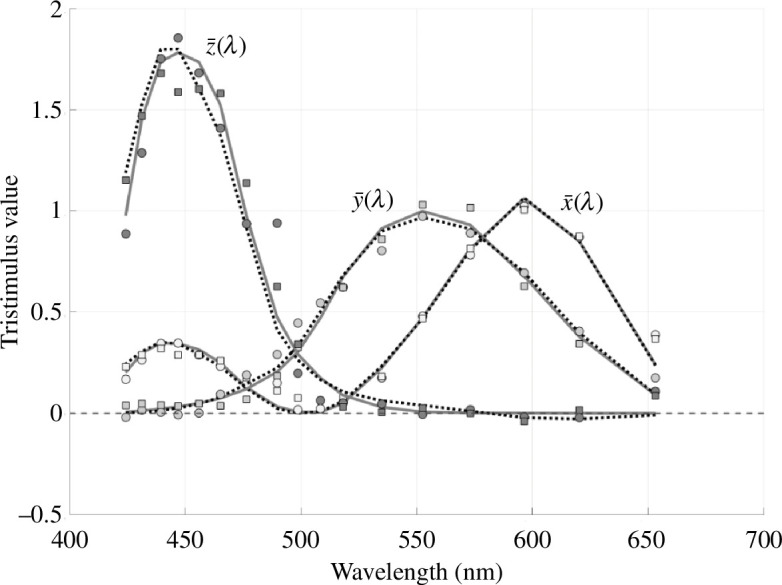 Figure 1
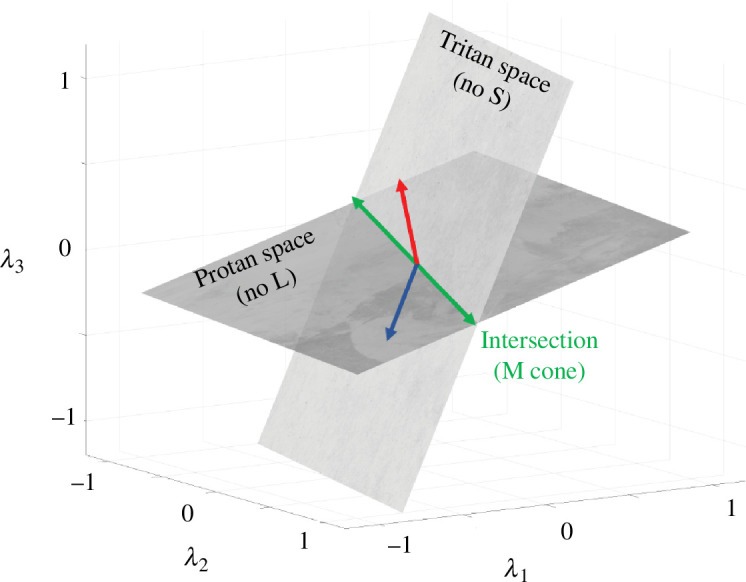 Figure 2
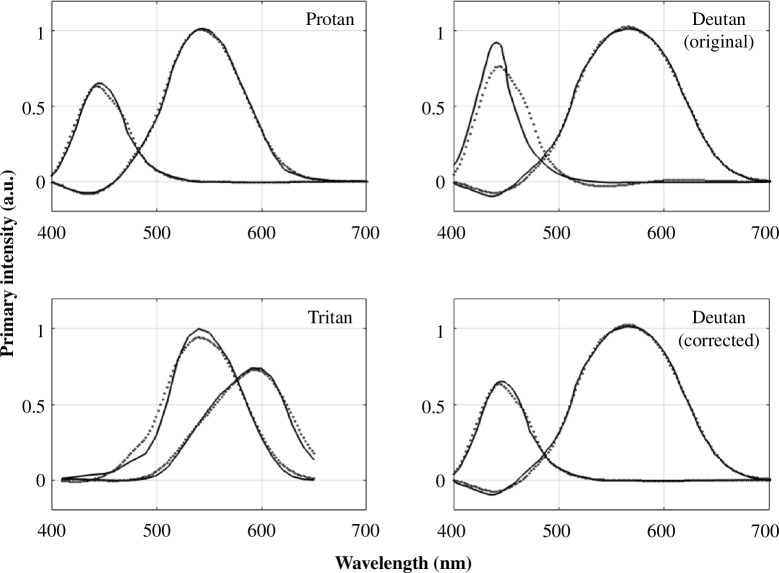 Figure 3
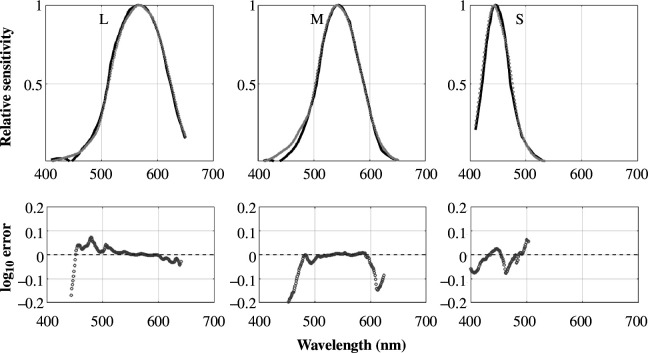 Figure 4
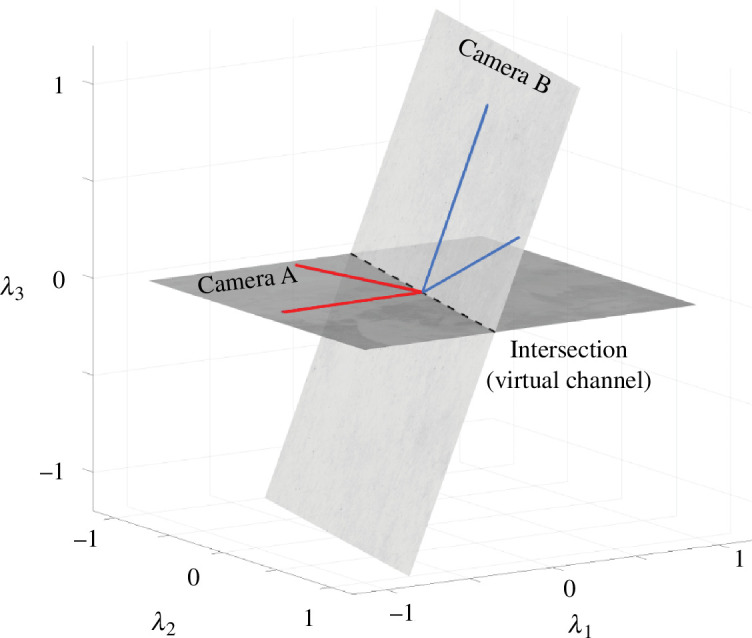 Figure 5
Peer Reviews
No public reviews on file for this paper yet. If you reviewed it on a platform where reviews are public (OpenReview, ICLR, NeurIPS, ICML), you can paste yours below so the community can read it here.
Videos
No videos yet. Explain this paper in a talk, walkthrough, or lecture? Add one.
Taxonomy
TopicsVisual perception and processing mechanisms · Color Science and Applications · Retinal Development and Disorders