Comparison of two labor induction regimens with intravaginal misoprostol 25 μg and adverse perinatal outcomes
Marcela Beraldo Santiago, Talita Beraldo Santiago, Samuel Machado Oliveira, João Victor Jacomele Caldas, Edward Araujo, Alberto Borges Peixoto

TL;DR
This study compares two dosing schedules of a drug used to induce labor and finds that one schedule leads to better outcomes for mothers and babies.
Contribution
The study identifies optimal dosing intervals for misoprostol in labor induction and links them to reduced adverse outcomes.
Findings
Women using misoprostol every 4 hours had fewer tablets but more adverse outcomes compared to those using it every 6 hours.
Using misoprostol every 6 hours was associated with lower postpartum hemorrhage and better labor progression.
Factors like dosing interval, parity, and Bishop’s score predict successful labor induction.
Abstract
The aim of the study was to compare two labor induction regimens (4 and 6 h), to determine predictors of successful labor induction with intravaginal misoprostol 25 μg tablets, and to evaluate the association with adverse perinatal outcomes. This was a retrospective cohort study that included singleton pregnancies undergoing induction of labor with an intravaginal misoprostol 25 μg tablet between 37 and 42 weeks of gestation. The pregnant women were divided into two groups: Group 1—intravaginal misoprostol 25 μg every 4 h and Group 2—intravaginal misoprostol 25 μg every 6 h. Pregnant women were divided into Group 1 (n=289) and Group 2 (n=278). Group 1 had a higher median number of intravaginal misoprostol 25 μg tablets (3.0 vs. 2.0 tablets, p<0.001), a lower prevalence of postpartum hemorrhage (7.6 vs. 32.7%, p<0.001), and a higher need for oxytocin (odds ratio [OR]: 2.1, 95%CI:…
Genes, proteins, chemicals, diseases, species, mutations and cell lines named across the full text — each resolved to its canonical identifier and authoritative record.
Click any figure to enlarge with its caption.
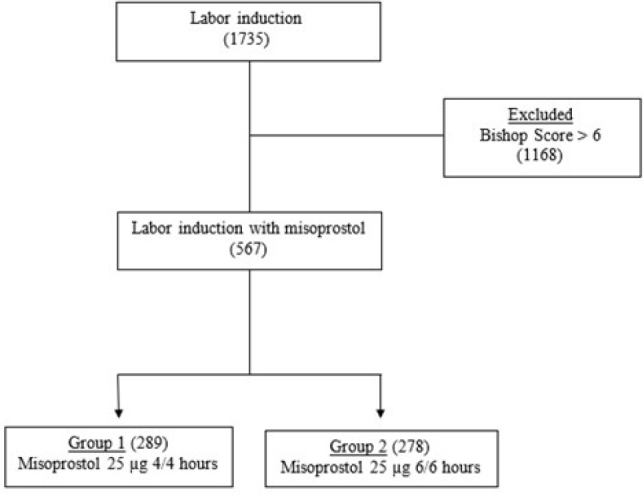 Figure 1
Peer Reviews
No public reviews on file for this paper yet. If you reviewed it on a platform where reviews are public (OpenReview, ICLR, NeurIPS, ICML), you can paste yours below so the community can read it here.
Videos
No videos yet. Explain this paper in a talk, walkthrough, or lecture? Add one.
Taxonomy
TopicsMaternal and Perinatal Health Interventions · Reproductive Health and Contraception