Distinct [18F]FDG-PET imaging features of a newly recognized and yet uncharacterized RDD-ECD overlap disease entity
Martin W. Huellner, Marco M. Bühler, Viktor H. Kölzer, Perparim Limani, Wiebke Rösler

Abstract
Genes, proteins, chemicals, diseases, species, mutations and cell lines named across the full text — each resolved to its canonical identifier and authoritative record.
Click any figure to enlarge with its caption.
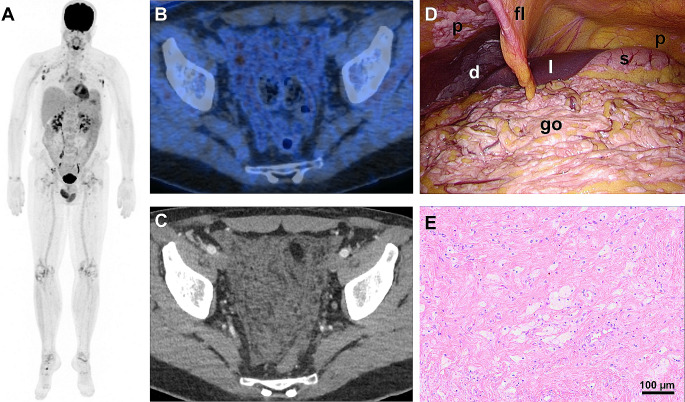 Figure 1
- —University of Zurich
Peer Reviews
No public reviews on file for this paper yet. If you reviewed it on a platform where reviews are public (OpenReview, ICLR, NeurIPS, ICML), you can paste yours below so the community can read it here.
Videos
No videos yet. Explain this paper in a talk, walkthrough, or lecture? Add one.
Taxonomy
TopicsHistiocytic Disorders and Treatments · Cardiac tumors and thrombi · Eosinophilic Disorders and Syndromes
A newly recognized histiocytosis entity, encompassing clinical and histopathologic features of Rosai-Dorfman disease (RDD) and Erdheim-Chester disease (ECD), is driven by MAP2K1 mutations [1, 2]. [^18^F]fluorodeoxyglucose ([^18^F]FDG) positron emission tomography (PET) features have not yet been reported.
This 46 year-old man presented with a two-year history of clinical hallmarks resembling RDD rather than ECD, including lymphadenopathy and painless testicle enlargement [3], being also visible on [^18^F]FDG-PET (A). Testicular RDD-ECD involvement was also reported in 6/13 patients by Razanamahery et al. [2]. Diffuse omental proliferations, manifesting as faintly [^18^F]FDG-avid omental thickening resembling a fishing net (SUV_max_ 5.5; A, B, C), and symmetric large-joint synovitis were reported as specific features of RDD-ECD [1, 2], Notably, none of these features are characteristic of RDD or hitherto known ECD subtypes. Other RDD and/or ECD features were absent [4–7].
Open biopsy targeted peritoneal lesions (D) localized on the diaphragm (d), peritoneum (p) and greater omentum (go). Histopathology revealed nodular fibrosis, foamy cell infiltrates, pigment deposits and chronic perivascular inflammatory infiltrates (E). Molecular genetic analyses confirmed presence of a characteristic MAP2K1 mutation (p.Q56P).
Diamond et al. effectively treated a patient harboring the identical mutation with MEK inhibitors [8]. FAPI-PET focusing on fibrosis aspects of histiocytosis might help determining disease extent and assessing treatment response [9, 10].
In summary, the newly recognized RDD-ECD overlap histiocytosis demonstrates distinct [^18^F]FDG-PET features setting it apart from RDD and ECD. The concurrent presence of omental proliferations, symmetric large-joint synovitis, and high testicular uptake should raise suspicion for this yet uncharacterized disease.
The reference list from the paper itself. Each links out to its DOI / PubMed record.
- 1Portegys J, Heidemeier A, Rosenwald A, Gernert M, Frohlich M, Hueper S, et al. Erdheim-Chester disease with Rosai-Dorfman-Like lesions: treatment with methotrexate, anakinra and upadacitinib. RMD Open. 2023;9. 10.1136/rmdopen-2022-002852.10.1136/rmdopen-2022-002852 PMC 988484736693681 · doi ↗ · pubmed ↗