DLGR-1, a homolog of vertebrate DLGAP proteins, regulates spindle length and anaphase velocity during C. elegans meiosis
Meghana Mahantesh Magadum, Francis McNally

TL;DR
The study identifies DLGR-1, a protein in C. elegans, which influences spindle length and anaphase speed during meiosis.
Contribution
The discovery of DLGR-1 as a C. elegans homolog of vertebrate DLGAP proteins and its role in meiotic spindle regulation.
Findings
DLGR-1 localizes to the plasma membrane during anaphase I and II in C. elegans meiosis.
Spindles in DLGR-1 deletion mutants are shorter and chromosome separation is slower.
Chromosome extrusion and progeny viability remain normal in DLGR-1 deletion mutants.
Abstract
Chromosome segregation requires a large number of microtubule-binding proteins that mediate spindle assembly and function during mitosis and meiosis. BLAST revealed a single C. elegans homolog of HURP/DLGAP5, a microtubule-binding protein that regulates mitotic and meiotic spindles in vertebrates. This homolog, W03A5.6 , was named DLGR-1 (DLGAP related). Time-lapse imaging of an endogenously tagged DLGR-1::GFP during C. elegans meiosis revealed plasma membrane localization specifically during anaphase I and anaphase II when the meiotic spindle is closely apposed to the plasma membrane. Time-lapse imaging of microtubules and chromosomes during meiosis in a strain with a CRISPR deletion of the DLGR-1 coding sequence revealed metaphase spindles that were significantly shorter than controls and chromosome separation velocities that were significantly slower than controls. Extrusion of…
Genes, proteins, chemicals, diseases, species, mutations and cell lines named across the full text — each resolved to its canonical identifier and authoritative record.
Click any figure to enlarge with its caption.
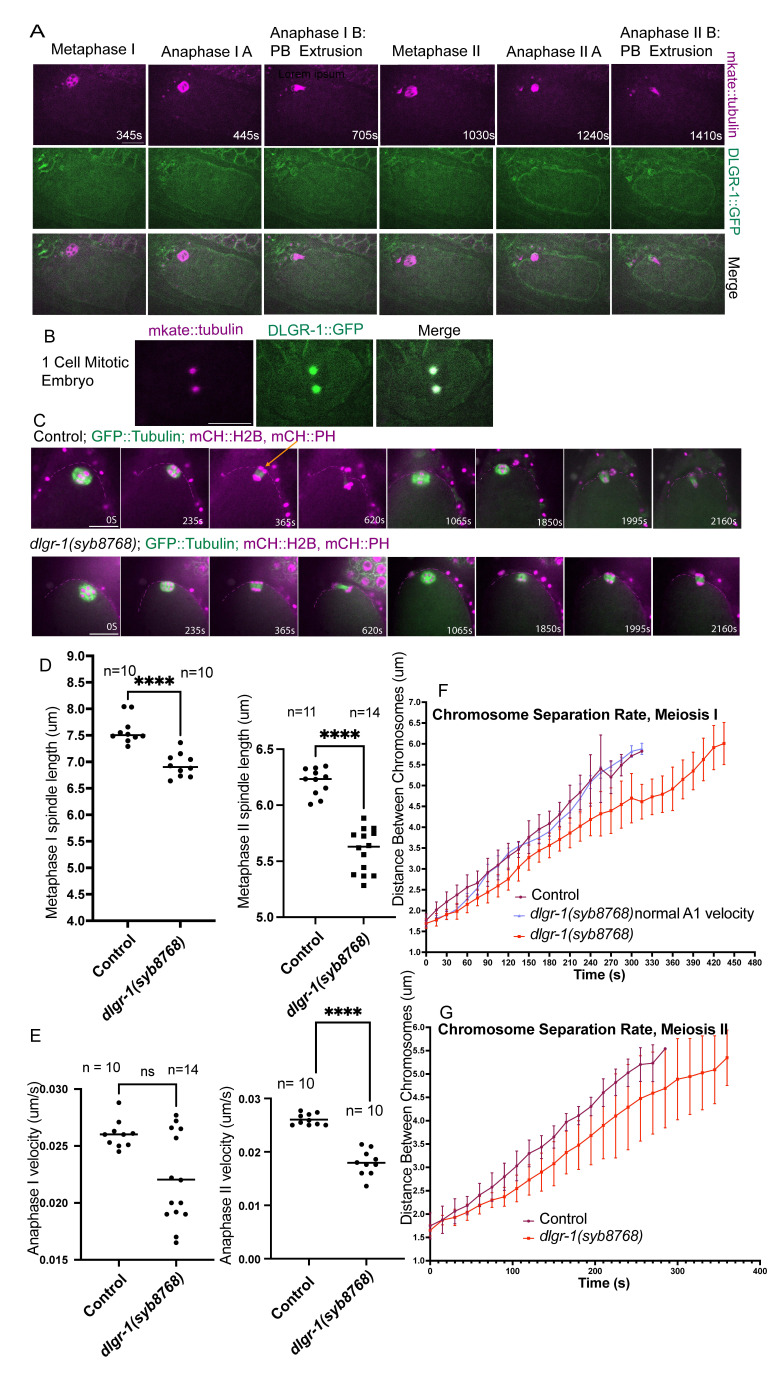 Figure 1
|
Strain number |
Genotype |
shorthand |
Available from |
|
|
|
Control for
| |
|
|
|
| |
|
|
|
Control for
| |
|
|
|
|
- —National Institute of General Medical Sciences (United States)https://ror.org/04q48ey07
Peer Reviews
No public reviews on file for this paper yet. If you reviewed it on a platform where reviews are public (OpenReview, ICLR, NeurIPS, ICML), you can paste yours below so the community can read it here.
Videos
No videos yet. Explain this paper in a talk, walkthrough, or lecture? Add one.
Taxonomy
TopicsMicrotubule and mitosis dynamics · Physiological and biochemical adaptations
Description
Microtubule-based spindles mediate chromosome segregation during mitosis and meiosis. Spindle function is regulated by hundreds of proteins with many mechanistic details remaining to be elucidated. * C. elegans * is the only animal in which all aspects of meiotic spindle function can be monitored by time-lapse fluorescence microscopy within the intact mother. HURP (hepatoma upregulated protein)/DLGAP5 is a microtubule-binding protein that regulates spindle assembly and function in vertebrate cells during mitosis (Koffa et al., 2006; Silljé, Nagel, Körner, & Nigg, 2006; Tsou et al., 2003) and during mouse oocyte meiosis (Breuer et al., 2010) . A BLAST search of the * C. elegans * genome with the human HURP protein sequence revealed a single potential homolog, W03A5.6 . A reciprocal BLAST search of the human genome with the W03A5.6 protein sequence revealed significant homology in the C-terminal GKAP domain with human DLGAP1 to DLGAP5 but no striking homology with the N-terminal region of HURP/DLGAP5 which binds microtubules (Song, Craney, & Rape, 2014; Wong, Lerrigo, Jang, & Fang, 2008) . The * Drosophila * mars protein similarly only has homology with HURP in the GKAP domain (Yang et al., 2005) but still regulates mitotic spindle function (Zhang, Breuer, Förster, Egger-Adam, & Wodarz, 2009) . W03A5.6 shows the highest homology with DLGAP1/GKAP, a synaptic protein (Kim et al., 1997) that co-localizes with microtubules and recruits cytoplasmic dynein in migrating astrocytes (Manneville, Jehanno, & Etienne-Manneville, 2010) and binds dynein light chain in neurons (Moutin, Raynaud, Fagni, & Perroy, 2012) . Because of the limited homology, we refer to W03A5.6 as DLGR-1 (DLGAP related).
We first added auxin induced degron (AID) and green fluorescent protein (GFP) sequences to the endogenous DLGR-1 locus and monitored its localization during meiosis by time-lapse imaging. In 19 time-lapse sequences, DLGR-1::AID::GFP was concentrated at the plasma membrane/cortex during anaphase I ( Fig. 1A, 445s) and anaphase II ( Fig. 1A, 1240s), which were inferred from the length and orientation of the mKate::tubulin-labelled meiotic spindle. DLGR-1::AID::GFP also localized to the plasma membrane/cortex of oocytes in the gonad (n=7 worms) and to both plasma membrane and centrosomes in mitotic embryos ( Fig. 1B )(n=12 embryos).
Because neither auxin nor GFP(RNAi) reduced the fluorescence intensity of DLGR-1::AID::GFP, we generated a strain with a deletion of the entire coding sequence, * dlgr-1 ( syb8768 ) * , to address function during meiosis. Meiosis proceeded relatively normally in * dlgr-1 ( syb8768 ) * worms ( Fig. 1C ), hatch rates were similar to controls [ * dlgr-1 ( syb8768 ) * 98% hatch, n=3 worms, n=635 progeny; FM1166 control 100% n= 3 worms, n= 745 progeny, p= .0004 Fisher's Exact Test], and the percentage of mitotic embryos with 2 polar bodies was not different than controls (control 100%, n=14; * dlgr-1 ( syb8768 ) * 100%, n=10). However, meiotic metaphase spindles in * dlgr-1 ( syb8768 ) * worms were shorter than controls ( Fig. 1D ) and meiotic anaphase chromosome separation velocities were slower than controls during anaphase II and in roughly half of anaphase I embryos ( Fig. 1E, F, G ).
The cortical localization of DLGR-1 suggests that it might influence anaphase velocities by scaffolding signaling molecules in close proximity to the spindle whereas the centrosome localization in mitotic embryos suggests that DLGR-1 might bind directly to microtubules of meiotic spindles at a level too low to observe with our imaging methods.
Methods
CRISPR-mediated genome edits were performed by SUNY Biotech. For time-lapse imaging, anesthetized worms were mounted between an agarose pad and coverslip as described in (Danlasky et al., 2020) and subjected to single plane time-lapse imaging on a Yokogawa CSU-10 spinning disk confocal microscope equipped with an Olympus 100X 1.3 PlanApo objective and a Hammamatsu Orca Quest qCMOS detector. Exposures were captured every 5 seconds. Metaphase spindle length measurements were collected on spindles before the initiation of shortening. Anaphase B velocities were determined as described in (Li, Crellin, Cheerambathur, & McNally, 2023) .
Reagents
**: **
The reference list from the paper itself. Each links out to its DOI / PubMed record.
- 1Breuer Manuel Kolano Agnieszka Kwon Mijung Li Chao-Chin Tsai Ting-Fen Pellman David Brunet Stéphane Verlhac Marie-Hélène 20101220 HURP permits MTOC sorting for robust meiotic spindle bipolarity, similar to extra centrosome clustering in cancer cells Journal of Cell Biology 19171540-81401251126010.1083/jcb.20100506521173113 PMC 3010075 · doi ↗ · pubmed ↗
- 2Danlasky Brennan M. Panzica Michelle T. Mc Nally Karen P. Vargas Elizabeth Bailey Cynthia Li Wenzhe Gong Ting Fishman Elizabeth S. Jiang Xueer Mc Nally Francis J. 20201016 Evidence for anaphase pulling forces during C. elegans meiosis Journal of Cell Biology 219120021-952510.1083/jcb.202005179 PMC 757705233064834 · doi ↗ · pubmed ↗
- 3Kim Eunjoon Naisbitt Scott Hsueh Yi-Ping Rao Anuradha Rothschild Adam Craig Ann Marie Sheng Morgan 1997210 GKAP, a Novel Synaptic Protein That Interacts with the Guanylate Kinase-like Domain of the PSD-95/SAP 90 Family of Channel Clustering Molecules The Journal of Cell Biology 13630021-952566967810.1083/jcb.136.3.6699024696 PMC 2134290 · doi ↗ · pubmed ↗
- 4Koffa Maria D. Casanova Claudia M. Santarella Rachel Köcher Thomas Wilm Matthias Mattaj Iain W. 200641 HURP Is Part of a Ran-Dependent Complex Involved in Spindle Formation Current Biology 1680960-982274375410.1016/j.cub.2006.03.05616631581 · doi ↗ · pubmed ↗
- 5Li Wenzhe Crellin Helena A. Cheerambathur Dhanya Mc Nally Francis J. 20231227 Redundant microtubule crosslinkers prevent meiotic spindle bending to ensure diploid offspring in C. elegans PLOS Genetics 19121553-7404 e 1011090 e 101109010.1371/journal.pgen.101109038150489 PMC 10775986 · doi ↗ · pubmed ↗
- 6Manneville Jean-Baptiste Jehanno Muguette Etienne-Manneville Sandrine 2010111 Dlg 1 binds GKAP to control dynein association with microtubules, centrosome positioning, and cell polarity Journal of Cell Biology 19131540-814058559810.1083/jcb.20100215121041448 PMC 3003329 · doi ↗ · pubmed ↗
- 7Moutin Enora Raynaud Fabrice Fagni Laurent Perroy Julie 201211 GKAP-DLC 2 interaction organizes postsynaptic scaffold complex to enhance synaptic NMDA receptor activity Journal of Cell Science 1477-913710.1242/jcs.09816022328512 · doi ↗ · pubmed ↗
- 8SilljéHerman H.W. Nagel Susanna Körner Roman Nigg Erich A. 200641 HURP Is a Ran-Importin β-Regulated Protein that Stabilizes Kinetochore Microtubules in the Vicinity of Chromosomes Current Biology 1680960-982273174210.1016/j.cub.2006.02.07016631580 · doi ↗ · pubmed ↗