Bilateral claw hand deformity: a rare image
Angan Ghosh, Sanjot Ninave

Abstract
Genes, proteins, chemicals, diseases, species, mutations and cell lines named across the full text — each resolved to its canonical identifier and authoritative record.
Click any figure to enlarge with its caption.
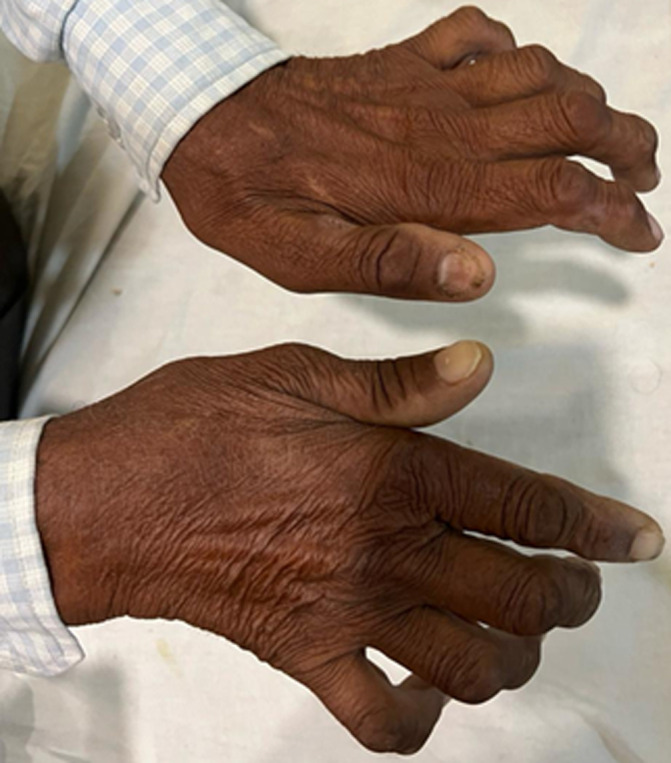 Figure 1
Peer Reviews
No public reviews on file for this paper yet. If you reviewed it on a platform where reviews are public (OpenReview, ICLR, NeurIPS, ICML), you can paste yours below so the community can read it here.
Videos
No videos yet. Explain this paper in a talk, walkthrough, or lecture? Add one.
Taxonomy
TopicsOrthopedic Surgery and Rehabilitation · Congenital limb and hand anomalies · Bone fractures and treatments
Image in medicine
A 58-year-old male came to the hospital with the complaint of difficulty in opening both hands and inability to perform routine activities. On inspection, fingers were bent with atrophy of the intrinsic muscles of both hands. On routine evaluation, it was noted that the patient had a past history of Hansen´s disease for which he took multidrug therapy (MDT) consisting of rifampicin, dapsone, and clofazimine for 6 months. The patient was then examined thoroughly to check the strength and flexibility of the fingers and an electromyography test was done. A diagnosis of bilateral claw hand was made due to ulnar nerve damage. The patient was advised physical therapy along with strengthening exercises to gain more flexibility in fingers and braces to prevent further nerve injury. The patient was posted for a Zancolli lasso procedure in the following hospital visit. Routine investigations and radiological imaging were normal and the surgery was done under a brachial plexus block with tourniquet control using local anaesthetics. Intraoperatively the patient was vitally and hemodynamically stable. The surgery was uneventful and postoperative rehabilitation was done.
a 58-year-old male with bilateral claw hand deformity