Functional and Symptomatic Improvements Based on the Femoral Tunnel Drilling Technique in Anterior Cruciate Ligament (ACL) Reconstruction
Sarah C Kurkowski, Michael J Thimmesch, Sophia Le, Henry Kuechly, Lynessa McGee, Michael Kloby, Paul McMillan, Logan P Lake, Barton Branam, Christopher Utz, Brian Grawe

TL;DR
This study compares three femoral tunnel drilling techniques used in ACL reconstruction and finds subtle differences in patient-reported outcomes like stair climbing and knee stiffness.
Contribution
The study identifies specific functional improvements associated with different femoral tunnel drilling techniques in long-term ACLR outcomes.
Findings
TT showed greater improvement in satisfaction and stair climbing ability compared to AMP-RR.
AMP-FR improved knee stiffness/swelling more than TT and knee pain during stairs more than AMP-RR.
No significant differences were found in return to sport or revision surgery rates across techniques.
Abstract
Background: The current literature comparing femoral tunnel techniques often reports on short-term outcomes after anterior cruciate ligament reconstruction (ACLR), but only a few studies have analyzed long-term outcomes. In addition, many studies have compared transtibial to anteromedial portal techniques without differentiating whether rigid or flexible reaming is used, making it difficult to infer how the techniques truly compare to one another. Purpose: This study aimed to detect differences in patient-reported outcome scores in those treated with three different femoral tunnel drilling techniques. Study design: This study is a prospective cohort study. Methods: Of 650 patients treated for anterior cruciate ligament (ACL) injuries with ACLR, 350 were 5+ years out from surgery. Of these patients, 111 completed patient-reported outcome surveys (PROs). The Kruskal-Wallis H test was…
Genes, proteins, chemicals, diseases, species, mutations and cell lines named across the full text — each resolved to its canonical identifier and authoritative record.
Click any figure to enlarge with its caption.
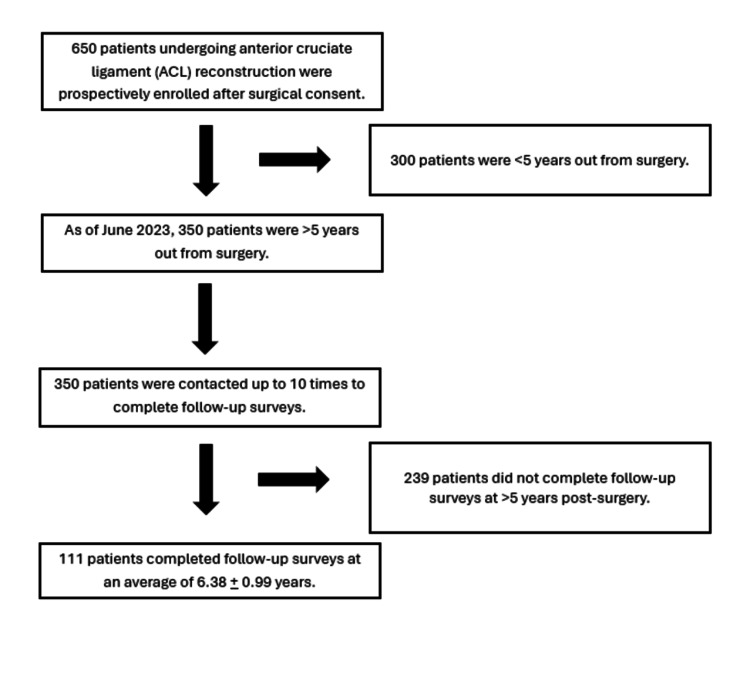 Figure 1
Peer Reviews
No public reviews on file for this paper yet. If you reviewed it on a platform where reviews are public (OpenReview, ICLR, NeurIPS, ICML), you can paste yours below so the community can read it here.
Videos
No videos yet. Explain this paper in a talk, walkthrough, or lecture? Add one.
Taxonomy
TopicsKnee injuries and reconstruction techniques · Total Knee Arthroplasty Outcomes · Sports injuries and prevention