A Three-Dimensional Method for Analysis of the Body Mode of Classical Guitars Using a Laser Displacement Sensor
Kuan-Cheng Su, Tsung-Yu Hsieh, Wei-Chih Lin, Fu-Li Hsiao, Tatyana Ryzhkova, Chii-Chang Chen

TL;DR
This paper introduces a 3D method to analyze the body mode of classical guitars using a laser sensor, enabling quantitative comparison of their timbre.
Contribution
A novel 3D method for quantitatively representing and comparing classical guitar body modes using three key acoustic parameters.
Findings
The body mode can be described using frequency, quality factors, and amplitude ratio in a 3D space.
Euclidean distance in this space allows quantitative analysis of differences in body mode characteristics among guitars.
The method enables visualization and classification of damping properties and timbre variations.
Abstract
In classical guitar acoustic spectra, the lowest frequency body mode’s amplitude often significantly surpasses that of the string overtones. However, the characteristics of the body mode have not been systematically utilized to quantitatively represent the timbre of classical guitars. In this study, we propose a quantitative method for describing the body mode, which can effectively differentiate the timbre of classical guitars. Our approach involves three key parameters presented in a three-dimensional space, as follows: the frequency and quality factors of the body mode, along with the amplitude ratio of the plucked string note to the body mode in the soundboard’s vibration spectrum. This representation allows for the visualization, quantitative comparison, and classification of the body mode note and damping properties across classical guitars. The differences in body mode among…
Genes, proteins, chemicals, diseases, species, mutations and cell lines named across the full text — each resolved to its canonical identifier and authoritative record.
Click any figure to enlarge with its caption.
 Figure 1
 Figure 2
 Figure 3
 Figure 4
 Figure 5
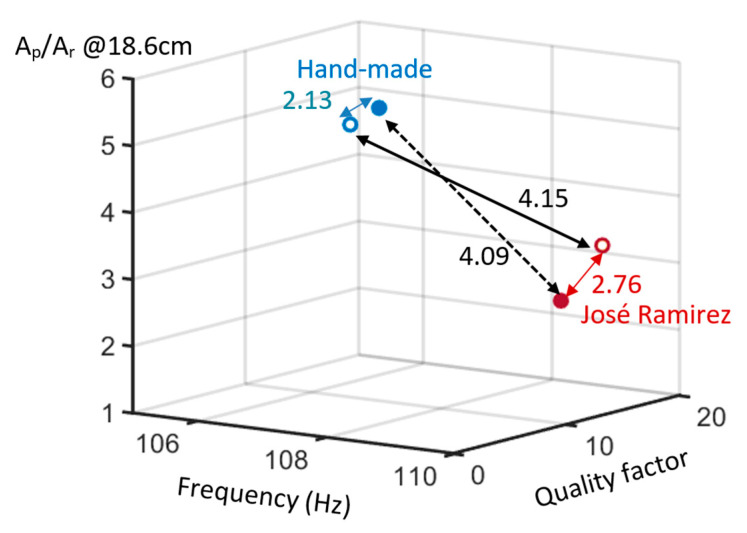 Figure 6
Peer Reviews
No public reviews on file for this paper yet. If you reviewed it on a platform where reviews are public (OpenReview, ICLR, NeurIPS, ICML), you can paste yours below so the community can read it here.
Videos
No videos yet. Explain this paper in a talk, walkthrough, or lecture? Add one.
Taxonomy
TopicsMusic Technology and Sound Studies · Music and Audio Processing · Experimental and Theoretical Physics Studies