Patient resuscitated after cardiopulmonary arrest exhibits abnormally increased phenytoin metabolic rate due to unknown factors: a case report
Ayumu Nagamine, Takuya Araki, Hideaki Yashima, Kiyohiro Oshima, Kyoko Obayashi, Koujirou Yamamoto

TL;DR
A patient who had a cardiac arrest showed unusually high metabolism of phenytoin, leading to low drug levels despite normal dosing.
Contribution
This case report identifies increased hepatic metabolic activity as a novel cause of low phenytoin plasma concentrations.
Findings
Hepatic metabolic activity of phenytoin was 4.6–6.1 times higher than normal.
The S/R ratio of a major metabolite was normal, indicating increased CYP2C9 and CYP2C19 activity.
No known factors like genetic mutations or drug interactions explained the increased metabolism.
Abstract
Fosphenytoin (FOS) is a prodrug of phenytoin (PHT) with a metabolism that exhibits Michaelis–Menten-type kinetics. Genetic polymorphisms of the metabolic enzymes of PHT make it challenging to predict its plasma concentrations. High plasma PHT concentrations are typically problematic, and several causes have been elucidated. In contrast, cases of patients with low PHT plasma concentrations that did not increase despite the administration of appropriate PHT doses have been reported, and the causes may include changes in plasma protein-binding rates, genetic mutations, and concomitant use of drugs that induce liver enzymes; however, even these factors do not explain the low PHT plasma concentrations in some cases. We encountered the case of a patient with plasma PHT concentrations that were continuously < 0.7 µg/mL after daily use of FOS for seizures that occurred after cardiopulmonary…
Genes, proteins, chemicals, diseases, species, mutations and cell lines named across the full text — each resolved to its canonical identifier and authoritative record.
Click any figure to enlarge with its caption.
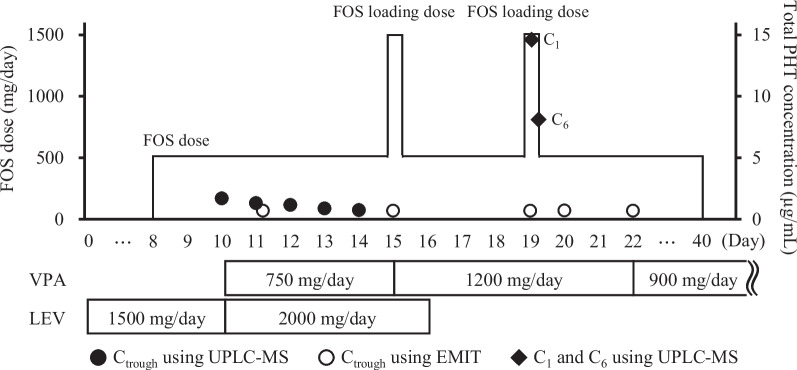 Figure 1
Peer Reviews
No public reviews on file for this paper yet. If you reviewed it on a platform where reviews are public (OpenReview, ICLR, NeurIPS, ICML), you can paste yours below so the community can read it here.
Videos
No videos yet. Explain this paper in a talk, walkthrough, or lecture? Add one.
Taxonomy
TopicsPharmacological Effects and Toxicity Studies · Epilepsy research and treatment · Antibiotics Pharmacokinetics and Efficacy