Co-designing ab initio electronic structure methods on a RISC-V vector architecture
Rogeli Grima Torres, Pablo Vizcaíno, Filippo Mantovani, José Julio Gutiérrez Moreno, William Dawson, Roman Wyrzykowski, Ahmed Kamaleldin, Flavio Vella

TL;DR
This paper explores optimizing ab initio electronic structure calculations on a RISC-V vector architecture to improve performance for high-performance computing.
Contribution
The novel contribution is the co-design approach for porting electronic structure codes to RISC-V-based platforms using a VPU.
Findings
Using intrinsics reduced vectorial instructions, executed instructions, and computing cycles compared to autovectorisation.
The study demonstrates potential for substantial speed-up in eigenvalue calculations on RISC-V architectures.
The work provides feedback for hardware and compiler development in the context of EU-developed RISC-V technologies.
Abstract
Ab initio electronic structure applications are among the most widely used in High-Performance Computing (HPC), and the eigenvalue problem is often their main computational bottleneck. This article presents our initial efforts in porting these codes to a RISC-V prototype platform leveraging a wide Vector Processing Unit (VPU). Our software tester is based on a mini-app extracted from the ELPA eigensolver library. The user-space Vehave and a RISC-V vector architecture implemented on an FPGA were tested. Metrics from both systems and different vectorisation strategies were extracted, ranging from the most simple and portable one (using autovectorisation and assisting this by fusing loops in the code) to the more complex one (using intrinsics). We observed a progressive reduction in the number of vectorial instructions, executed instructions and computing cycles with the different…
Genes, proteins, chemicals, diseases, species, mutations and cell lines named across the full text — each resolved to its canonical identifier and authoritative record.
Click any figure to enlarge with its caption.
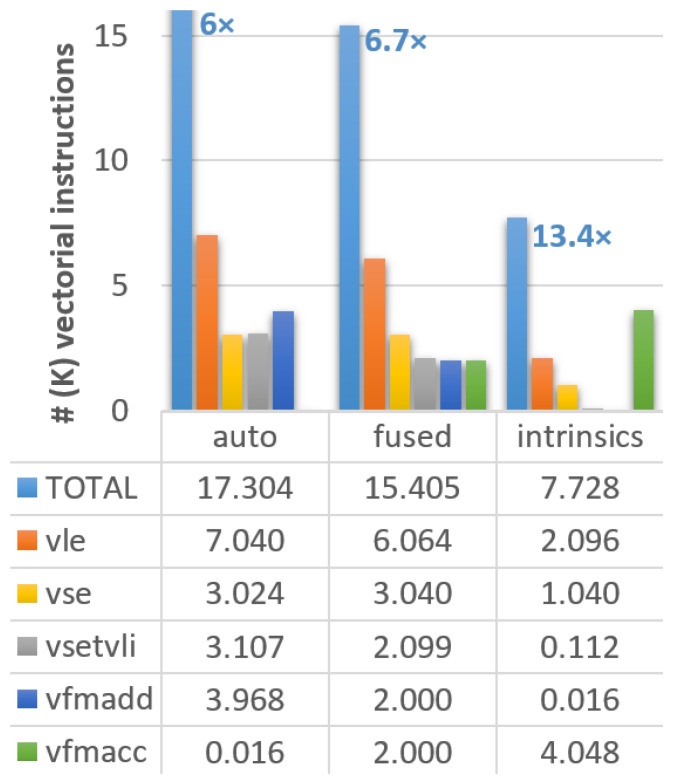 Figure 1
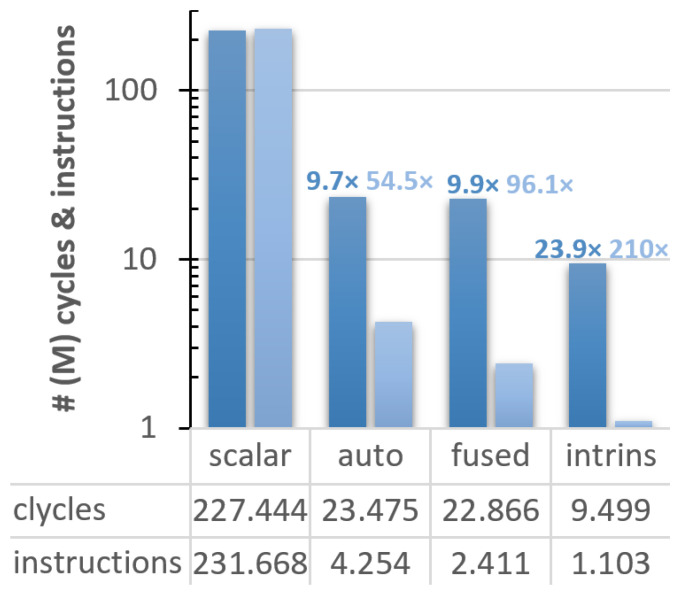 Figure 2
Peer Reviews
No public reviews on file for this paper yet. If you reviewed it on a platform where reviews are public (OpenReview, ICLR, NeurIPS, ICML), you can paste yours below so the community can read it here.
Videos
No videos yet. Explain this paper in a talk, walkthrough, or lecture? Add one.
Taxonomy
TopicsParallel Computing and Optimization Techniques · Semiconductor materials and devices · Radiation Effects in Electronics