Path analysis model to identify the effect of poor diet quality on NAFLD among Iranian adults from Amol Cohort Study
Azam Doustmohammadian, Bahareh Amirkalali, Barbora de Courten, Saeed Esfandyari, Nima Motamed, Mansooreh Maadi, Hossein Ajdarkosh, Esmaeel Gholizadeh, Samira Chaibakhsh, Farhad Zamani

TL;DR
The study explores how poor diet quality contributes to nonalcoholic fatty liver disease in Iranian adults, highlighting the role of factors like obesity and inflammation.
Contribution
A novel path analysis model reveals gender-specific indirect effects of diet quality and nutrient density on NAFLD via metabolic and inflammatory markers.
Findings
Poor diet quality is an independent predictor of NAFLD, with stronger associations in individuals with abdominal obesity.
Diet quality affects NAFLD in women and men through different metabolic pathways involving WHtR, CRP, and metabolic syndrome.
Nutrient density influences NAFLD both directly and indirectly via metabolic markers, suggesting early dietary interventions could prevent disease progression.
Abstract
Nonalcoholic fatty liver disease (NAFLD) is expanding as a global health problem with approximately 25% of the world's population affected by it. Dietary modification is one of the most important strategies for preventing NAFLD. The association between nutrient density and the Healthy Eating Index 2015 (HEI2015) with NAFLD demonstrates that nutrient density is an independent predictor of NAFLD in Iranian adults [fully adjusted model: OR (95% CI)tertile3vs.1: 0.68 (0.54–0.85), P for trend = 0.001]. However, a favorable association between NAFDL and diet quality (HEI 2015) is more pronounced in participants with abdominal obesity [fully adjusted model: OR (95% CI)tertile3vs.1: 0.63 (0.41–0.98), P for trend = 0.03]. Based on the gender-stratified path analysis, diet quality indirectly through Waist-to-Height Ratio (WHtR), C-reactive protein (CRP), and metabolic syndrome in women, and men…
Genes, proteins, chemicals, diseases, species, mutations and cell lines named across the full text — each resolved to its canonical identifier and authoritative record.
Click any figure to enlarge with its caption.
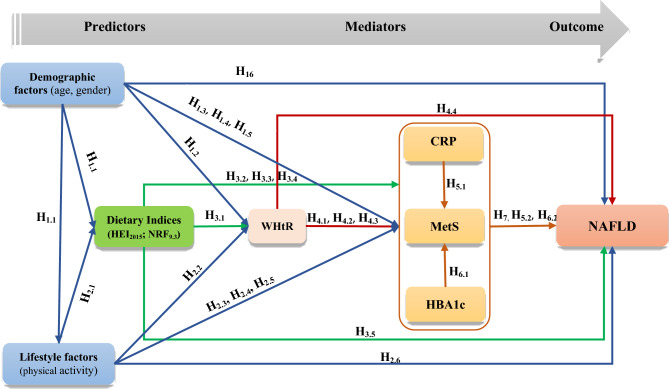 Figure 1
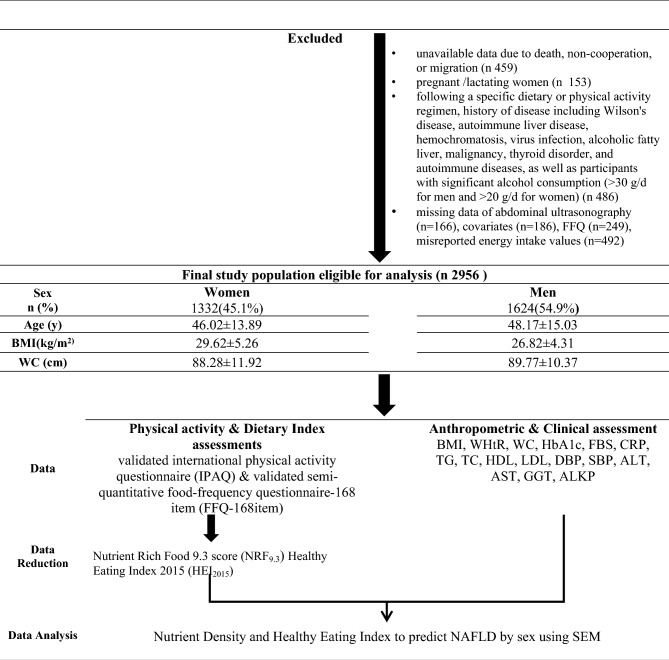 Figure 2
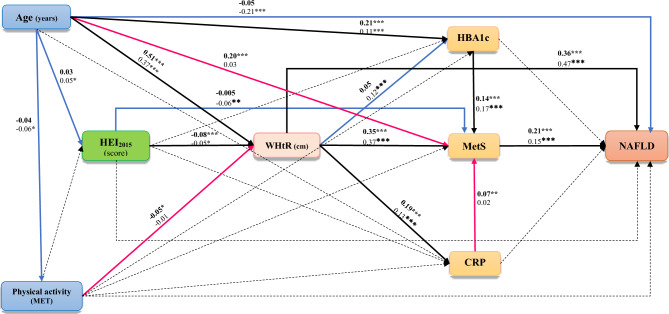 Figure 3
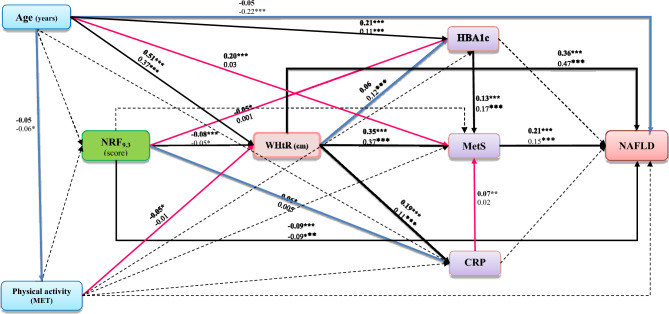 Figure 4
Peer Reviews
No public reviews on file for this paper yet. If you reviewed it on a platform where reviews are public (OpenReview, ICLR, NeurIPS, ICML), you can paste yours below so the community can read it here.
Videos
No videos yet. Explain this paper in a talk, walkthrough, or lecture? Add one.
Taxonomy
TopicsMedia and Digital Communication · Advertising and Communication Studies