Centrifugation is an effective and inexpensive way to determine Batrachochytrium dendrobatidis quantity in water samples with low turbidity
Taegan A. McMahon, Tatum S. Katz, Kate M. Barnett, Bridget A. Hilgendorff

TL;DR
A simple and affordable centrifugation method effectively measures the amount of a deadly amphibian fungus in clear water samples.
Contribution
A streamlined, cost-effective centrifugation method for quantifying Batrachochytrium dendrobatidis in low-turbidity water.
Findings
Centrifugation of water samples produced DNA concentrations highly correlated with expected Bd values.
The method is repeatable and provides a linear relationship between measured and actual Bd concentrations.
The technique is time- and cost-efficient, increasing accessibility for Bd research.
Abstract
Batrachochytrium dendrobatidis (Bd) is a pathogenic chytrid fungus that is particularly lethal for amphibians. Bd can extirpate amphibian populations within a few weeks and remain in water in the absence of amphibian hosts. Most efforts to determine Bd presence and quantity in the field have focused on sampling hosts, but these data do not give us a direct reflection of the amount of Bd in the water, which are useful for parameterizing disease models, and are not effective when hosts are absent or difficult to sample. Current methods for screening Bd presence and quantity in water are time, resource, and money intensive. Here, we developed a streamlined method for detecting Bd in water with low turbidity (e.g., water samples from laboratory experiments and relatively clear pond water from a natural lentic system). We centrifuged water samples with known amounts of Bd to form a pellet…
Genes, proteins, chemicals, diseases, species, mutations and cell lines named across the full text — each resolved to its canonical identifier and authoritative record.
Click any figure to enlarge with its caption.
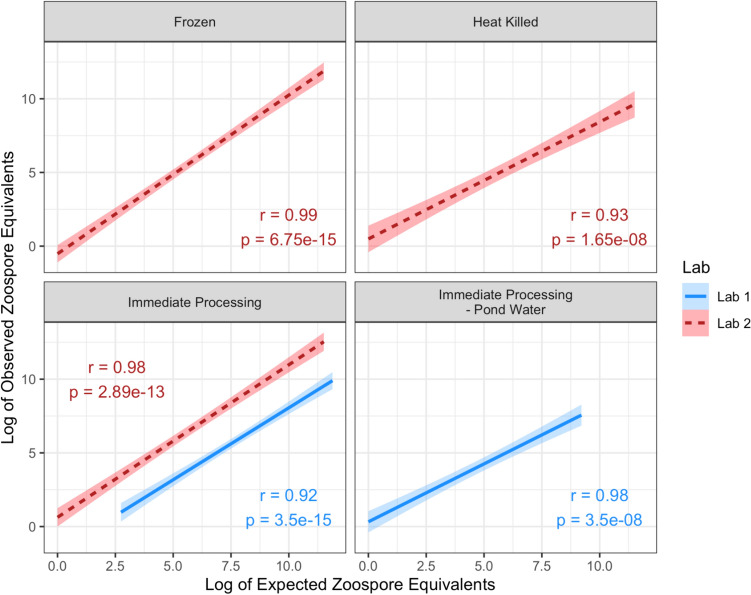 Figure 1
Peer Reviews
No public reviews on file for this paper yet. If you reviewed it on a platform where reviews are public (OpenReview, ICLR, NeurIPS, ICML), you can paste yours below so the community can read it here.
Videos
No videos yet. Explain this paper in a talk, walkthrough, or lecture? Add one.
Taxonomy
TopicsAmphibian and Reptile Biology · Turtle Biology and Conservation · Environmental DNA in Biodiversity Studies