A rare presentation of cardiac and hepatic hydatid cysts in a young female: a case report
Yerkhanat Khuanbai, Bagdat Alataev, Yermagambet Kuatbayev, Nurzhan Bikhanov

TL;DR
A young woman from Kazakhstan had rare heart and liver hydatid cysts caused by a tapeworm, treated with surgery and medication.
Contribution
This case report highlights the rare cardiac and hepatic involvement of hydatid disease in a young female.
Findings
The patient had a hydatid cyst in the left ventricle of the heart and the left lobe of the liver.
Surgical resection and albendazole treatment were effective in managing the condition.
Abstract
Hydatid disease is an endemic parasitic infection caused by the larval stages of the tapeworm Echinococcus. It is highly endemic in Kazakhstan, with both Echinococcus granulosus and Echinococcus multilocularis widely distributed throughout the country. Hydatid disease can affect almost any organ in the body, with the liver and lung being the most common sites, while cardiac involvement is rare. We report a case of a young female presenting with a 1-year history of stabbing precordial pain, shortness of breath, and weakness. She had a hydatid cyst involving the myocardium of the left ventricle and the left lobe of the liver. The patient underwent surgical resection and received albendazole medication as part of the treatment regimen.
Genes, proteins, chemicals, diseases, species, mutations and cell lines named across the full text — each resolved to its canonical identifier and authoritative record.
Click any figure to enlarge with its caption.
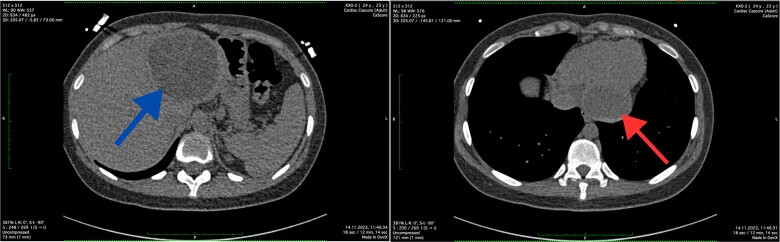 Figure 1
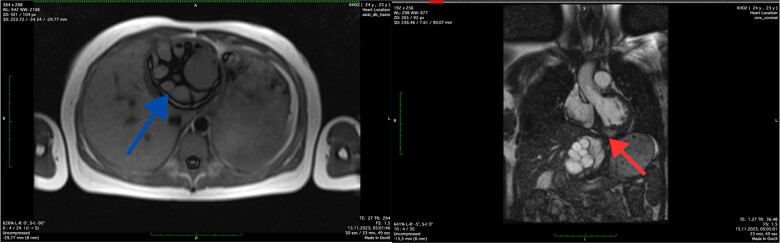 Figure 2
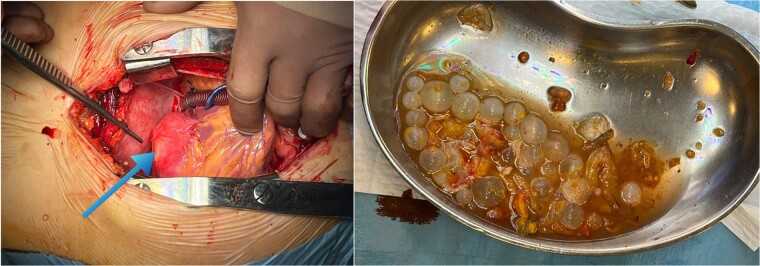 Figure 3
Peer Reviews
No public reviews on file for this paper yet. If you reviewed it on a platform where reviews are public (OpenReview, ICLR, NeurIPS, ICML), you can paste yours below so the community can read it here.
Videos
No videos yet. Explain this paper in a talk, walkthrough, or lecture? Add one.
Taxonomy
TopicsParasitic infections in humans and animals · Congenital Anomalies and Fetal Surgery · Parasite Biology and Host Interactions