Low-Temperature Fabrication of BiFeO3 Films on Aluminum Foils under a N2-Rich Atmosphere
Jing Yan

TL;DR
Researchers developed a method to create high-performance ferroelectric films at low temperatures using aluminum foils and a nitrogen-rich atmosphere.
Contribution
A novel low-temperature fabrication process for BiFeO3 films under a N2-rich atmosphere is introduced.
Findings
BiFeO3 films showed high remnant polarization and rectangularity under a N2-rich atmosphere at low temperatures.
The films retained excellent charge and fatigue resistance after extensive switching cycles.
Acceptable electrical properties were achieved at an annealing temperature as low as 365 °C.
Abstract
To be CMOS-compatible, a low preparation temperature (<500 °C) for ferroelectric films is required. In this study, BiFeO3 films were successfully fabricated at a low annealing temperature (<450 °C) on aluminum foils by a metal–organic decomposition process. The effect of the annealing atmosphere on the performance of BiFeO3 films was assessed at 440 ± 5 °C. By using a N2-rich atmosphere, a large remnant polarization (Pr~78.1 μC/cm2 @ 1165.2 kV/cm), and a high rectangularity (~91.3% @ 1165.2 kV/cm) of the P-E loop, excellent charge-retaining ability of up to 1.0 × 10³ s and outstanding fatigue resistance after 1.0 × 10⁹ switching cycles could be observed. By adopting a N2-rich atmosphere and aluminum foil substrates, acceptable electrical properties (Pr~70 μC/cm2 @ 1118.1 kV/cm) of the BiFeO3 films were achieved at the very low annealing temperature of 365 ± 5 °C. These results offer a…
Genes, proteins, chemicals, diseases, species, mutations and cell lines named across the full text — each resolved to its canonical identifier and authoritative record.
Click any figure to enlarge with its caption.
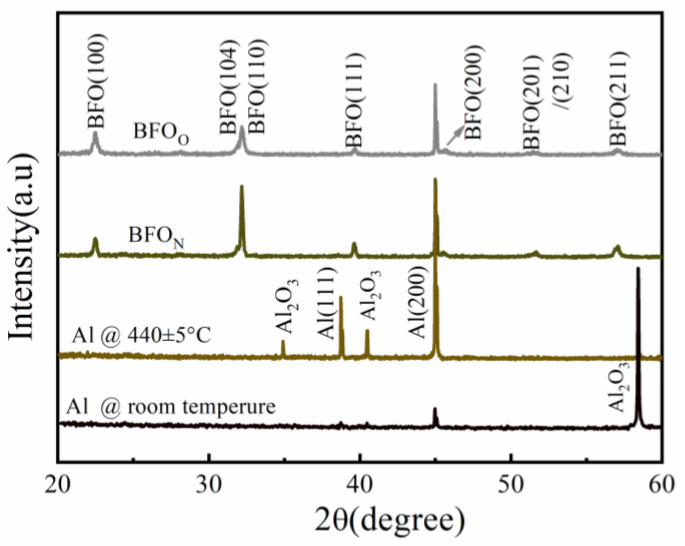 Figure 1
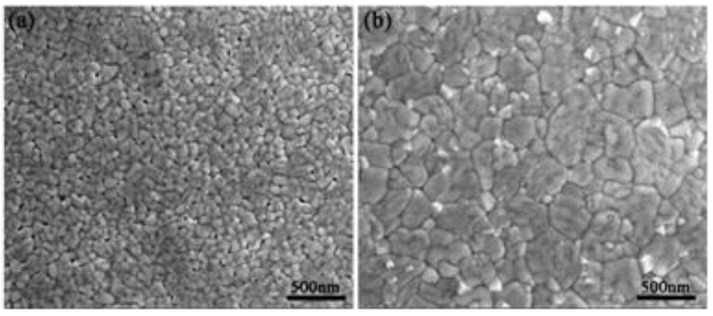 Figure 2
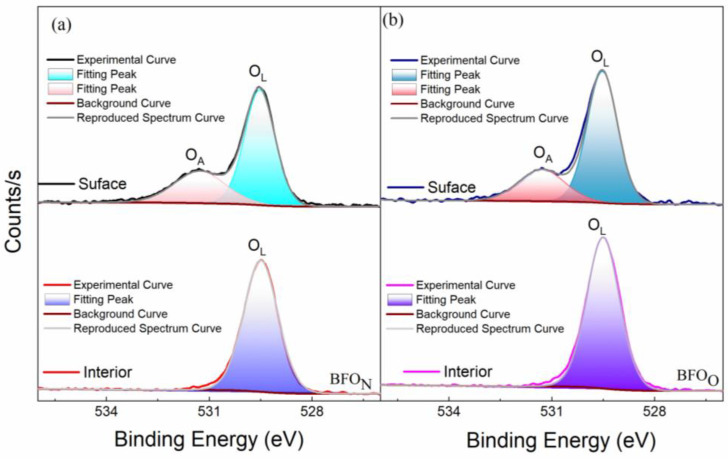 Figure 3
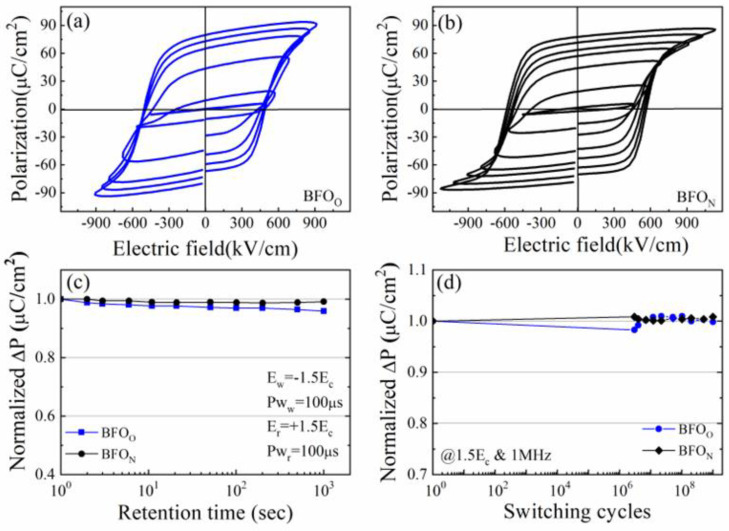 Figure 4
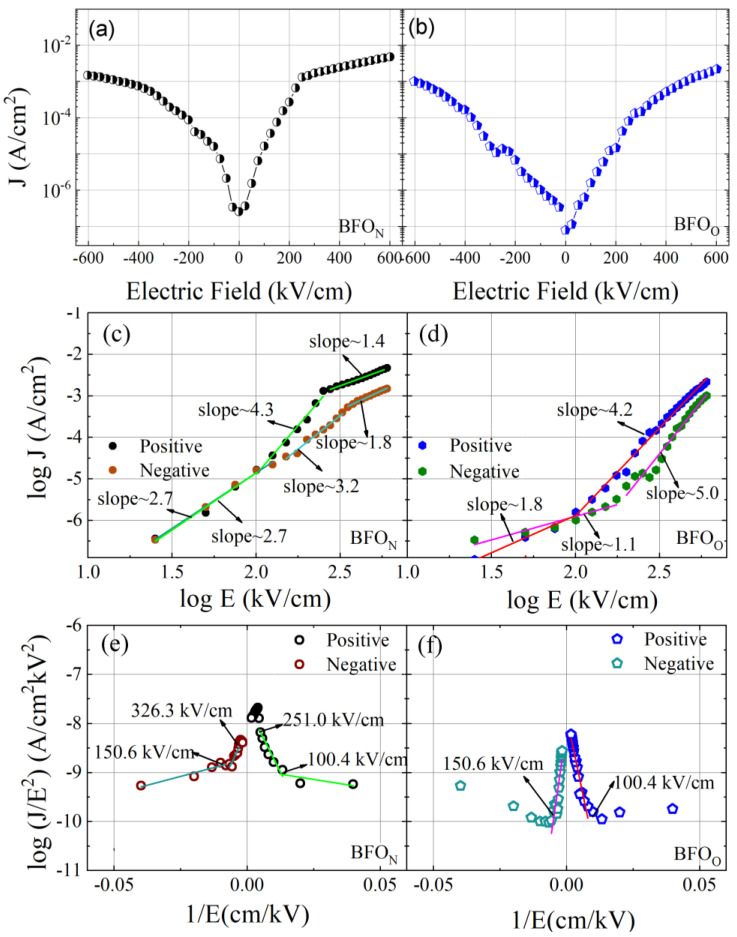 Figure 5
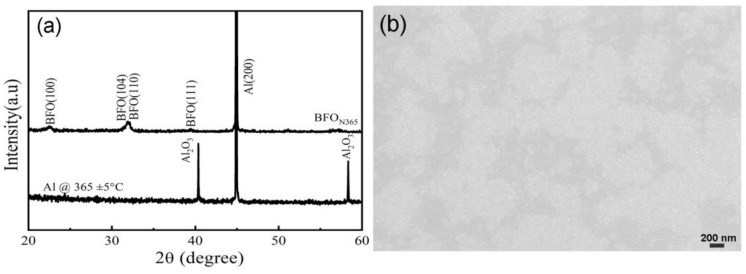 Figure 6
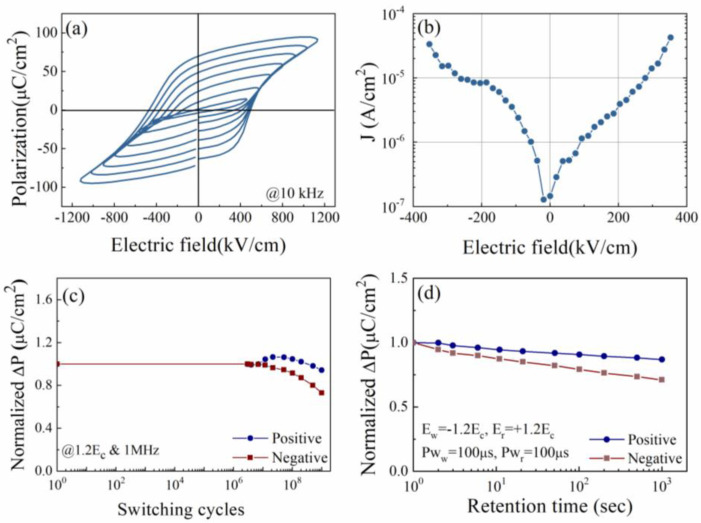 Figure 7
- —Natural Science Foundation of Shandong Province
Peer Reviews
No public reviews on file for this paper yet. If you reviewed it on a platform where reviews are public (OpenReview, ICLR, NeurIPS, ICML), you can paste yours below so the community can read it here.
Videos
No videos yet. Explain this paper in a talk, walkthrough, or lecture? Add one.
Taxonomy
TopicsMultiferroics and related materials · Ferroelectric and Piezoelectric Materials · Dielectric properties of ceramics
1. Introduction
BiFeO_3_ (BFO) has been extensively investigated as a promising multiferroic material in recent years [1,2,3,4,5,6,7,8]. Studies have reported various approaches for enhancing the ferroelectric properties of BFO films, such as by introducing buffer layers, doping the isovalent or aliovalent ions, and domain engineering [9,10,11,12,13,14,15,16,17]. However, obtaining P-E hysteresis loops with high rectangularity in polycrystalline BFO films using chemical solution deposition methods remains a challenge, especially under low annealing temperatures (<500 °C). Most efforts have focused on improving the quality of BFO films [9,10,11,12,13,14,15,16,17,18,19]; however, few studies have focused on the bottom electrode as well as the interface between the bottom electrode and the film, even though these factors remain equally important. In general, obtaining the desired contact at the interface between the traditional substrate (such as Si) and the film may be difficult to achieve due to slight thermal deformations during the low-temperature (<500 °C) annealing treatment. Recently, Kingon et al. successfully obtained high-quality Pb(Zr_0.52_Ti_0.48_)O_3_ films directly on base metal copper foils, providing a new strategy for choosing base metal foils as the bottom electrodes [20]. As a common base metal, aluminum (Al) foil may serve as an alternative electrode for BFO ferroelectric films as Al_2_O_3_ can readily form a very dense, stable, and extremely thin (~5 nm) layer. This may effectively reduce the leakage current and lower the risk of breakdown. Furthermore, the thermal expansion coefficient of Al (23.8 × 10^−6^/°C) [21] is much higher than that of Si (3.6 × 10^−6^/°C) [22]; thus, a tight contact interface between the BFO film and the Al substrate can be expected, even at a low annealing temperature. In this work, aluminum foils were adopted as substrates for the preparation of BFO films using the metal–organic decomposition (MOD) method. High temperatures often cause serious problems, including interdiffusion, charged defects, phase decomposition, and valence fluctuations, and these issues can damage a film’s electrical properties and performance stability [23]. To enhance the performance of BFO films and to provide complementary metal oxide semiconductor (CMOS) compatibility, a low processing temperature below 500 °C was required. The effects of annealing atmospheres on the properties of BFO films on Al substrates were discussed, and it was found that a N_2_-rich atmosphere could facilitate the crystallization of BFO films and thus lower the annealing temperature. Therefore, low-temperature preparation of BFO films was attempted. By adopting a N_2_-rich atmosphere and aluminum foil substrates, adequate ferroelectric properties (P_r_~70 μC/cm^2^ @ 1118.1 kV/cm) were obtained at a very low annealing temperature of 365 ± 5 °C.
2. Materials and Methods
BFO films (~800 nm) were fabricated on mirror aluminum foils (surface roughness ~0.02 ± 0.005 μm; thickness ~0.3 mm; size 10 mm × 10 mm) using the MOD process. The precursor solution was prepared by dissolving bismuth nitrate and iron nitrate in acetic acid and ethylene glycol according to the stoichiometric ratio (All the chemical reagents were purchased from Sinopharm Chemical Reagent, Shanhai, China). Excess 5 mol% bismuth was used to compensate for the volatilization of Bi_2_O_3_. The ratio of acetic acid and ethylene glycol was 3:1, and the solution concentration was 0.1 mol/L. The films were deposited onto the Al foils by spin-coating and then annealed layer by layer for 10 min at 365440 ± 5 °C in N_2_-rich (BFO_N_) or O_2_-rich (BFO_O_) atmospheres (during the annealing process, N_2_ or O_2_ was introduced at a rate of 1.5 sccm). Each layer of film was deposited onto the substrate by spin-coating at 4000 rpm for 30 s. Au top electrodes were deposited onto the films using a sputtering system through a shadow mask with a diameter of 0.2 mm. Crystallographic characteristics of BFO films were analyzed by using standard X-ray diffraction (XRD) 2θ-scans in a Dmax-2500PC diffractometer (Rigaku, Tokyo, Japan) equipped with a Ni-filtered Cu-Kα radiation source (λ = 1.54184 Å). Surface morphologies were characterized using a SU-70 thermal field-emission scanning electron microscope (SEM) (Hitachi, Tokyo, Japan). The chemical bonding states of the constituent elements were analyzed using a Thermo Scientific™ K-Alpha™ (hν = 1486.6 eV) X-ray Photoelectron Spectrometer (Thermo Fisher Scientific, Waltham, MA, USA). The energy resolution and the spatial resolution of the spectrometer were 0.5 eV and 50 μm, respectively. A Precision Premium II ferroelectric tester (maximum voltage of 99.9 V, Radiant Technology, Albuquerque, NM, USA) was adopted to measure the ferroelectric properties and leakage currents. The soaking time was 500 ms during the leakage test under the unswitched linear mode.
3. Results and Discussion
3.1. Performance of BiFeO3 Annealed at 440 ± 5 °C under Different Atmospheres
3.1.1. Microstructure Analysis
The polycrystalline perovskite structures with a bulk-like rhombohedral phase were obtained in both the BFO_N_ and BFO_O_ films at 440 ± 5 °C [23], as shown in Figure 1. No secondary phase was observed. This demonstrated that the Al foil was a suitable substrate material for the preparation of BFO films. The global average grain size calculated via the Scherrer formula for the BFO_N_ and BFO_O_ films are shown in Table 1. The grain size of the BFO_N_ film was larger than that of the BFO_O_ film. The local average grain sizes via SEM analysis (Figure 2, from a statistical analysis of 100 grains via the Nano Measurer 1.2.5 software) are also shown in Table 1. The similar results indicate that a reduced atmosphere can facilitate grain growth. The difference between the global average grain size and the local grain size may be related to the grain size nonuniformity.
Figure 2 shows the surface morphologies of the BFO films. A compact surface and larger grains were observed in the BFO_N_ films compared with the BFO_O_ films at 440 ± 5 °C, possibly due to the higher content of oxygen vacancies under a reducing atmosphere than that in an O_2_-rich atmosphere. Reports have demonstrated that oxygen vacancies can facilitate the diffusion of ions during the annealing process [24]. As shown in Figure 2b, the BFO_N_ film was mainly composed of large block-like grains, which could be ascribed to the presence of the grain merger phenomenon during the grain growth process. Notably, the observed white fine grains on the surface of the BFO_N_ film may be Bi_2_O_3_ grains, because the relatively high content of oxygen vacancies in the BFO_N_ film possibly accelerated the diffusion of Bi_2_O_3_. As a result, significantly more Bi_2_O_3_ potentially migrated from the interior to the surface. From Figure 2a, a granular surface morphology with uniform small grains were observed in the BFO_O_ film. Obvious voids were located at the grain boundaries, deteriorating the densification of the BFO_O_ film and its electrical properties.
The X-ray photoelectron spectroscopy (XPS) spectrum of O1s core levels of the BFO_O_ and BFO_N_ thin films are shown in Figure 3. A strong peak at ~529.5 eV was observed for the BFO_O_ and BFO_N_ thin films, which corresponds to oxygen in the perovskite lattice (O_L_). The peak at ~531.2 eV is the surface-absorbed oxygen (O_A_) [23]. To verify this, the surface of the BFO_O_ and BFO_N_ films were etched to a thickness of ~3 nm. No peaks could be obtained at ~531.2 eV at the interior of the BFO_O_ and BFO_N_ thin films. Furthermore, no obvious oxygen vacancy peak was observed in the BFO films, which may be related to the low number of oxygen vacancies in BFO films annealing in a rapid thermal annealing furnace in air.
3.1.2. Room-Temperature Electrical Properties
Figure 4 shows the electrical properties of BFO_O_ and BFO_N_ films at 440 ± 5 °C. Figure 4a,b present the typical P-E loops of the BiFeO_3_ films. When the applied electric field was sufficiently large, well-formed rectangular-shaped, saturated P-E hysteresis loops were observed in the BFO_N_ and BFO_O_ films. A large remanent polarization (P_r_~78.1 μC/cm^2^) and high rectangularity (~91.3%) of the hysteresis loop were observed in the BFO_N_ film at the applied electric field of 1165.2 kV/cm. A high remanent polarization (P_r_~79.6 μC/cm^2^) and good rectangularity (~86.8%) of the hysteresis loop were observed in the BFO_O_ film at the applied electric field of 915.4 kV/cm. Compared with the BFO_N_ film, the P-E loops of the BFO_O_ film displayed a somewhat roundish shape, indicating contributions from the leakage current induced by the voids, and more grain boundaries [25]. The normalized pulsed polarization (ΔP = P* (switched polarization) − Pˆ (nonswitched polarization), their retention time, and switching cycles are shown in Figure 4c,d. Both the BFO_N_ and BFO_O_ films exhibited good charge-retaining ability for up to 1.0 × 10^3^ s. The improved charge-retaining ability (~1% loss) of the BFO_N_ film compared with that (~4% loss) for the BFO_O_ film was attributed to the reduced domain backswitching induced by the grain boundary defects and voids in the former compared with the latter [25]. As shown in Figure 4d, good fatigue resistance of up to 1.0 × 10^9^ switching cycles was observed in both the BFO_N_ and BFO_O_ films, which could be attributed to the improved interface from using Al substrates as well as the low oxygen vacancies, as discussed in Figure 3.
Leakage performances for the BFO_O_ and BFO_N_ films are shown in Figure 5; the soaking time was 500 ms during the leakage test under the unswitched linear mode [26]. From Figure 5a,b, we can see that the leakage current density (J) of the BFO_N_ film was slightly higher than 1-fold that of BFO_O_ film but less than 2-fold, which can be ascribed to the slightly lower oxygen vacancy concentration in the BFO_O_ film, as discussed in Figure 3. To clarify the dominant leakage mechanism involved in BFO films, linear fittings of the leakage behavior are shown in Figure 5c–f based on leakage mechanism formulas [27]. From Figure 5c,e, the Fowler–Nordheim tunneling (FN tunneling) [ln (J/E^2^)∝1/E] mechanism is induced by the interface electrons activated into the conduction band by the tunneling involved in the BFO_N_ film under the positive electric field (<251.0 kV/cm) [28,29]. The FN tunneling mechanism observed at the low electric field may be related to the good crystallization of the BFO_N_ film. The Ohmic conduction mechanism (log J∝log E) can be observed at a high electric field (>251.0 kV/cm), which should be related to the free oxygen vacancies in the film under the positive electric field. With an increasing electric field, the electrons transitioning from the interface to the body may form defect complexes with oxygen vacancies. The formation of defect complexes suppresses the electron transition from the interface to the conduction band and changes the leakage mechanism [30]. In a negative electric field, the FN tunneling mechanism (<326.3 kV/cm) and space-charge-limited conduction (SCLC) (log J∝2log E) were involved in the leakage behavior of the BFO_N_ film. From Figure 5d,f, the SCLC mechanism (<100.4 kV/cm) and the FN tunneling mechanism (>100.4 kV/cm) were predominant under a positive electric field. The Ohmic conduction mechanism (<150.6 kV/cm) and FN tunneling mechanism (>150.6 kV/cm) can be observed under the negative electric field.
According to the above discussion, it can be concluded that by adopting a N_2_-rich atmosphere, improved crystalline quality could be achieved in the BFO films at 440 ± 5 °C, resulting in better ferroelectric properties. Furthermore, a lower annealing temperature was expected for the BiFeO_3_ films with Al substrates and a N_2_-rich atmosphere. Therefore, an attempt was made to fabricate the BFO films below the annealing temperature of 400 °C. Finally, BFO films with adequate electric properties were achieved a low temperature of 365 ± 5 °C (BFO_N365_) on Al substrates under a N_2_-rich atmosphere. The detailed properties of the BFO_N365_ film are shown in Figure 6 and Figure 7.
3.2. Performance of BiFeO3 Films Annealed at 365 ± 5 °C under a N2-Rich Atmospheres
3.2.1. Microstructure Analysis
The XRD 2θ-scan pattern and surface SEM image of the BFO_N365_ film are shown in Figure 6. A bulk-like random polycrystalline structure with obvious (100) and (110)/(104) peaks was observed, indicating that the BFO films were crystallized even at a low annealing temperature of 365 ± 5 °C. A dense morphology with fine nanograins was clearly revealed, indicating that the film had crystallized at this low annealing temperature.
3.2.2. Room-Temperature Electrical Properties
Typical P-E loops were observed in Figure 7a for the BFO_N365_ film, and a sizable remnant polarization (P_r_~70 μC/cm^2^) and good rectangularity (~75.0%) of the hysteresis loop at the applied electric field of 1118.1 kV/cm were obtained. These observations indicate that Al foil serves as a suitable substrate for fabricating ferroelectric BiFeO_3_ films under low annealing temperatures. As shown in Figure 7b, the leakage current density of BFO_N365_ was lower than ~1 × 10^−4^ A/cm^2^ under the electric field of 353.5 kV/cm. Figure 7c,d illustrates that good fatigue resistance with a low loss (~5.8%) of up to 1.0 × 10^9^ switching cycles for positive polarization was observed, and the loss for negative polarization under the same testing conditions was ~27%. Retention testing was carried out for BFO_N365_ films; a degradation of ~29% for the negative polarization was observed after 1.0 × 10^3^ s, which is much higher than that for the positive polarization (~14%). The improved fatigue and retention performance at the positive side could be ascribed to the reduced interfacial defects (e.g., vacancies, grain boundaries or amorphous regions) at the bottom electrode after a long exposure to a processing temperature. The achieved ferroelectric characteristics of a BFO film directly deposited onto the substrate without a buffer layer under the temperature of 400 °C have not previously been reported. This was attributed to the N_2_-rich atmosphere, the Al foil substrate, as well as the homogeneous precursor solution.
4. Conclusions
In summary, BFO films were successfully fabricated at a low annealing temperature (<450 °C). A common base metal, aluminum foil, was adopted as the bottom electrode and substrate for the BFO ferroelectric film. Compared with an oxygen-rich atmosphere, a nitrogen-rich atmosphere was more conducive to optimizing the performance of BFO films. Along with excellent retention and fatigue properties, P-E loops with a large P_r_ value (~78.1 μC/cm^2^) and high rectangularity (~91.3%) at the applied electric field of 1165.2 kV/cm were obtained in the BFO films deposited under a N_2_-rich atmosphere at 440 ± 5 °C. By using a N_2_-rich atmosphere as well as Al substrates, BFO films with good electrical properties were achieved a very low temperature of 365 ± 5 °C. This offers a new strategy for lowering the annealing temperature of BFO films.
The reference list from the paper itself. Each links out to its DOI / PubMed record.
- 1Wu J. Wang J. Orientation dependence of ferroelectric behavior of Bi Fe O 3 thin films J. Appl. Phys.200910610411110.1063/1.3261841 · doi ↗
- 2Yan J. Ouyang J. Cheng H.B. Yan P. Low temperature deposition of Bi Fe O 3 films on Ti foils for piezoelectric applications Scr. Mater.202120411415210.1016/j.scriptamat.2021.114152 · doi ↗
- 3Wang J. Neaton J.B. Zheng H. Nagarajan V. Ogale S.B. Liu B. Viehland D. Vaithyanathan V. Schlom D.G. Waghmare U.V. Epitaxial Bi Fe O 3 multiferroic thin film heterostructures Science 20032991719172210.1126/science.108061512637741 · doi ↗ · pubmed ↗
- 4Wu J.G. Fan Z. Xiao D.Q. Zhu J.G. Wang J. Multiferroic bismuth ferrite-based materials for multifunctional applications: Ceramic bulks, thin films and nanostructures Prog. Mater. Sci.20168433540210.1016/j.pmatsci.2016.09.001 · doi ↗
- 5Yang B.B. Jin L.H. Wei R.H. Tang X.W. Hu L. Tong P. Yang J. Song W.H. Dai J.M. Zhu X.B. Chemical solution route for high-quality multiferroic Bi Fe O 3 thin films Small 202117190366310.1002/smll.20190366331729163 · doi ↗ · pubmed ↗
- 6Catalan G. Scott J.F. Physics and applications of bismuth ferrite Adv. Mater.2010212463248510.1002/adma.200802849 · doi ↗
- 7Zhu H.F. Yang Y.L. Ren W. Niu M.M. Hu W. Ma H.F. Ouyang J. Rhombohedral Bi Fe O 3 thick films integrated on Si with a giant electric polarization and prominent piezoelectricity Acta Mater.202020030531410.1016/j.actamat.2020.09.022 · doi ↗
- 8Tomczyk M. Bretos I. Jiménez R. Mahajan A. Ramana E.V. Calzada M.L. Vilarinho P.M. Direct fabrication of Bi Fe O 3 thin films on polyimide substrates for flexible electronics J. Mater. Chem. C 20175125291253710.1039/C 7TC 04571 A · doi ↗