Chain Extension of Piperazine in Ethanol: Synthesis of 2-(4-(2-(Phenylthio)ethyl)piperazinyl)acetonitriles and ACAT-1 Inhibitors
Ying Huang, Tingyu Zhu, Yinghua Li, Deguang Huang

TL;DR
A new method for synthesizing acetonitriles using ethanol and less-odor disulfides is developed, leading to effective ACAT-1 inhibitors.
Contribution
A novel, efficient, and environmentally friendly synthesis method for ACAT-1 inhibitors using ethanol and less-odor disulfides.
Findings
The three-component reaction proceeds via an SN2 mechanism.
The synthesized compounds show good activity for ACAT-1 inhibition.
The method uses ethanol and less-odor disulfides with a simple purification process.
Abstract
A base-induced synthesis of 2-(4-(2-(phenylthio)ethyl)piperazinyl) acetonitriles by reaction of disulfides, 1-(chloromethyl)-4-aza-1-azonia bicyclo[2.2.2]octane chloride and trimethylsilyl cyanide is reported. The scope of the method is demonstrated with 30 examples. The reaction mechanism research indicates that the three-component reaction would be a SN2 reaction. The products exhibit good activities towards advanced synthesis of aqueous soluble acyl-CoA: cholesterol O-acyltransferase-1 (ACAT-1) inhibitors. Our work is superior as it uses less-odor disulfides as carbon sources and EtOH as solvent in a water and dioxygen insensitive reaction system, followed by a simple purification process.
Genes, proteins, chemicals, diseases, species, mutations and cell lines named across the full text — each resolved to its canonical identifier and authoritative record.
Click any figure to enlarge with its caption.
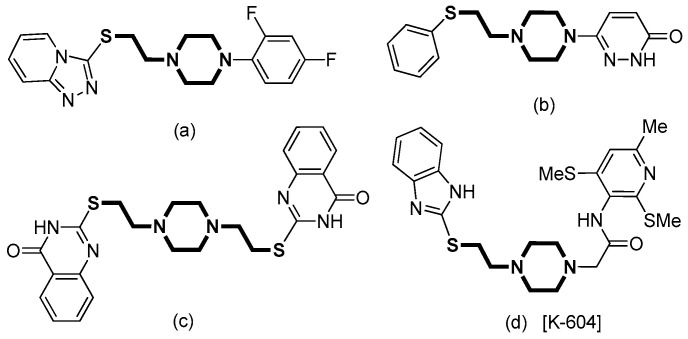 Figure 1
- —National Natural Science Foundation of China
- —Natural Science Foundation of Fujian Province
Peer Reviews
No public reviews on file for this paper yet. If you reviewed it on a platform where reviews are public (OpenReview, ICLR, NeurIPS, ICML), you can paste yours below so the community can read it here.
Videos
No videos yet. Explain this paper in a talk, walkthrough, or lecture? Add one.
Taxonomy
TopicsCholesterol and Lipid Metabolism · Eicosanoids and Hypertension Pharmacology · Pharmacogenetics and Drug Metabolism
1. Introduction
The incorporation of piperazine into medicinal molecules is proved effective in the increase in aqueous solubility and therefore in the improvement of oral absorption and bioavailability. It is of high importance in medication safety for further development of clinical candidates. Sulfur-containing ethyl piperazine compounds and their derivatives (Figure 1) are important building blocks in pharmaceuticals. Their biochemical activities were discovered and explored in the treatment of cancer [1], glioblastoma [2,3], atherosclerosis [4], anxiety neurosis [5] and the reduction of blood pressure [6]. The 2-mercaptobenzimidazole bound ethyl piperazine is recognized as a targeting moiety for the structural accommodation of 2-(4-(2-((1H-Benzo[d]imidazol-2-yl)thio)-ethyl)piperazin-1-yl)-N-(6-methyl-2,4-bis(methylthio)-pyridin-3-yl)acetamide hydrochloride [K-604], an acyl-CoA: cholesterol O-acyltransferase-1 (ACAT-1) inhibitor (Figure 1d). The enzymes catalyze cholesterol esterification with acylcoenzyme A [7]. They have received attention as promising drug targets for the treatment of diseases such as hyperlipidemia [8], neurodegenerative disease [9,10,11,12,13,14], cancer [15,16], leukemia [17], and bleomycin-induced lung injury [18].
Sulfur-containing ethyl piperazine compounds were originally obtained by introducing thiol groups on the side chain of the 4-substituted 1-(2-chloroethyl)piperazine or 1-(2-hydroxyethyl) piperazine via nucleophilic substitution reactions [8,19,20,21,22] (Scheme 1). A ring-opening method was developed using cyclic tertiary amines as the ethyl piperazine source enabled by the incorporation of thiolates through facile C-N bond cleavage. Reaction of aromatic halogenated compounds with triethylenediamine (DABCO) in the presence of Na_2_S as the sulfur source at 120 °C afforded the products 1-(2-(pyridin-2-yl)ethyl)-4-(pyridin-2-yl)piperazines in considerable yields [23] (Scheme 1b). Similar products were obtained by reaction of either o-silyl aryl triflates or pyridine-N-oxides with thiolates in the presence of CsF or trifluoroacetic anhydride as the activating agent, respectively [24,25]. The method was extended using 1-alkyl group bound 4-aza-1-azoniabicyclo[2.2.2]octane as the ethyl piperazine source under alkaline conditions [26,27,28,29]. Although significant advances have been made, the synthesis of sulfur-containing ethyl piperazine compounds is of interest to scientists. Up to now, almost all the works concerning the building of the sulfur-containing ethyl piperazine skeleton have said that the C-N bond cleavage of the cyclic tertiary amines was achieved in two steps: quaternization first, ring-opening second. Synthesis of the sulfur-containing ethyl piperazine compound by a SN2 reaction was rarely reported.
Representative bioactive sulfur-containing ethyl piperazine compounds (a) [23], (b) [6], (c) [1], and (d) [8,20].
To date, there are mainly two routes to prepare the sulfur-containing ethyl piperazine compound [K-604] and its derivatives [8,20,30,31,32] (Scheme 2). The non-tertiary amine 1-(2-hydroxyethyl)piperazine was employed as the starting material in the routes, and the target product was prepared by multi-step reactions. Interestingly, the tertiary amine 4-aza-1-azoniabicyclo[2.2.2]octane has not been used for the synthesis of ACAT-1 inhibitors. Therefore, we report here a simple and eco-friendly method for the synthesis of various 2-(4-(2-(phenylthio)ethyl)piperazinyl)acetonitriles (2) by a three-component SN2 disubstitution reaction, using 1-(chloromethyl)-4-aza-1-azonia bicyclo[2.2.2]octane chloride (CAABC) as the ethyl piperazine source, disulfide as the thiol source, trimethylsilyl cyanide (TMSCN) as the cyanide source, and EtOH as the solvent. The products were easily obtained by a simple purification process. They can be applied to the preparation of [K-604] and its derivatives in two steps.
2. Results and Discussion
Reaction of diphenyl disulfide (1a, 0.1 mmol), CAABC (0.2 mmol), TMSCN (0.22 mmol) and Cs_2_CO_3_ (0.6 mmol) under air atmosphere in EtOH (1 mL) for 3 h at 100 °C provided the product 2-(4-(2-(phenylthio)ethyl)piperazinyl)acetonitrile (2a) in 90% yield (based on diphenyl disulfide, Table 1, entry 1). Other alkali salts, such as K_2_CO_3_, Na_2_CO_3_, KOH, and *^t^*BuOK, afforded the product in lower yields (entries 2–5). The addition of a trace of water had little effect on production, but a greater amount of water (7:3) would lead to the generation of 2a in a lower yield (entry 6). Only a trace of product could be found when the reaction was performed in a clear aqueous solution (entry 7). The use of MeOH as the solvent provided 2a in 75% yield (entry 8). With other polar solvents, such as DMF and DMSO, no corresponding product could be obtained (entries 9 and 10). Higher temperature would not help to improve the yield, while a lower temperature would decrease the reaction (entries 11 and 12). A period of 3 h would be enough for the completeness of the reaction. A longer or shorter time is of no advantage to the reaction (entries 13 and 14).
At the optimized conditions, the scope of the substrates was investigated for the production of 2 (Figure 2). Thirty compounds were prepared in terms of the electronic effect and steric effect of the functional groups on the substrates. It was found that both the electron-donating groups and the electron-withdrawing groups on the benzene ring of diphenyl sulfides would lead to the reduction of yields. By contrast, the electron-donating groups (2b–2d) might have a larger effect than the electron-withdrawing groups (2e–2g), except for the strong electron-withdrawing groups CF_3_ by which the yield decreased dramatically, down to 61%. This inference was consistent with the experimental results obtained from the comparison of compounds 2i and 2j with 2k–2m, and 2n and 2o with 2p–2r. The influence of steric hindrance on the reaction was studied by the employment of methoxyl-(2b, 2i and 2n), methyl-(2d, 2j and 2o), Br-(2e, 2k and 2p), Cl-(2f, 2l and 2q), and F-(2g, 2m and 2r) groups at the para, meta, and ortho positions of the benzene rings. The results showed that the steric effect had little impact on the production of the target products. It was in accordance with the reaction of the disubstituted diphenyl disulfide under the same conditions (2s–2u, 74–78%). Our reaction exhibited good compatibility with other cyclic thiol sources, such as 2-naphthalenethiol (2v), 2-mercaptopyridine (2w), thiophenethiol (2x), 2-methyl-3-furanthiol (2y), 2-benzothiazolethiol (2z), 2-benzoxazolethiol (2aa), and 2-mercaptobenzimidazole (2ab). The corresponding products were obtained in yields of 57–84%. In addition, the reaction of n-hexyl disulfide (2ac) or diphenyl diselenide (2ad) under the standard conditions also produced the desired products in yields of 51% and 80%, respectively. These results implicate a relatively broad range of substrates in our reaction. In addition, the synthetic utility of reaction was checked by performing the experiments on the gram scale. The reaction of diphenyl disulfide (1a) and CAABC on a 1.5 g scale produced compound 2a in 90% yield (Supporting Information, Section S2.4), which implies that the amount of the starting material did not directly influence the quality of reaction, and our reaction was suitable for the production of sulfur-containing ethyl piperazine compounds for further synthesis.
With the progress of research on compounds 2, a number of experiments were conducted to study the reaction mechanism. The reaction of diphenyl disulfide (1a) with CAABC, TMSCN and Cs_2_CO_3_ under N_2_ atmosphere in EtOH afforded the product 2a in 91% yield (Scheme 3a). The reaction of thiophenol with CAABC and TMSCN under the standard conditions also provided the product 2a in similar yield (Scheme 3b). It meant that the reaction was independent of dioxygen and the thiophenol could be an intermediate of reaction. Compound 3a was obtained when the reaction was repeated in the absence of TMSCN. The result was checked using TMSCF_3_ and Et_4_NCN as the nucleophiles. The reaction of 1a, CAABC and TMSCF_3_ under the standard conditions afforded 3a in a similar yield. With the replacement of TMSCF_3_ by Et_4_NCN, compound 2a was obtained in 60% yield. It indicated that cyanide anion was the right nucleophile for the substitution of the chloride group, and the chloromethyl group might work as a leaving group without the presence of CN^−^. Meanwhile, the reaction of 1a with 1-(cyanomethyl)-4-aza-1-azonia bicyclo[2.2.2]octane chloride (CYAABC) produced a piperazine amide compound 4a rather than the desired compound 2a. They seemed to be SN2 reactions with the attack of sulfide (obtained by the reduction of diphenyl disulfide) on the ethylene group of the DABCO ring on one side, and the attack of the hydroxyl ion (generated by the alkalization of H_2_O in EtOH) on the cyanomethyl groups of the other side. The speculation was supported by the reaction of 1a and TMSCN with triethylenediamine (DABCO) or 1-ethyl-4-aza-1-azonia bicyclo[2.2.2]octane bromide (EAABB), from which no desired product could be observed (Scheme 3e,f). At last, there was no reaction between CAABC and TMSCN under the standard conditions.
Based on the above results, a possible reaction mechanism was proposed in Scheme 4. Diphenyl disulfide is reduced to thiophenolate in the presence of Cs_2_CO_3_ in EtOH when heated. The PhS^−^ anion attacks CAABC on the ethylene with the attack of CN^−^ on the chloromethyl group to yield the desired compound 2a.
Our reaction exhibited good tolerance towards the transformation of aromatic thiols and/or disulfides to ACAT-1 inhibitors. Two routes were discovered in this work, one by acylation of compounds 2, the other by cutting the chloromethyl group off from the piperazine (Scheme 5). The stirring of compound 2ab in the presence of KOH under air atmosphere in *^t^*BuOH for 3 h at 110 °C afforded compound 4b in 75% yield. Reaction of 4b with 2,6-diisopropylaniline and 6-methyl-2,4-bis(methylthio)pyridin-3-amine provided the desired products 5a and 5b in yields of 10 and 12%, respectively. The poor solubility of 4b in MeCN restricted its application. Other polar solvents, such as MeOH, H_2_O and DMF, would cause the increase in by-products. Although the method had its disadvantage, it offered a chance to improve the rate of production. The reaction of 2-mercaptobenzimidazole (1ab) with CAABC in the absence of TMSCN under the standard conditions produced compound 3b in 80% yield, which was further reacted with 2-bromo-N-(2,6-diisopropylphenyl)acetamide and 2-bromo-N-(6-methyl-2,4-bis(methylthio)pyridin-3-yl)acetamide to yield compounds 5a and 5b in yields of 60% and 75%. In comparison to what has been described in the literatures, our method is superior in offering fewer reaction steps with a similar yield in EtOH (first step). The structures of compounds were determined by X-ray crystallography and are shown in Figure 3 (2b, 2ab, 3b, 4b, and 5a) and Figure S1 (2w, 2z and 2ab), respectively.
3. Experimental Section
3.1. General Preparations
Chemicals: Unless otherwise stated, all commercial-grade chemicals were used without further purification. 6-Methyl-2,4-bis(methylthio)-pyridin-3-amine, 2-bromo-N-(2,6-diisopropylphenyl) acetamide and 2-bromo-N-(6-methyl-2,4-bis(methylthio)pyridin-3-yl)acetamide were prepared according to the reported methods (see Supporting Information).
3.2. Synthesis Procedures
3.2.1. General Procedure for the Synthesis of Compounds 2
Disulfides 1 (0.1 mmol), 1-(chloromethyl)-4-aza-1-azonia bicyclo[2.2.2]octane chloride (CAABC) (0.2 mmol), trimethylsilyl cyanide (0.22 mmol), Cs_2_CO_3_ (0.6 mmol) and EtOH (1 mL) were mixed in a 50 mL Teflon screw-cap sealed tube. The mixture was vigorously stirred under air atmosphere for 3 h at 100 °C (oil bath). After cooling to room temperature, the reaction mixture was filtered. The precipitate was washed with EtOH (2 mL). The organic layers were combined and flashed through a pad of silica gel (3 mL) in pipette eluted with petroleum ether/EtOH (10:1 to 5:1 v/v) (10 mL) to yield the products 2. The yields and the characterization data of products are shown on pages S11–S17; ^1^H NMR spectra are presented on pages S31–S60 (SI).
2-(4-(2-(phenylthio)ethyl)piperazinyl)acetonitrile (2a): yield, 90% (47.1 mg); light yellow oil. ^1^H NMR (400 MHz, CDCl_3_) δ 7.32 (d, J = 7.3 Hz, 2H), 7.26 (t, J = 7.6 Hz, 2H), 7.15 (t, J = 7.2 Hz, 1H), 3.46 (s, 2H), 3.02 (t, J = 7.2 Hz, 2H), 2.65–2.47 (m, 10H). ^13^C NMR (101 MHz, CDCl_3_) δ 136.3, 129.0, 128.97, 126.0, 114.8, 57.4, 52.5, 51.7, 45.9, 30.8. HRMS (ESI) m/z [M + H]^+^ calcd for C_14_H_20_N_3_S, 262.1372; found, 262.1375.
2-(4-(2-((4-methoxyphenyl)thio)ethyl)piperazinyl)acetonitrile (2b): yield, 76% (44.3 mg); light yellow solid. M.p. 88–89 °C. ^1^H NMR (400 MHz, CDCl_3_) δ 7.32 (d, J = 8.7 Hz, 2H), 6.81 (d, J = 8.7 Hz, 2H), 3.76 (s, 3H), 3.46 (s, 2H), 2.90 (t, J = 7.6 Hz, 2H), 2.59–2.42 (m, 10H). ^13^C NMR (101 MHz, CDCl_3_) δ 159.0, 133.3, 126.1, 114.8, 114.6, 57.7, 55.4, 52.5, 51.7, 45.9, 32.8. HRMS (ESI) m/z [M + H]^+^ calcd for C_15_H_22_N_3_OS, 292.1484; found, 292.1487.
2-(4-(2-((4-(tert-butyl)phenyl)thio)ethyl)piperazinyl)acetonitrile (2c): yield, 77% (48.9 mg); light yellow oil. ^1^H NMR (400 MHz, CDCl_3_) δ 7.33–7.26 (m, 4H), 3.49 (s, 2H), 3.02 (t, J = 7.2 Hz, 2H), 2.66–2.49 (m, 10H), 1.30 (s, 9H). ^13^C NMR (101 MHz, CDCl_3_) δ 149.4, 132.6, 129.3, 126.0, 114.8, 57.5, 52.5, 51.7, 45.9, 34.5, 31.3, 31.2. HRMS (ESI) m/z [M + H]^+^ calcd for C_18_H_28_N_3_S, 318.2004; found, 318.2007.
2-(4-(2-(p-tolylthio)ethyl)piperazinyl)acetonitrile (2d): yield, 78% (43.0 mg); light yellow oil. ^1^H NMR (400 MHz, CDCl_3_) δ 7.23 (d, J = 8.1 Hz, 2H), 7.07 (d, J = 8.0 Hz, 2H), 3.46 (s, 2H), 2.97 (t, J = 7.6 Hz, 2H), 2.64–2.45 (m, 10H), 2.29 (s, 3H). ^13^C NMR (101 MHz, CDCl_3_) δ 136.3, 132.3, 130.0, 114.8, 57.5, 52.5, 51.7, 45.9, 31.4, 21.1. HRMS (ESI) m/z [M + H]^+^ calcd for C_15_H_22_N_3_S, 276.1534; found, 276.1538.
2-(4-(2-((4-bromophenyl)thio)ethyl)piperazinyl)acetonitrile (2e): yield, 88% (60.0 mg); light yellow solid. M.p. 102–103 °C. ^1^H NMR (400 MHz, CDCl_3_) δ 7.36 (d, J = 8.5 Hz, 2H), 7.16 (d, J = 8.5, 2H), 3.47 (s, 2H), 2.98 (t, J = 7.2, 2H), 2.63–2.48 (m, 10H). ^13^C NMR (101 MHz, CDCl_3_) δ 135.6, 132.0, 130.6, 119.8, 114.8, 57.1, 52.5, 51.6, 45.9, 30.9. HRMS (ESI) m/z [M + H]^+^ calcd for C_14_H_19_BrN_3_S, 340.0483; found, 340.0487.
2-(4-(2-((4-chlorophenyl)thio)ethyl)piperazinyl)acetonitrile (2f): yield, 87% (51.5 mg); white solid. M.p. 91–92 °C. ^1^H NMR (400 MHz, CDCl_3_) δ 7.29–7.23 (m, 4H), 3.51 (s, 2H), 3.02 (t, J = 7.2 Hz, 2H), 2.65–2.50 (m, 10H). ^13^C NMR (101 MHz, CDCl_3_) δ 134.8, 132.0, 130.5, 129.1, 114.8, 57.2, 52.5, 51.7, 45.9, 31.2. HRMS (ESI) m/z [M + H]^+^ calcd for C_14_H_19_ClN_3_S, 296.0988; found, 296.0992.
2-(4-(2-((4-fluorophenyl)thio)ethyl)piperazinyl)acetonitrile (2g): yield, 84% (47.0 mg); light yellow oil. ^1^H NMR (400 MHz, CDCl_3_) δ 7.36 (dd, J = 8.4, 5.3 Hz, 2H), 7.00 (t, J = 8.6 Hz, 2H), 3.50 (s, 2H), 2.99 (t, J = 7.2 Hz, 2H), 2.64–2.35 (m, 10H). ^13^C NMR (101 MHz, CDCl_3_) δ 161.7 (d, J = 246.3 Hz), 132.3 (d, J = 8.0 Hz), 131.0 (d, J = 3.3 Hz), 116.1 (d, J = 21.8 Hz), 114.8, 57.4, 52.4, 51.6, 45.8, 32.1. HRMS (ESI) m/z [M + H]^+^ calcd for C_14_H_19_FN_3_S, 280.1284; found, 280.1287.
2-(4-(2-((4-(trifluoromethyl)phenyl)thio)ethyl)piperazinyl)acetonitrile (2h): yield, 61% (40.2 mg); light yellow oil. ^1^H NMR (400 MHz, CDCl_3_) δ 7.48 (d, J = 8.0 Hz, 2H), 7.33 (d, J = 8.0 Hz), 3.48 (s, 2H), 3.08 (t, J = 7.3 Hz), 2.68–2.48 (m, 10H). ^13^C NMR (101 MHz, CDCl_3_) δ 141.1, 126.3 (q, J = 32.8 Hz), 126.3, 124.7 (q, J = 3.7 Hz), 123.1 (q, J = 271.8 Hz), 113.7, 55.7, 51.4, 50.6, 44.8, 28.9. HRMS (ESI) m/z [M + H]^+^ calcd for C_15_H_19_F_3_N_3_S, 330.1252; found, 330.1255.
2-(4-(2-((3-methoxyphenyl)thio)ethyl)piperazinyl)acetonitrile (2i): yield, 68% (39.6 mg); light yellow oil. ^1^H NMR (400 MHz, CDCl_3_) δ 7.16 (t, J = 8.0 Hz, 1H), 6.87 (d, J = 7.9 Hz, 1H), 6.84 (s, 1H), 6.68 (d, J = 8.2 Hz, 1H), 3.75 (s, 3H), 3.46 (s, 2H), 3.01 (t, J = 7.2 Hz, 2H), 2.67–2.47 (m, 10H). ^13^C NMR (101 MHz, CDCl_3_) δ 159.8, 137.6, 129.8, 120.9, 114.8, 114.3, 111.6, 57.3, 55.3, 52.5, 51.6, 45.8, 30.5. HRMS (ESI) m/z [M + H]^+^ calcd For C_15_H_22_N_3_OS, 292.1484; found, 292.1487.
2-(4-(2-(m-tolylthio)ethyl)piperazinyl)acetonitrile (2j): yield, 76% (41.9 mg); light yellow oil. ^1^H NMR (400 MHz, CDCl_3_) δ 7.17–7.08 (m, 3H), 6.97 (d, J = 7.0 Hz), 3.47 (s, 2H), 3.01 (t, J = 7.6 Hz, 2H), 2.65–2.48 (m, 10H), 2.30 (s, 3H). ^13^C NMR (101 MHz, CDCl_3_) δ 138.7, 135.9, 129.7, 128.8, 126.9, 126.0, 114.8, 57.4, 52.5, 51.7, 45.9, 30.7, 21.4. HRMS (ESI) m/z [M + H]^+^ calcd for C_15_H_22_N_3_S, 276.1534; found, 276.1538.
2-(4-(2-((3-bromophenyl)thio)ethyl)piperazinyl)acetonitrile (2k): yield, 86% (58.6 mg); light yellow oil. ^1^H NMR (400 MHz, CDCl_3_) δ 7.38 (s, 1H), 7.21 (d, J = 7.8 Hz, 1H), 7.17 (d, J = 7.9 Hz, 1H), 7.06 (t, J = 7.9 Hz, 1H), 3.43 (s, 2H), 2.97 (t, J = 7.2 Hz, 2H), 2.61–2.44 (m, 10H). ^13^C NMR (101 MHz, CDCl_3_) δ 139.0, 131.0, 130.3, 128.9, 127.2, 122.8, 114.8, 57.0, 52.4, 51.6, 45.9, 30.6. HRMS (ESI) m/z [M + H]^+^ calcd for C_14_H_19_BrN_3_S, 340.0483; found, 340.0487.
2-(4-(2-((3-chlorophenyl)thio)ethyl)piperazinyl)acetonitrile (2l): yield, 85% (50.3 mg); light yellow oil. ^1^H NMR (400 MHz, CDCl_3_) δ 7.23–7.21 (m, 1H), 7.13–7.10 (m, 2H), 7.07–7.04 (m, 1H), 3.42 (s, 2H), 2.97 (t, J = 7.2 Hz, 2H), 2.61–2.41 (m, 10H). ^13^C NMR (400 MHz, CDCl_3_) δ 138.7, 134.6, 130.0, 128.1, 126.6, 125.9, 114.8, 57.0, 52.4, 51.6, 45.9, 30.6. HRMS (ESI) m/z [M + H]^+^ calcd for C_14_H_19_ClN_3_S, 296.0988; found, 296.0992.
2-(4-(2-((3-fluorophenyl)thio)ethyl)piperazinyl)acetonitrile (2m): yield, 82% (45.8 mg); light yellow oil. ^1^H NMR (400 MHz, CDCl_3_) δ 7.21 (td, J = 8.0, 6.2 Hz, 1H), 7.05 (d, J = 7.9 Hz, 1H), 6.99 (t, J = 8.4 Hz, 1H), 6.83 (t, J = 8.4 Hz, 1H), 3.48 (s. 2H), 3.03 (t, J = 7.2 Hz, 2H), 2.67–2.44 (m, 10H). ^13^C NMR (101 MHz, CDCl_3_) δ162.9 (d, J = 247.9 Hz), 139.0 (d, J = 7.9 Hz), 130.2 (d, J = 8.6 Hz), 124.0 (d, J = 2.9 Hz), 115.1 (d, J = 23.1 Hz), 114.8, 112.7 (d, J = 21.2 Hz), 57.0, 52.5, 51.7, 45.9, 30.5. HRMS (ESI) m/z [M + H]^+^ calcd for C_14_H_19_FN_3_S, 280.1284; found, 280.1287.
2-(4-(2-((2-methoxyphenyl)thio)ethyl)piperazinyl)acetonitrile (2n): yield, 67% (39.0 mg); light yellow oil. ^1^H NMR (400 MHz, CDCl_3_) δ 7.20 (d, J = 7.6 Hz, 1H), 7.11 (t, J = 7.8 Hz, 1H), 6.84 (t, J = 7.5 Hz, 1H), 6.77 (d, J = 8.2 Hz, 1H), 3.80 (s, 3H), 3.41 (s, 2H), 2.94 (t, J = 7.2 Hz), 2.71–2.29 (m, 10H). ^13^C NMR (101 MHz, CDCl_3_) δ 157.4, 129.5, 127.3, 124.2, 121.0, 114.8, 110.5, 57.3, 55.8, 52.5, 51.7, 45.8, 29.2. HRMS (ESI) m/z [M + H]^+^ calcd for C_15_H_22_N_3_OS, 292.1484; found, 292.1487.
2-(4-(2-(o-tolylthio)ethyl)piperazinyl)acetonitrile (2o): yield, 70% (38.6 mg); light yellow oil. ^1^H NMR (400 MHz, CDCl_3_) δ 7.28 (d, J = 7.2 Hz, 1H), 7.19–7.12 (m, 2H), 7.09 (t, J = 7.2 Hz, 1H), 3.50 (s, 2H), 3.02 (t, J = 7.2 Hz), 2.71–2.47 (m, 10H), 2.37 (s, 3H). ^13^C NMR (101 MHz, CDCl_3_) δ 137.6, 135.5, 130.2, 127.8, 126.5, 125.8, 114.8, 57.2, 52.5, 51.7, 45.9, 30.1, 20.5. HRMS (ESI) m/z [M + H]^+^ calcd for C_15_H_22_N_3_S, 276.1534; found, 276.1538.
2-(4-(2-((2-bromophenyl)thio)ethyl)piperazinyl)acetonitrile (2p): yield, 85% (57.8 mg); light yellow oil. ^1^H NMR (400 MHz, CDCl_3_) δ 7.46 (d, J = 7.9 Hz, 1H), 7.21–7.18 (m, 2H), 6.99–6.92 (m, 1H), 3.43 (s, 2H), 2.99 (t J = 7.2 Hz, 2H), 2.66–2.44 (m, 10H). ^13^C NMR (101 MHz, CDCl_3_) δ 137.8, 133.0, 128.0, 127.9, 126.7, 123.6, 114.8, 56.7, 52.5, 51.6, 45.9, 30.2. HRMS (ESI) m/z [M + H]^+^ calcd for C_16_H_11_N_3_NaO_2_, C_14_H_19_BrN_3_S, 340.0483; found, 340.0487.
2-(4-(2-((2-chlorophenyl)thio)ethyl)piperazinyl)acetonitrile (2q): yield, 84% (49.7 mg); light yellow oil. ^1^H NMR (400 MHz, CDCl_3_) δ 7.28 (d, J = 7.8 Hz, 1H), 7.22 (d, J = 8.2 Hz, 1H), 7.14 (t, J = 7.5 Hz, 1H), 7.04 (t, J = 7.6 Hz, 1H), 3.42 (s, 2H), 2.99 (t, J = 7.2 Hz, 2H), 2.68–2.41 (m, 10H). ^13^C NMR (101 MHz, CDCl_3_) δ 135.7, 133.5, 129.7, 128.4, 127.2, 126.6, 114.8, 56.8, 52.5, 51.7, 45.9, 29.8. HRMS (ESI) m/z [M + H]^+^ calcd for C_14_H_19_ClN_3_S, 296.0988; found, 296.0992.
2-(4-(2-((2-fluorophenyl)thio)ethyl)piperazinyl)acetonitrile (2r): yield, 79% (44.1 mg); light yellow oil. ^1^H NMR (400 MHz, CDCl_3_) δ 7.38 (t, J = 7.6 Hz, 1H), 7.20 (dd, J = 13.1, 7.5 Hz, 1H), 7.12–7.00 (m, 2H), 3.48 (s, 2H), 3.01 (t, J = 7.2 Hz, 2H), 2.67–2.43 (m, 10H). ^13^C NMR (101 MHz, CDCl_3_) δ161.6 (d, J = 245.1 Hz), 132.3 (d, J = 1.8 Hz), 128.5 (d, J = 7.9 Hz), 123.0 (d, J = 17.6 Hz), 115.7 (d, J = 22.5 Hz), 114.8, 57.5, 52.4, 51.7, 45.9, 30.7. HRMS (ESI) m/z [M + H]^+^ calcd for C_14_H_19_FN_3_S, 280.1284; found, 280.1287.
2-(4-(2-((2,4-dimethylphenyl)thio)ethyl)piperazinyl)acetonitrile (2s): yield, 75% (43.4 mg); light yellow oil. ^1^H NMR (400 MHz, CDCl_3_) δ 7.21 (d, J = 7.9 Hz, 1H), 7.00 (s, 1H), 6.96 (d, J = 8.0 Hz, 1H), 3.49 (s, 2H), 2.96 (t, J = 7.2 Hz, 2H), 2.65–2.50 (m, 10H), 2.35 (s, 3H), 2.28 (s, 3H). ^13^C NMR (101 MHz, CDCl_3_) δ 138.3, 136.1, 131.6, 131.2, 129.4, 127.2, 114.8, 57.4, 52.5, 51.7, 45.9, 30.8, 20.9, 20.5. HRMS (ESI) m/z [M + H]^+^ calcd for C_16_H_24_N_3_S, 290.1691; found, 290.1694.
2-(4-(2-((2,5-dimethylphenyl)thio)ethyl)piperazinyl)acetonitrile (2t): yield, 74% (42.8 mg); light yellow oil. ^1^H NMR (400 MHz, CDCl_3_) δ 7.09 (s, 1H), 7.04 (d, J = 7.6 Hz, 1H), 6.89 (d, J = 7.6 Hz, 1H), 3.48 (s, 2H), 3.00 (t, J = 7.2 Hz, 2H), 2.67–2.51 (m, 10H), 2.32 (s, 3H), 2.29 (s, 3H). ^13^C NMR (101 MHz, CDCl_3_) δ 136.0, 135.1, 134.6, 130.0, 128.7, 126.6, 114.8, 57.2, 52.5, 51.7, 45.9, 30.2, 21.1, 20.0. HRMS (ESI) m/z [M + H]^+^ calcd for C_16_H_24_N_3_S, 290.1691; found, 290.1694.
2-(4-(2-((3,5-dimethylphenyl)thio)ethyl)piperazinyl)acetonitrile (2u): yield, 78% (45.2 mg); light yellow iol. ^1^H NMR (400 MHz, CDCl_3_) δ 6.94 (s, 2H), 6.78 (s, 1H), 3.47 (s, 2H), 3.00 (t, J = 7.6 Hz, 2H), 2.65–2.46 (m, 10H), 2.26 (s, 6H). ^13^C NMR (101 MHz, CDCl_3_) δ 138.5, 135.7, 127.9, 126.7, 114.8, 57.5, 52.5, 51.7, 45.9, 30.7, 21.3. HRMS (ESI) m/z [M + H]^+^ calcd for C_16_H_24_N_3_S, 290.1691; found, 290.1694.
2-(4-(2-(naphthalen-2-ylthio)ethyl)piperazinyl)acetonitrile (2v): yield, 57%, (35.5 mg), light yellow oil. ^1^H NMR (400 MHz, CDCl_3_) δ 7.79–7.70 (m, 4H), 7.49–7.39 (m, 3H), 3.46 (s, 2H), 3.13 (t, J = 7.6 Hz, 2H), 2.71–2.48 (m, 10H). ^13^C NMR (101 MHz, CDCl_3_) δ 133.8, 131.7, 128.5, 127.8, 127.3, 127.1, 126.7, 125.7, 114.8, 57.3, 52.5, 51.7, 45.9, 30.7. HRMS (ESI) m/z [M + H]^+^ calcd for C_18_H_22_N_3_S, 312.1534; found, 312.1538.
2-(4-(2-(pyridin-2-ylthio)ethyl)piperazinyl)acetonitrile (2w): yield, 84% (44.1 mg); light yellow oil. ^1^H NMR (400 MHz, CDCl_3_) δ 8.40 (d, J = 4.0 Hz, 1H), 7.46 (t, J = 7.5 Hz, 1H), 7.17 (d, J = 8.0 Hz, 1H), 6.96 (t, J = 5.6 Hz, 1H), 3.50 (s, 2H), 3.31 (t, J = 7.3 Hz, 2H), 2.74–2.66 (m, 2H), 2.61 (br s, 8H). ^13^C NMR (101 MHz, CDCl_3_) δ 158.6, 149.4, 135.9, 122.2, 119.4, 114.9, 57.5, 52.4, 51.6, 45.8, 26.9. HRMS (ESI) m/z [M + H]^+^ calcd for C_13_H_19_N_4_S, 263.1331; found, 263.1334.
2-(4-(2-(thiophen-2-ylthio)ethyl)piperazinyl)acetonitrile (2x): yield, 76% (40.6 mg); light yellow oil. ^1^H NMR (400 MHz, CDCl_3_) δ 7.32 (d, J = 5.3 Hz, 1H), 7.11 (d, J = 3.5 Hz, 1H), 6.95 (dd, J = 5.3, 3.6 Hz, 1H), 3.48 (s, 2H), 2.89 (t, J = 7.2 Hz, 2H), 2.64–2.45 (m, 10H). ^13^C NMR (101 MHz, CDCl_3_) δ 134.2, 133.7, 129.3, 127.6, 114.8, 57.5, 52.5, 51.7, 45.9, 35.8. HRMS (ESI) m/z [M + H]^+^ calcd For C_12_H_18_N_3_S_2_, 268.0942; found, 268.0946.
2-(4-(2-((2-methylfuran-3-yl)thio)ethyl)piperazinyl)acetonitrile (2y): yield, 45% (23.9 mg); light yellow oil. ^1^H NMR (400 MHz, CDCl_3_) δ 7.21 (d, J = 2.0 Hz, 1H), 6.27 (d, J = 1.8 Hz, 1H), 3.43 (s, 2H), 2.66 (t, J = 7.2 Hz, 2H), 2.57–2.41 (m, 10H), 2.27 (s, 3H). ^13^C NMR (101 MHz, CDCl_3_) δ 154.9, 140.6, 115.0, 114.7, 110.0, 57.9, 52.5, 51.7, 45.9, 32.8, 11.9. HRMS (ESI) m/z [M + H]^+^ calcd for C_13_H_20_N_3_OS, 266.1327; found, 266.1331.
2-(4-(2-(benzo[d]thiazol-2-ylthio)ethyl)piperazinyl)acetonitrile (2z): yield, 60% (38.2 mg); light yellow solid. M.p. 77–78 °C. ^1^H NMR (400 MHz, CDCl_3_) δ 7.77 (d, J = 8.0 Hz, 1H), 7.67 (d, J = 7.9 Hz, 1H), 7.32 (t, J = 7.7 Hz, 1H), 7.20 (t, J = 7.6 Hz, 1H), 3.44 (t, J = 7.1 Hz, 2H), 3.42 (s, 2H), 2.74 (t, J = 7.2 Hz, 2H), 2.54 (br s, 8H). ^13^C NMR (101 MHz, CDCl_3_) δ 167.0, 153.2, 135.2, 126.1, 124.3, 121.4, 121.0, 114.8, 56.7, 52.4, 51.7, 45.9, 30.8. HRMS (ESI) m/z [M + H]^+^ calcd for C_15_H_19_N_4_S_2_, 319.1051; found, 319.1055.
2-(4-(2-(benzo[d]oxazol-2-ylthio)ethyl)piperazinyl)acetonitrile (2aa): yield, 68% (41.1 mg); light yellow solid. M.p. 57–58 °C. ^1^H NMR (400 MHz, CDCl_3_) δ 7.50 (d, J = 7.3 Hz, 1H), 7.35 (d, J = 7.5 Hz, 1H), 7.17 (tt, J = 7.5, 6.4 Hz, 2H), 3.41 (s, 2H), 3.38 (t, J = 6.9 Hz, 2H), 2.74 (t, J = 6.9 Hz, 2H), 2.54 (br s, 8H). ^13^C NMR (101 MHz, CDCl_3_) δ 165.2, 151.8, 141.9, 124.3, 123.9, 118.3, 114.8, 109.9, 56.5, 52.3, 51.7, 45.9, 30.0. HRMS (ESI) m/z [M + H]^+^ calcd for C_15_H_19_N_4_OS, 303.1280; found, 303.1283.
2-(4-(2-((1H-benzo[d]imidazol-2-yl)thio)ethyl)piperazinyl)acetonitrile (2ab): yield, 71% (42.8 mg); light yellow solid. M.p. 139–140 °C. ^1^H NMR (400 MHz, CDCl_3_) δ 10.66 (s, 1H), 7.54 (dd, J = 6.0, 3.2 Hz, 2H), 7.10 (dd, J = 6.0, 3.2 Hz, 2H), 3.48 (s, 2H), 3.14 (t, J = 5.2 Hz, 2H), 2.81 (t, J = 5.6 Hz, 2H), 2.63 (br s, 8H). ^13^C NMR (101 MHz, CDCl_3_) δ 151.0, 139.7, 122.1, 114.7, 114.3, 60.0, 52.8, 51.4, 45.8, 29.7. HRMS (ESI) m/z [M + H]^+^ calcd for C_15_H_20_N_5_S, 302.1439; found, 302.1443.
2-(4-(2-(hexylthio)ethyl)piperazinyl)acetonitrile (2ac): yield, 51%, (27.5 mg), light yellow oil. ^1^H NMR (400 MHz, CDCl_3_) δ 3.45 (s, 2H), 2.60–2.43 (m, 14H), 1.55–1.47 (m, 2H), 1.34–1.18 (m, 6H), 0.82 (t, J = 6.8 Hz, 3H). ^13^C NMR (101 MHz, CDCl_3_) δ 114.8, 58.2, 52.5, 51.7, 45.8, 32.4, 31.4, 29.7, 29.1, 28.5, 22.5, 14.1. HRMS (ESI) m/z [M + H]^+^ calcd for C_14_H_28_N_3_S, 270.2004; found, 270.2007.
2-(4-(2-(phenylselanyl)ethyl)piperazinl)acetonitrile (2ad): yield, 80%, (49.3 mg), light yellow oil. ^1^H NMR (400 MHz, CDCl_3_) δ 7.49 (d, J = 7.8 Hz, 2H), 7.29–7.20 (m, 3H), 3.48 (s, 2H), 3.02 (t, J = 7.2 Hz, 2H), 2.70 (t, J = 8.0 Hz, 2H), 2.63–2.49 (m, 8H). ^13^C NMR (101 MHz, CDCl_3_) δ 132.4, 130.3, 129.1, 126.9, 114.8, 58.1, 52.3, 51.7, 45.9, 24.8. HRMS (ESI) m/z [M + H]^+^ calcd for C_14_H_20_N_3_Se, 310.0817; found, 310.0819.
3.2.2. Experimental Procedures for the Synthesis of ACAT-1 Inhibitors 5a and 5b
(a)Method 1:
Compound 2ab (60.3 mg, 0.2 mmol), KOH (44.9 mg, 0.8 mmol) and tert-butanol (2.0 mL) were mixed in a 50 mL Teflon screw-cap sealed tube. The mixture was vigorously stirred under N_2_ atmosphere for 1 h at 110 °C (oil bath). The reaction mixture was diluted with CH_2_Cl_2_/MeOH (10 mL, 1/1) and filtered. Solvent was removed, and the crude product was purified on a silica gel column eluted with CH_2_Cl_2_/MeOH (3:1 v/v) to afford the product 4b in 75% yield (47.9 mg). White solid. M.p. 208–209 °C. ^1^H NMR (400 MHz, CD_3_OD/CDCl_3_ (1:1)) δ 7.49 (dd, J = 5.8, 3.1 Hz, 2H), 7.21 (dd, J = 6.0, 3.1 Hz, 2H), 3.33 (t, J = 6.4 Hz, 2H), 3.07 (s, 2H), 2.88 (t, J = 6.4 Hz, 2H), 2.68 (s, 8H).
Compound 4b (6.4 mg, 0.02 mmol), 2,6-diisopropylaniline (3.5 mg, 0.02 mmol), K_2_S_2_O_8_ (16.2 mg, 0.06 mmol) and MeCN (3 mL) were mixed in a 50 mL Teflon screw-cap sealed tube. The mixture was vigorously stirred under N_2_ atmosphere for 8 h at 85 °C (oil bath). The reaction mixture was diluted with CH_2_Cl_2_/MeOH (10 mL, 1/1) and filtered. Solvent was removed, and the crude product was purified on a silica gel column eluted with CH_2_Cl_2_/MeOH (10:1 v/v) to afford product 5a as a white solid (10%, 1.0 mg). ^1^H NMR (400 MHz, DMSO-d_6_) δ 12.57 (s, 1H), 9.13 (s, 1H), 7.40 (s, 2H), 7.24–7.19 (m, 1H), 7.12 (s, 1H), 7.10 (s, 1H), 7.08 (dd, J = 5.9, 3.2 Hz, 2H), 3.41 (t, J = 6.9 Hz, 2H), 3.11 (s, 2H), 3.04–2.93 (m, 2H), 2.68 (t, J = 6.9 Hz, 2H), 2.55 (br s, 8H), 1.08 (d, J = 6.9 Hz, 12H). ^13^C NMR (101 MHz, DMSO-d_6_) δ 169.9, 151.1, 146.4, 133.0, 128.0, 123.3, 121.8, 61. 9, 57.8, 53.6, 52.9, 29.3, 28.6, 24.0.
Compound 4b (6.4 mg, 0.02 mmol), 6-methyl-2,4-bis(methylthio)pyridin-3-amine (4.0 mg, 0.02 mmol), K_2_S_2_O_8_ (16.2 mg, 0.06 mmol), and MeCN (3 mL) were mixed in a 50 mL Teflon screw-cap sealed tube. The mixture was vigorously stirred under N_2_ atmosphere for 8 h at 85 °C (oil bath). The reaction mixture was diluted with CH_2_Cl_2_/MeOH (10 mL, 1/1) and filtered. Solvent was removed, and the crude product was purified on a silica gel column eluted with CH_2_Cl_2_/MeOH (10:1 v/v) to afford the product 5b as a white solid (12%, 1.2 mg). ^1^H NMR (400 MHz, CDCl_3_) δ 8.53 (s, 1H), 7.48 (dd, J = 5.4, 2.9 Hz, 2H), 7.16 (dd, J = 5.9, 3.1 Hz, 2H), 6.61 (s, 1H), 3.33–3.25 (m, 4H), 2.92–2.70 (m, 10H), 2.51 (s, 3H), 2.46 (s, 3H), 2.38 (s, 3H). ^13^C NMR (101 MHz, CDCl_3_) δ169.2, 156.9, 156.2, 151.0, 148.4, 139.8, 122.9, 121.9, 114.2, 113.7, 61.6, 59.4, 53.5, 53.2, 29.7, 24.5, 14.0, 12.9.
(b)Method 2:
1H-benzo[d]imidazole-2-thiol 1ab (30.0 mg, 0.2 mmol), CAABC (59.1 mg, 0.3 mmol), Cs_2_CO_3_ (195.5 mg, 0.6mmol) and EtOH (1 mL) were mixed in a 50 mL Teflon screw-cap sealed tube. The mixture was vigorously stirred under air atmosphere for 3 h at 100 °C (oil bath). The reaction mixture was diluted with CH_2_Cl_2_/MeOH (10 mL, 1/1) and filtered. Solvent was removed, and the crude product was purified on a silica gel column eluted with CH_2_Cl_2_/MeOH (6:1 v/v) to afford product 3b in 80% yield (51.9 mg). White solid. M.p. 117–118 oC. ^1^H NMR (400 MHz, CD_3_OD/CDCl_3_ (1:1)) δ 7.56 (d, J = 2.8 Hz, 2H), 7.31–7.25 (m, 2H), 3.51–3.45 (m, 2H), 3.21–3.18 (m, 4H), 2.95–2.89 (m, 2H), 2.84 (br s, 4H). ^13^C NMR (101 MHz, CD_3_OD/CDCl_3_ (1:1)) δ 154.6, 143.2, 126.1, 117.9, 62.5, 56.1, 48.5, 33.3.
A mixture of compound 3b (162.2 mg, 0.5 mmol), 2-bromo-N-(2,6-diisopropylphenyl) acetamide (149.1 mg, 0.5 mmol), and K_2_CO_3_ (414.6 mg, 3 mmol) in MeCN (10 mL) was stirred under air atmosphere for 12 h at room temperature. The reaction mixture was filtered, and solvent was removed under reduced pressure. The crude product was purified on a silica gel column eluted with CH_2_Cl_2_/MeOH (10:1 v/v) to afford compound 5a in 60% yield (143.9 mg).
A mixture of compound 3b (162.2 mg, 0.5 mmol), 2-bromo-N-(6-methyl-2,4-bis(methylthio)pyridin-3-yl)acetamide (160.6 mg, 0.5 mmol) and K_2_CO_3_ (414.6 mg, 3 mmol) in MeCN (10 mL) was stirred under air atmosphere for 12 h at room temperature. The reaction mixture was filtered, and solvent was removed under reduced pressure. The crude product was purified on a silica gel column eluted with CH_2_Cl_2_/MeOH (6:1 v/v) to afford compound 5b in 75% yield (188.5 mg).
4. Conclusions
In summary, we have described a simple and eco-friendly method for the synthesis of 2-(4-(2-(phenylthio)ethyl)piperazinyl)acetonitriles (2) in one-pot. Further reactions produced aqueous soluble acyl-CoA:cholesterol O-acyltransferase-1 (ACAT-1) inhibitors such as [K-604]. The advantage of this method lies in green solvent, water and dioxygen insensitivity, less-odor disulfide source, and easy purification. Gram level of reaction with purity over 90% makes this method more practical. The methodology would prove very useful in the area of medicinal chemistry.
The reference list from the paper itself. Each links out to its DOI / PubMed record.
- 1Tomass S.I. Pfahler J. Mautone N. Rovere A. Esposito C. Passeri D. Pellicciari R. Novellino E. Pannek M. Steegborn C. Synthesis and Evaluation of Cyclic Secondary Amine Substituted Phenyl and Benzyl Ni-trofuranyl Amides as Novel Antituberculosis Agents ACS Med. Chem. Lett.2020118628683243539710.1021/acsmedchemlett.9b 00654 PMC 7236224 · doi ↗ · pubmed ↗
- 2Geng F. Cheng X. Wu X. Yoo J.Y. Cheng C. Guo J.Y. Mo X. Ru P. Hurwitz B. Kim S.-H. Inhibition of SOAT 1 Suppresses Glioblastoma Growth via Blocking SREBP-1-Mediated Lipogenesis Clin. Cancer Res.2016225337534810.1158/1078-0432.CCR-15-297327281560 PMC 5093025 · doi ↗ · pubmed ↗
- 3Ohmoto T. Nishitsuji K. Yoshitani N. Mizuguchi M. Yanagisawa Y. Saito H. Sakashita N. K 604, a Specific Acyl-Co A: Cholesterol Acyltrans-ferase 1 Inhibitor, Suppresses Proliferation of U 251-MG Glio-blastoma Cells Mol. Med. Rep.2015126037604210.3892/mmr.2015.420026252415 · doi ↗ · pubmed ↗
- 4Yang W. Bai Y. Xiong Y. Zhang J. Chen S. Zheng X. Meng X. Li L. Wang J. Xu C. Potentiating the Antitumour Response of CD 8+T Cells by Modulating Cholesterol Metabolism Nature 201653165165510.1038/nature 1741226982734 PMC 4851431 · doi ↗ · pubmed ↗
- 5Ballet S. Mauborgne A. Bourgoin S. Caussade F. Cloarec A. Hamon M. Cesselin F. Collin E. Effects of the Analgesic Drug up 26-91 on the in vivo Release of Substance P and Cal-citonin Gene-Related Peptide from the Rat Spinal Cord Fundam. Clin. Pharmacol.199711151199
- 6Corsano S. Strappaghetti G. Codagnone A. Scapicchi R. Marucci G. Synthesis and Pharmacological Activity of Some New Pyridazinones Eur. J. Med. Chem.19922154554910.1016/0223-5234(92)90189-8 · doi ↗
- 7Qian H. Zhao X. Yan R. Yao X. Gao S. Sun X. Du X. Yang H. Wong C.C.L. Yan N. Structural Basis for Catalysis and Substrate Specificity of Human ACAT 1Nature 202058133333810.1038/s 41586-020-2290-032433614 · doi ↗ · pubmed ↗
- 8Shibuya K. Kawamine K. Ozaki C. Ohgiya T. Edano T. Yoshinaka Y. Tsunenari Y. Discovery of Clinical Candidate 2-(4-(2-((1H-Benzo[d]imidazol-2-yl)thio)ethyl)piperazin-1-yl)-N-(6-methyl-2,4-bis(methylthio)pyridin-3-yl)acetamide Hydrochloride [K-604], an Aqueous-Soluble Acyl-Co A: Cho-lesterol O-Acyltransferase-1 Inhibitor J. Med. Chem.201861106351065010.1021/acs.jmedchem.8b 0125630433781 · doi ↗ · pubmed ↗