Evaluation of the Xpert Carba-R assay for quantifying carbapenemase-producing bacterial load in stool samples
Jie Yin Chua, Ze Qin Lim, Song Qi Dennis Loy, Vanessa Koh, Natascha May Thevasagayam, Xiaowei Huan, Kyaw Zaw Linn, Kalisvar Marimuthu, Oon Tek Ng

TL;DR
This study evaluates the Xpert Carba-R assay's ability to estimate the amount of carbapenemase-producing bacteria in stool samples, aiming to improve detection speed and accuracy.
Contribution
The study introduces a validated method using Xpert Carba-R Ct values to estimate bacterial load in stool samples with reasonable accuracy.
Findings
The limit of detection for blaNDM and blaKPC was approximately 10³ cfu/mL.
The Xpert Carba-R assay estimated bacterial loads with an average error of less than 1 log(cfu/mL) for blaNDM and blaOXA-48.
The method shows potential for quantifying CPO colonization in clinical settings.
Abstract
The spread of Carbapenemase-producing Organisms (CPO) remains a major threat globally. Within clinical settings, the existing method of determining gene load involves traditional culture to determine bacterial load and polymerase-chain-reaction-based Xpert Carba-R Assay to determine carbapenemase gene type. However, there is a need for a fast and accurate method of quantifying CPO colonisation to study the risk of persistent CPO carriage. This study evaluated the accuracy of Xpert Carba-R Ct value in estimating carbapenamase producing bacterial loads in stool samples. Stool samples were obtained from an ongoing study investigating the household transmission of CPO in Singapore. Stool samples lacking carbapenemase producing organisms were spiked with organism carrying a single carbapenemase gene (blaKPC, blaNDM, blaVIM, blaOXA-48(-like) or blaIMP-1) and serially diluted before being…
Genes, proteins, chemicals, diseases, species, mutations and cell lines named across the full text — each resolved to its canonical identifier and authoritative record.
Click any figure to enlarge with its caption.
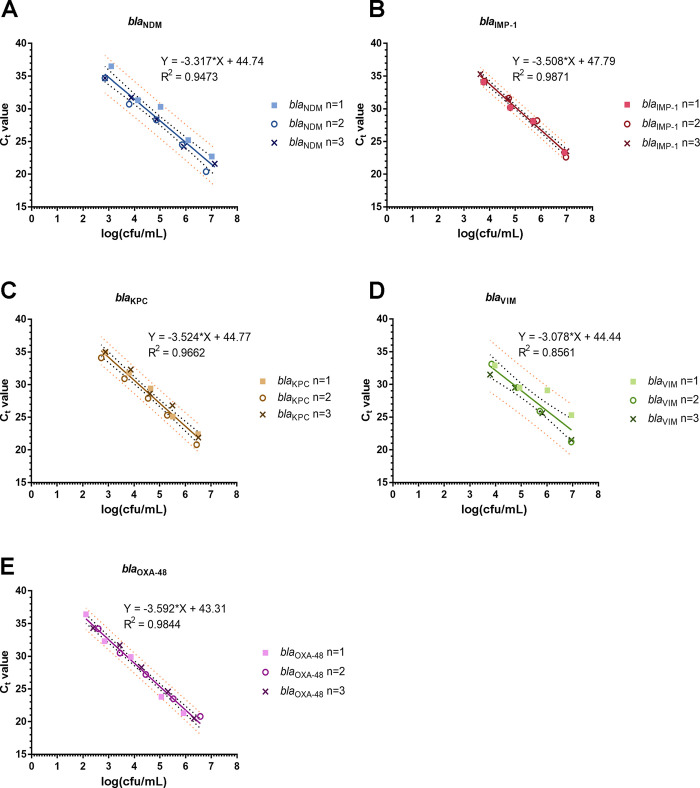 Figure 1
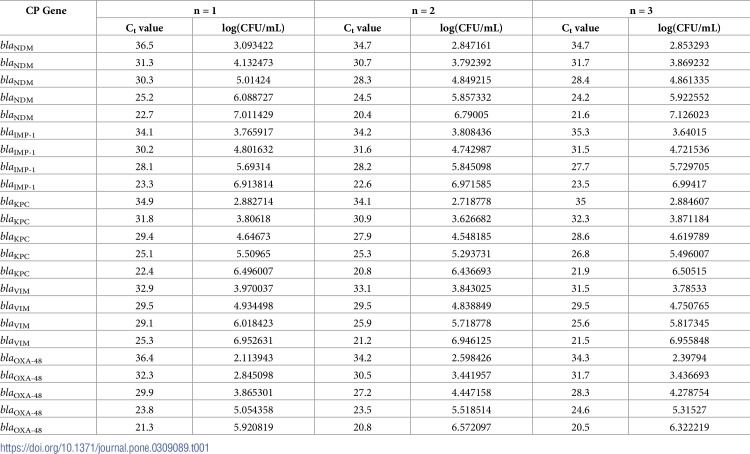 Figure 2
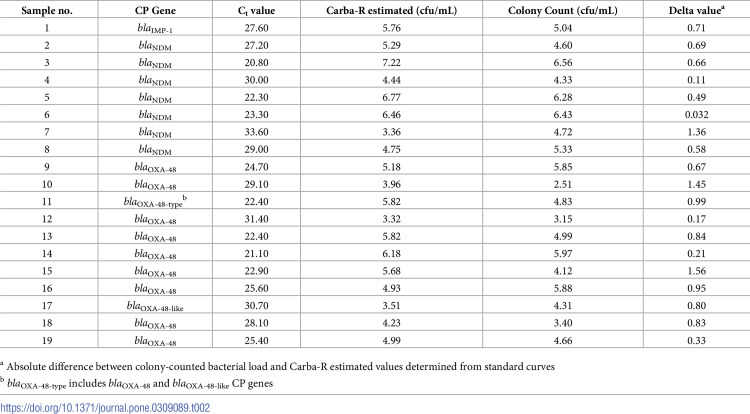 Figure 3
Peer Reviews
No public reviews on file for this paper yet. If you reviewed it on a platform where reviews are public (OpenReview, ICLR, NeurIPS, ICML), you can paste yours below so the community can read it here.
Videos
No videos yet. Explain this paper in a talk, walkthrough, or lecture? Add one.
Taxonomy
TopicsAntibiotic Resistance in Bacteria · Bacterial Identification and Susceptibility Testing · Antibiotic Use and Resistance