Harmonizing Heartbeats: The Mosaic of Cardiac Resynchronization Therapy Responders—A Comprehensive Exploration of Diverse Criteria and Predictors
Elke Boxhammer, Sophie Zauner, Johannes Kraus, Christian Dinges, Christiana Schernthaner, Franz Danmayr, Tobias Kolbitsch, Christina Granitz, Lukas J. Motloch, Matthias Hammerer, Michael Lichtenauer, Uta C. Hoppe, Bernhard Strohmer

TL;DR
This study examines different ways to define patients who benefit from cardiac resynchronization therapy and finds factors that predict better outcomes.
Contribution
The study introduces a nuanced, patient-centered approach to defining CRT-D responders and identifies novel predictors of therapy success.
Findings
CRT-D responders defined by NYHA, LVEF, or proBNP criteria show improved survival after 2 and 3 years.
Young age, absence of recent MI, and normal right ventricular parameters predict positive CRT-D response.
LVEF ≥ 5% and proBNP decrease ≥ 25% are independent predictors of extended survival.
Abstract
Background: Heart failure (HF) remains a challenging healthcare issue necessitating innovative therapies like cardiac resynchronization–defibrillation therapy (CRT-D). However, the definition of a CRT-D response lacks uniformity, impeding effective clinical evaluation. This study explores diverse CRT-D responder definitions encompassing functional, echocardiographic and laboratory criteria. Materials & Methods: A single-center study involving 132 CRT-D patients scrutinized responder criteria including NYHA stage, LVEF increase and proBNP decrease. Statistical analyses such as Kaplan–Meier curves and Cox hazard regression were employed to evaluate responder characteristics and survival outcomes. Results: Responder rates varied across criteria, revealing nuanced patient profiles. CRT-D responders defined by NYHA decrease, LVEF increase or proBNP decrease exhibit improved survival rates…
Genes, proteins, chemicals, diseases, species, mutations and cell lines named across the full text — each resolved to its canonical identifier and authoritative record.
Click any figure to enlarge with its caption.
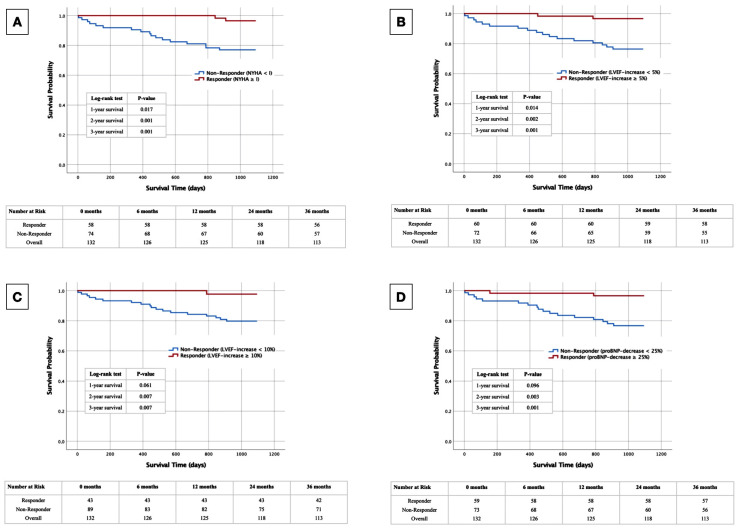 Figure 1
Peer Reviews
No public reviews on file for this paper yet. If you reviewed it on a platform where reviews are public (OpenReview, ICLR, NeurIPS, ICML), you can paste yours below so the community can read it here.
Videos
No videos yet. Explain this paper in a talk, walkthrough, or lecture? Add one.
Taxonomy
TopicsCardiac pacing and defibrillation studies · Cardiac electrophysiology and arrhythmias · Cardiac Arrhythmias and Treatments