Gender-specific play behavior in relation to autistic traits and behavioral difficulties at the age of seven in the SELMA study
Fatih Özel, Marlene Stratmann, Fotios C. Papadopoulos, Joëlle Rüegg, Carl-Gustaf Bornehag, Ewa Pisula, Ewa Pisula, Ewa Pisula

TL;DR
This study found that gender nonconforming play behavior in children is linked to higher autistic traits and behavioral difficulties at age seven in a general population.
Contribution
The study provides population-based evidence linking gender nonconformity with autistic traits and behavioral difficulties in children.
Findings
Higher masculine or less feminine play behavior in girls was associated with increased autistic traits.
Gender nonconforming play behavior was linked to behavioral difficulties in both girls and boys.
Higher feminine play behavior in boys was associated with more peer relationship problems.
Abstract
Childhood gender nonconformity is related to psychological distress and behavioral difficulties. Similarly, there is evidence for a link between gender nonconformity, or gender dysphoria in some studies, and autism spectrum disorder and related traits. Our knowledge on those associations mostly originates from clinical populations, which might lead to overestimation. Thus, this study aimed to assess associations between gender nonconformity and behavioral difficulties in a population-based study. In the Swedish Environmental Longitudinal, Mother and Child, Asthma and Allergy (SELMA) study, cross-sectional associations between gender-specific play behavior and behavioral outcomes and autistic traits were investigated among 718 children at 7-years of age. Play behavior was measured using the Preschool Activities Inventory; behavioral outcomes and autistic traits were measured with the…
Genes, proteins, chemicals, diseases, species, mutations and cell lines named across the full text — each resolved to its canonical identifier and authoritative record.
Click any figure to enlarge with its caption.
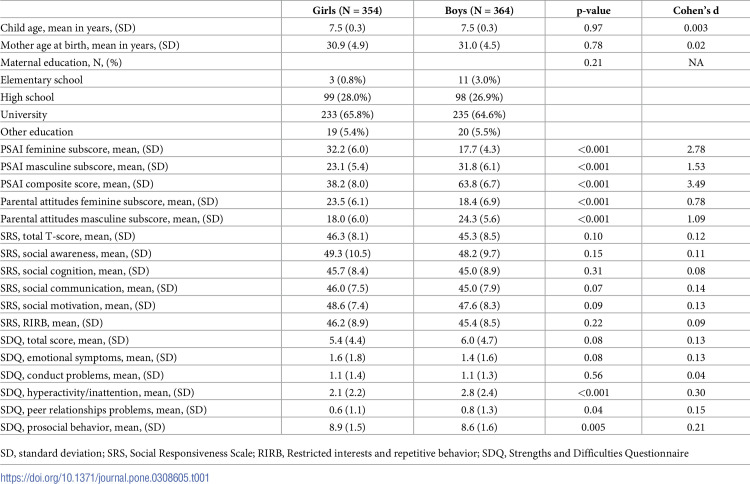 Figure 1
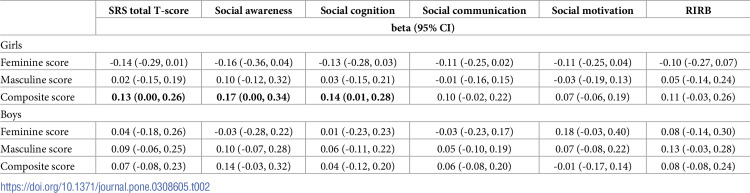 Figure 2
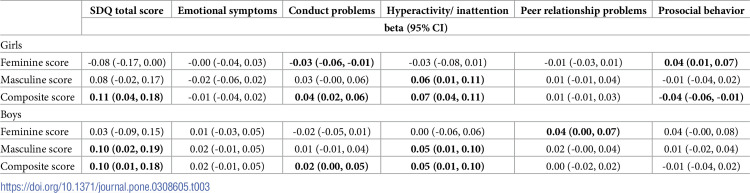 Figure 3
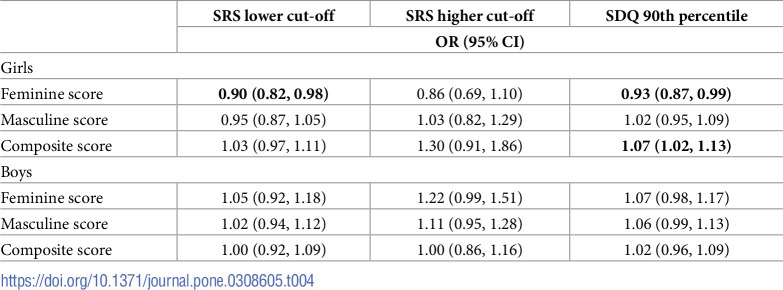 Figure 4
Peer Reviews
No public reviews on file for this paper yet. If you reviewed it on a platform where reviews are public (OpenReview, ICLR, NeurIPS, ICML), you can paste yours below so the community can read it here.
Videos
No videos yet. Explain this paper in a talk, walkthrough, or lecture? Add one.
Taxonomy
TopicsAutism Spectrum Disorder Research · Child Development and Digital Technology · Child and Adolescent Psychosocial and Emotional Development