A Cortical-Inspired Contour Completion Model Based on Contour Orientation and Thickness
Ivan Galyaev, Alexey Mashtakov

TL;DR
This paper presents a new model for completing visual contours in the brain, incorporating orientation and thickness using advanced mathematical techniques.
Contribution
The paper introduces a four-dimensional cortical-inspired model for contour completion that includes thickness and orientation.
Findings
The model uses sub-Riemannian geodesics to restore damaged image contours.
Existence of minimal geodesics between boundary conditions is proven using geometric control theory.
Explicit solutions and qualitative analysis are provided for the geodesic problem.
Abstract
An extended four-dimensional version of the traditional Petitot–Citti–Sarti model on contour completion in the visual cortex is examined. The neural configuration space is considered as the group of similarity transformations, denoted as M=SIM(2). The left-invariant subbundle of the tangent bundle models possible directions for establishing neural communication. The sub-Riemannian distance is proportional to the energy expended in interneuron activation between two excited border neurons. According to the model, the damaged image contours are restored via sub-Riemannian geodesics in the space M of positions, orientations and thicknesses (scales). We study the geodesic problem in M using geometric control theory techniques. We prove the existence of a minimal geodesic between arbitrary specified boundary conditions. We apply the Pontryagin maximum principle and derive the geodesic…
Genes, proteins, chemicals, diseases, species, mutations and cell lines named across the full text — each resolved to its canonical identifier and authoritative record.
Click any figure to enlarge with its caption.
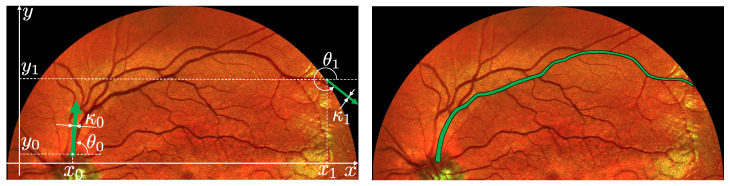 Figure 1
 Figure 2
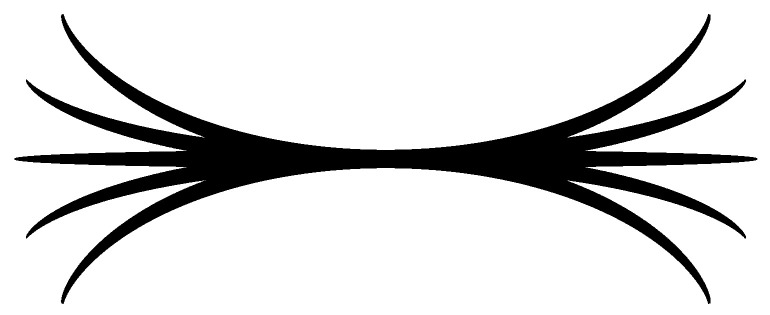 Figure 3
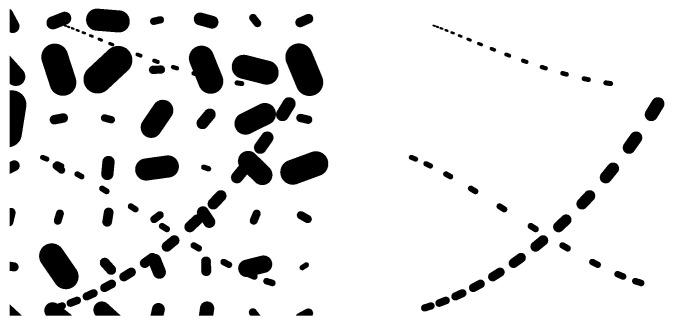 Figure 4
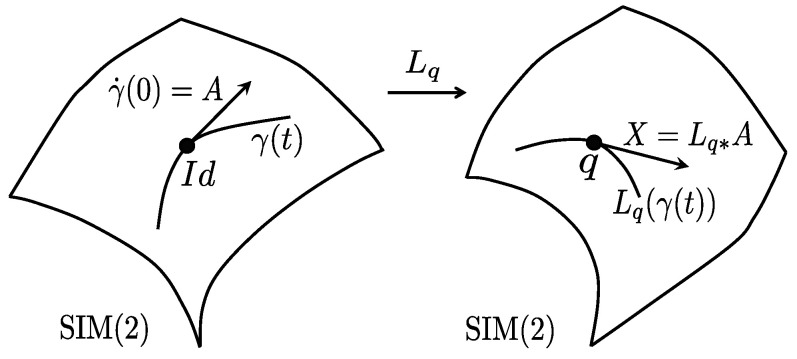 Figure 5
Peer Reviews
No public reviews on file for this paper yet. If you reviewed it on a platform where reviews are public (OpenReview, ICLR, NeurIPS, ICML), you can paste yours below so the community can read it here.
Videos
No videos yet. Explain this paper in a talk, walkthrough, or lecture? Add one.
Taxonomy
TopicsVisual perception and processing mechanisms · Morphological variations and asymmetry · Advanced Vision and Imaging