Intravitreal Antiangiogenic Treatment for Diabetic Retinopathy: A Mexican Real-Life Scenario Experience
Sonia López-Letayf, Oscar Vivanco-Rojas, Valentina Londoño-Angarita, Fátima Sofía Magaña-Guerrero, Beatriz Buentello-Volante, Yonathan Garfias

TL;DR
This study evaluates how well two eye drugs work in Mexican patients with diabetes-related eye issues, finding they improve vision and retinal thickness but don't fully reverse damage.
Contribution
The study provides real-world evidence on the effectiveness of ranibizumab and aflibercept in a Mexican diabetic retinopathy population over five years.
Findings
Both ranibizumab and aflibercept improved visual acuity and central retinal thickness in patients with diabetic retinopathy.
Patients with diabetic macular edema showed less response to antiangiogenic treatment compared to others.
Improvements in visual acuity and retinal thickness measurements did not fully correlate in the study population.
Abstract
The objective of this study was to analyze the effectiveness of two intravitreal antiangiogenic drugs, ranibizumab and aflibercept, in a Mexican population over a period of 5 years, evaluating the improvement in visual acuity (VA) and central retinal thickness (CRT) in a real-world scenario. This is a retrospective study with subjects diagnosed with diabetic retinopathy (DR), proliferative diabetic retinopathy (PDR), and diabetic macular edema (DME) receiving intravitreal injections of ranibizumab and/or aflibercept. In this study, we analyzed 588 eyes of 294 patients who received intravitreal antiangiogenic injections. The results showed an improvement regardless of antiangiogenic treatment or diagnosis in both VA and CRT. We found that both aflibercept and ranibizumab improved VA, while subjects with DME responded less to antiangiogenic treatment (p < 0.05), and that this difference…
Genes, proteins, chemicals, diseases, species, mutations and cell lines named across the full text — each resolved to its canonical identifier and authoritative record.
Click any figure to enlarge with its caption.
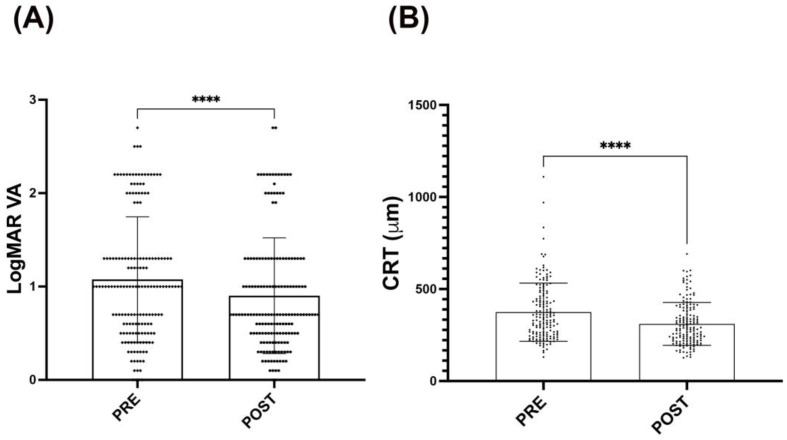 Figure 1
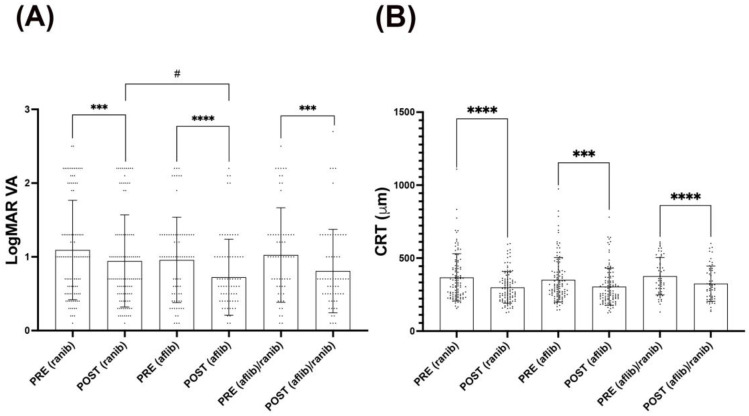 Figure 2
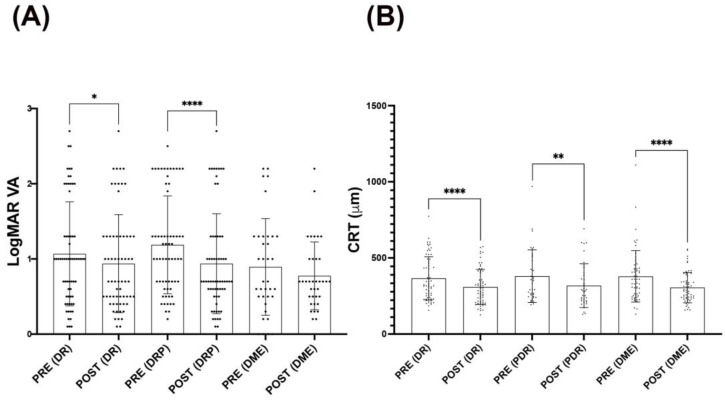 Figure 3
Peer Reviews
No public reviews on file for this paper yet. If you reviewed it on a platform where reviews are public (OpenReview, ICLR, NeurIPS, ICML), you can paste yours below so the community can read it here.
Videos
No videos yet. Explain this paper in a talk, walkthrough, or lecture? Add one.
Taxonomy
TopicsRetinal Diseases and Treatments · Retinal Imaging and Analysis · Retinal and Optic Conditions