Air-Drying Time Affects Mortality of Pyrethroid-Susceptible Aedes aegypti Exposed to Transfluthrin-Treated Filter Papers
Dae-Yun Kim, Jeffrey Hii, Theeraphap Chareonviriyaphap

TL;DR
The study shows that how long transfluthrin-treated papers are air-dried affects mosquito mortality, which is important for detecting resistance and controlling mosquitoes.
Contribution
This is the first study to evaluate spatial repellents using a high-throughput screening system toxicity bioassay with varying air-drying times.
Findings
After 24 h of air-drying, transfluthrin concentration needed for efficacy was 2.8 times higher than after 1 h.
Mosquito mortality was significantly reduced at 24 h of air-drying compared to 1 h at the highest concentration.
The WHO bottle bioassay is recommended for determining mosquito susceptibility to volatile insecticides like transfluthrin.
Abstract
This study emphasizes the significance of appropriate air-drying times in toxicity bioassays to accurately establish sublethal concentrations and discriminating concentrations for resistance detection in mosquitoes to a highly volatile pyrethroid, namely, transfluthrin. The high-throughput screening system toxicity bioassay study demonstrated consistent dose-dependent responses in susceptible mosquito populations. Our findings emphasize the importance of accurate susceptibility testing to facilitate early resistance detection. The air-drying duration significantly affected the efficacy of transfluthrin: after drying for 24 h, the concentration needed to achieve the same level of efficacy was 2.8 times higher compared to the concentration needed after 1 h of drying. This is the first study to evaluate spatial repellents using a high-throughput screening system toxicity bioassay, yielding…
Genes, proteins, chemicals, diseases, species, mutations and cell lines named across the full text — each resolved to its canonical identifier and authoritative record.
Click any figure to enlarge with its caption.
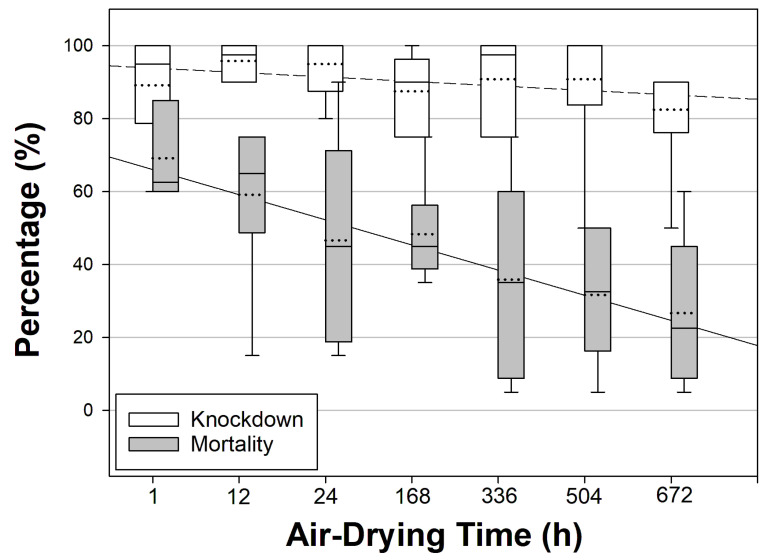 Figure 1
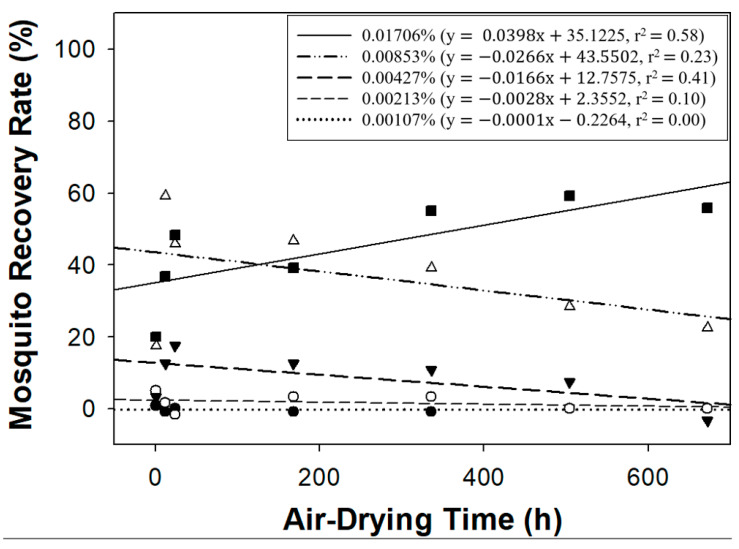 Figure 2
Peer Reviews
No public reviews on file for this paper yet. If you reviewed it on a platform where reviews are public (OpenReview, ICLR, NeurIPS, ICML), you can paste yours below so the community can read it here.
Videos
No videos yet. Explain this paper in a talk, walkthrough, or lecture? Add one.
Taxonomy
TopicsMosquito-borne diseases and control · Malaria Research and Control · Viral Infections and Vectors