Intention for internal whistleblowing to report sexual violence in higher education institutions: a Nigerian national study
Adesola A. Ogunfowokan, Saleh N. Garba, Monica A. Orisadare, Ayobami G. Adeleke, Patience E. Samson-Akpan, Mathew O. Olatubi, Omowumi R. Salau, Ayotunde Titilayo, Florence Okoro, Anna Bull, Adesola Ogunfowokan

TL;DR
This study explores whether Nigerian higher education staff and students intend to report sexual violence internally and identifies preferred reporting mechanisms.
Contribution
The study provides novel data on whistleblowing intentions and attitudes toward sexual violence in Nigerian higher education institutions.
Findings
Quantitative and qualitative data were collected from over 25,000 participants across Nigerian higher education institutions.
The study reveals attitudes, self-efficacy, and subjective norms related to internal whistleblowing of sexual violence.
It identifies current reporting systems and preferred mechanisms for reporting sexual violence.
Abstract
Background Sexual violence is prevalent in higher education institutions in Nigeria and stakeholders have encouraged staff and students to blow the whistle whenever they fall victim to or are aware of any sexual violence case. However, there is lack of data about whether the staff and students of these institutions have the intention to blow the whistle internally (within the institution) or not. There is also a lack of data on the existing reporting mechanisms or preferred whistleblowing mechanisms in these institutions. These have hindered the analysis of stakeholders’ opinions on this topic. Methods This data note presents a comprehensive quantitative and qualitative data set collected from staff and students of three categories of government owned higher education institutions (Universities, Polytechnics, Colleges of Education) in Nigeria. Data collection was between February and…
Genes, proteins, chemicals, diseases, species, mutations and cell lines named across the full text — each resolved to its canonical identifier and authoritative record.
Click any figure to enlarge with its caption.
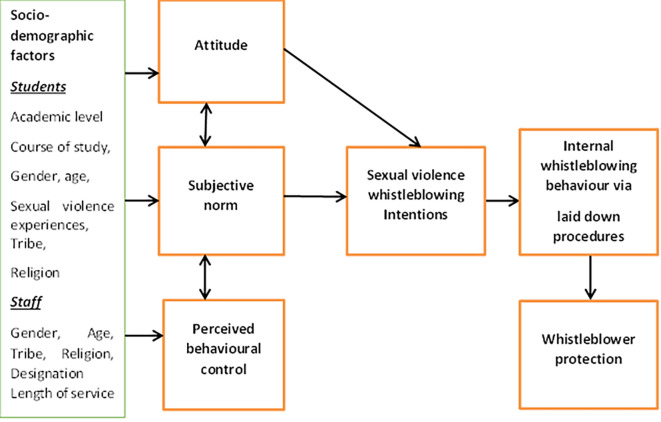 Figure 1
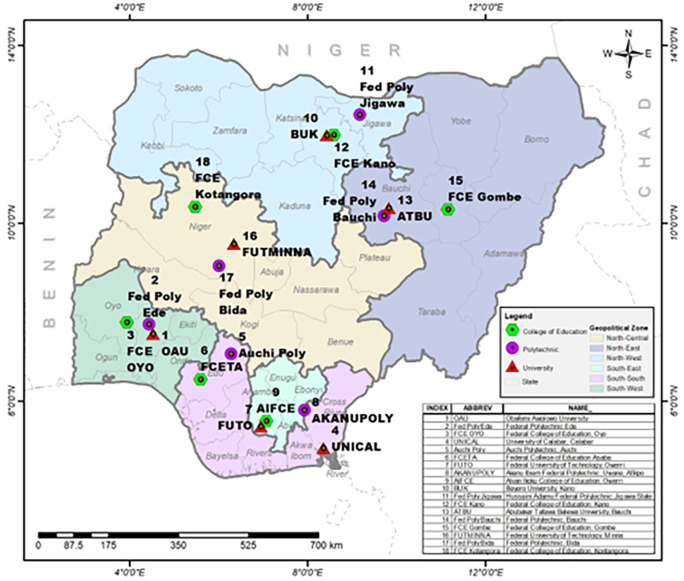 Figure 2
| Region | State | School | Student population | Sample | Staff population | Sample |
|---|---|---|---|---|---|---|
| South-West | Oyo | Federal College of Education, Oyo | 6,075 | 743 | 1,021 | 240 |
| Osun | Federal Polytechnic, Ede | 7,655 | 936 | 800 | 188 | |
| Osun | Obafemi Awolowo University, Ile-Ife | 29,938 | 3,662 | 1,723 | 405 | |
| South-South | Asaba | Federal College of Education, Asaba | 5, 047 | 617 | 226 | 53 |
| Auchi Polytechnic | 8,376 | 1,025 | 1,324 | 312 | ||
| Cross-River | University of Calabar, Calabar | 29,566 | 3,616 | 6,278 | 1,477 | |
| South-East | Imo | Alvan Ikoku College of Education, Owerri | 7,909 | 967 | 1,554 | 366 |
| Ebonyi | Akanu Ibiam Federal Polytechnic, Uwana, Afikpo | 4,244 | 519 | 251 | 59 | |
| Imo | Federal University of Technology, Owerri | 20,924 | 2,559 | 3,107 | 731 | |
| North-West | Kano | Federal College of Education, Kano | 8,200 | 1,003 | 2,284 | 537 |
| Jigawa | Hussaini Adamu Federal Polytechnic Kazaure | 4,478 | 548 | 132 | 31 | |
| Kano | Bayero University, Kano | 34,912 | 4,270 | 4,289 | 1,009 | |
| North-Central | Niger | Federal College of Education, Kotangora | 3, 928 | 481 | 611 | 144 |
| Niger | Federal Polytechnic, Bida | 5,819 | 712 | 229 | 54 | |
| Niger | Federal University of Technology, Minna | 18,407 | 2,251 | 3,481 | 819 | |
| North-East | Gombe | Federal College of Education, Gombe | 24,773 | 3,030 | 768 | 181 |
| Bauchi | Federal Polytechnic, Bauchi | 9,773 | 1,195 | 1,477 | 348 | |
| Bauchi | Abubakar Tafawa Balewa University, Bauchi | 16,191 | 1,980 | 2,427 | 571 | |
|
|
|
|
|
|
| Variables | Students | Staff | ||
|---|---|---|---|---|
| Pilot | Main study | Pilot | Main study | |
| Attitude | 0.797 | 0.807 | 0.770 | 0.805 |
| Subjective norm | 0.628 | 0.817 | 0.819 | 0.831 |
| Self-efficacy | 0.804 | 0.776 | 0.629 | 0.796 |
| Whistleblowing intention | 0.734 | 0.857 | 0.663 | 0.841 |
| Sexual violence experiences | 0.478 | 0.795 |
|
|
| Variable | Question number |
|---|---|
|
| |
| Whistleblowing reduces incidence of sexual violence | A1 |
| Reporting sexual violence controls perpetration | A2 |
| Whistleblowing enhances the public interest | A3 |
| Whistleblowing for sexual violence reporting is to prove loyalty to the school | A4 |
| Whistleblowing is the moral thing to do | A5 |
| Whistleblowing enhances organization’s sustainability | A6 |
| Whistleblowing is a way of exercising true conscience | A7 |
| Whistleblowing is to enable student to be a moral agent | A8 |
| Whistleblowing is the management tool to protect students | A9 |
| Whistleblowing is to make perpetrators liable for their wrong doings | A10 |
|
| |
| Classmates | B11 |
| Course-mates | B12 |
| Family members | B13 |
| Immediate Supervisor | B14 |
| Lecturers | B15 |
| Neighbours | B16 |
| The public | B17 |
| Friends | B18 |
| School Administrators | B19 |
|
| |
| School will ignore my reporting | C20 |
| My reporting won’t make any difference | C21 |
| I will be subjected to harassment by my colleagues | C22 |
| I will be isolated by my friends | C23 |
| 1 will be closely monitored | C24 |
| I will be charged for breach of loyalty to the school | C25 |
|
| |
| Rate the extent to which the behaviour is offensive | D26 |
| Rate the likelihood that you will report | D27 |
| Rate the likelihood that your schoolmates/classmates will report | D28 |
| Rate the extent to which the behavior of the course-mate is offensive | D29 |
| Rate the likelihood that you will report | D30 |
| Rate the likelihood that your schoolmates/classmates will report | D31 |
| Rate the extent to which the behaviour is offensive | D32 |
| Rate the likelihood that you will report | D33 |
| Rate the likelihood that your schoolmates/classmates will report | D34 |
|
| |
| Number of time attempted to be rape in the past 12 months | E35 |
| Number of time raped in the past 12 months | E36 |
| Number of time sexually harassed in the past 12 months | E37 |
|
| |
| Gender | F38 |
| Religion | F39 |
| Age | F40 |
| Trobe | F41 |
| Course of Study | F42 |
| Faculty/Field | F43 |
| Level | F44 |
| Name of Institution | |
| Type of Institution | |
| Region |
| Variable | Question number |
|---|---|
|
| |
| Whistleblowing reduces incidence of sexual violence | A1 |
| Reporting sexual violence controls perpetration | A2 |
| Whistleblowing enhances the school community interest | A3 |
| Whistleblowing for sexual violence reporting is to prove loyalty to the school | A4 |
| Whistleblowing is the moral thing to do | A5 |
| Whistleblowing enhances organization’s sustainability | A6 |
| Whistleblowing is a way of exercising true conscience | A7 |
| Whistleblowing is to enable employee to be a moral agent | A8 |
| Whistleblowing is the management tool to protect students | A9 |
| Whistleblowing is to make perpetrators liable for their wrongdoings | A10 |
|
| |
| Co-workers | B11 |
| Superior | B12 |
| School management | B13 |
| Subordinate | B14 |
| Office mate | B15 |
| Neighbours | B16 |
| The public | B17 |
| Friends | B18 |
| Family members | B19 |
|
| |
| School will ignore my reporting | C20 |
| My reporting won’t make any difference | C21 |
| I will be subjected to harassment by my colleagues | C22 |
| I will be isolated by my friends | C23 |
| I will be closely monitored | C24 |
| I will be charged for breach of loyalty to the school | C25 |
| I will be demoted | C26 |
|
| |
| Rate the extent to which the behaviour is offensive | D26 |
| Rate the likelihood that you will report | D28 |
| Rate the likelihood that your colleagues will report | D29 |
| Rate the extent to which the behavior of the course-mate is offensive | D30 |
| Rate the likelihood that you will report | D31 |
| Rate the likelihood that your colleagues will report | D32 |
| Rate the extent to which the behaviour is offensive | D33 |
| Rate the likelihood that you will report | D34 |
| Rate the likelihood that your colleagues will report | D35 |
|
| |
| Gender | E36 |
| Religion | F37 |
| Age | F38 |
| Trobe | F41 |
| Course of Study | F42 |
| Faculty/Field | F43 |
| Level | F44 |
| Name of Institution | |
| Type of Institution | |
| Region |
- —Tertiary Education Trust Fund
Peer Reviews
No public reviews on file for this paper yet. If you reviewed it on a platform where reviews are public (OpenReview, ICLR, NeurIPS, ICML), you can paste yours below so the community can read it here.
Videos
No videos yet. Explain this paper in a talk, walkthrough, or lecture? Add one.
Taxonomy
TopicsSexual Assault and Victimization Studies · Ethics in Business and Education · Workplace Violence and Bullying
Introduction
Sexual violence has been a global issue for many years, most especially in the 21 ^st^ century among the young population. Students of higher education have been reported to fall victim to and have also been documented to be perpetrators of this social menace. In Nigeria, there are reports of increased prevalence of sexual violence among higher education students ( Egbegi et al., 2019; Yesufu & Adimula, 2018, April, 23; Onoyase, 2019; British Broadcasting Corporation - BBC, 2019). Due to the magnanimity of sexual violence in educational institutions in Nigeria, the Independent Corrupt Practices and other Related Offences Commission (ICPC) (an agency established to prosecute perpetrators of corrupt practices in Nigeria) instructed students to report cases of sexual harassment to the commission ( ICPC, 2019) and that such cases will be handled under anti-corruption laws. Anecdotal evidences have shown that, the reporting systems for sexual violating acts have not been very effective in many of these institutions as many cases still go unreported, thereby perpetuating the menace. As far back as 2004, Lee and others have documented that whistleblowing can be used to report sexual harassment just like any other organizational wrongdoings ( Lee et al., 2004). There has been a call for the use of internal whistleblowing for reporting sexual violence in higher education institutions in Nigeria by many stakeholders. Less than two years ago, the Shehu Musa Yar’Adua Foundation, in partnership with the Gender and Development Policy Centre, University of Nigeria Nsukka, launched the ’Gender Justice Whistleblowing Portal’ for reporting sexual violence at the university ( Odu, 2021; Nov. 19).
Nonetheless, we are of the opinion that an individual must have intention to blow the whistle to report sexual violence before carrying out the task. An enabling environment or recognized laid down mechanism must be put in place to ensure effective whistleblowing. As of today, we are not aware of any dataset that provides information on all of these variables which may subsequently be analysed and used for policy formulation for sexual violence prevention in higher educational institutions in Nigeria. Therefore, this data note provides information on the variables included in the study dataset which are: respondents’ attitude, self-efficacy, subjective norm; self-reported sexual violence experiences; whistleblowing intention, reporting systems in higher institutions and the preferred sexual violence whistleblowing mechanisms. In this data note, we provide detailed account of the variables in the dataset and then highlight the potential of this study to contribute to improved sexual violence reporting in higher education institutions thereby reducing the occurrence of the menace.
Specific objectives of the study
The six specific objectives of the study were to
- 1.describe the sexual violence experiences of students in tertiary educational institutions;
- 2.determine the influence of attitude, subjective norm and perceived behavioural control on intentions of studen ts and staff to internally blow the whistle for reporting sexual violence cases;
- 3.identify socio-demographic factors (academic level, course of study, gender, age, sexual violence experiences, tribe and religion) that predict students’ intention to internally blow the whistle for reporting sexual violence cases;
- 4.identify socio-demographic factors (gender, age, tribe, religion, designation and length of service) that predict staff intention to internally blow the whistle for reporting sexual violence cases;
- 5.explore possible internal whistleblowing strategies for reporting sexual violence cases; and
- 6.explore strategies for protecting sexual violence whistleblowers.
Theoretical framework
This study was hinged on the Theory of Planned Behaviour (TPB). The theory describes that behavioural intention of an individual to engage in a particular behaviour is a product of three determinants: the individual’s attitude (opinions of oneself towards the behaviour); the subjective norms (opinions of others towards the behaviour); and perceived behavioural control (self-efficacy towards the behaviour) ( Ajzen, 2012). For an individual to have intention to blow the whistle for reporting sexual violence act, he/she must have a positive attitude towards whistleblowing as an effective mechanism. Such individual must also consider that, his/her action will be acceptable by significant others and that he/she has the capacity and the wherewithal to blow the whistle. However, aside from the three determinants, background variables such as demographic factors have been identified to indirectly influence behavioural intention through the three determinants and consequently the behaviour ( Menozzi et al., 2015). It is expected in this study that the socio-demographic factors of the students and staff such as academic level, course of study, gender, age, sexual violence experiences, tribe, religion, designation and length of service will influence their intention to internally blow the whistle for reporting sexual violence cases. In cases of sexual violence, being a culturally sensitive issue, a reprisal attack on the whistleblower is inevitable. Therefore, it is essential that protection mechanisms are established to protect the whistleblower ( Figure 1).
Framework for the study.
Methods
A concurrent mixed method design using quantitative and qualitative data collection methods was adopted for the study. The study was carried out in 18 institutions comprising Federal Colleges of Education, Polytechnics and Universities in all the six geo-political zones of Nigeria. The target population of the students in the selected schools was 246,216 students while that of staff was 31,982 ( National University Commission - NUC, 2017; Federal Ministry of Education, 2019; National Bureau of Statistics, 2019). The sample size calculation was in two modes; qualitative and quantitative methods.
Eligibility criteria
Institutions where the study was conducted were those owned and controlled by the Federal Government of Nigeria and must either be a polytechnic, college of education or university. The students were those undergoing full-time traditional face-to-face programmes and were undergraduates. Staff participants were those who work full-time mode in the selected institutions. Contract or part-time staff were excluded from the study.
Quantitative strand
Using Cochran’s survey sample size formula: n = z ^2^pq/e ^2^ where n = sample size; z = standard normal deviate set at 1.95 which corresponds to 95% confidence level; p = 0.5 (set at 50% for unknown prevalence of whistleblowing intention); q = 1-p = 0.5; e = permitted error of margin set at 2.5% (in order to get a large representative sample), a sample size of 1,521 students was obtained per institution. Adding non-response rate of 10%, a final sample size of 1,673 was obtained per institution giving a total of 30,114 students’ respondents for the 18 institutions. Using the same Cochran’s formula: n = z ^2^pq/e ^2^ and same parameters for the staff except for the permitted error of margin set at 5%, a sample size of 418 was obtained per institution after adding 10% non-response rate. Therefore, a total of 7,524 staff (academic & non-academic) was selected and distributed proportionately in all the 18 institutions and into equal proportion of male and female staff.
Qualitative strand
The number of participants in non-commercial focus groups is recommended to be between six and 10 in order to be able to control the group ( Kabir, 2016). Therefore, we proposed to have eight members (four males and four females) of the Student Union Government in each of the institutions to participate in the study making a total of 144 students for the 18 institutions. Also, two representatives (a male and a female) from each of the Staff Unions in each institution were selected to participate in the FGD. The Unions represented are listed according to the type of school:
- •University: Academic Staff Union of Universities (ASUU); Senior Staff Association of Nigerian Universities (SSANU); National Association of Academic Technologies (NAAT); and the Non-Academic Staff Union of Universities (NASUU).
- •Colleges of Education: Colleges of Education Academic Staff Union (COEASU); Senior Staff Union of Colleges of Education in Nigeria (SSUCOEN); and Non-Academic Staff Union of Colleges of Education (NASUCED).
- •Polytechnics: Academic Staff Union of Polytechnics (ASUP); Senior Staff Association of Nigerian Polytechnics (SSANIP); and Non-Academic Staff Union of Polytechnics (NASUP).
Therefore, for Universities, there were eight Executive Officers (four males, four females) from each institution giving a total of 48 participants for the six Universities. For Colleges of Education and Polytechnics, there were six officers (three males and three females) from each institution giving a total of 72 participants for the 12 institutions. Overall, a total of 120 staff formed the sample size for the staff FGD participants.
Sampling
Multistage stratified sampling technique was adopted in this study. Nigeria is already stratified into six geo-political zones and in each zone, government-owned higher institutions were stratified by University, Polytechnic and College of Education. In each of the stratum, one institution was selected using simple random sampling technique (balloting) thereby giving a total of three schools from each zone ( Figure 2 - produced by the authors). A random selection of departments from each of the schools were done followed by the students’ and staff stratification into male and female gender and also stratification into academic and non-academic staff. A random selection was finally used to select the respondents by proportion as shown in Table 1. For the qualitative strand, the Presidents of each of the unions were contacted to nominate members of their cabinet to participate in the FGD putting into consideration equal gender in the nomination. However, it was observed that there were more males in many of the cabinets than females hence, more male officers participated in the FGD than females.
Map of the six geopolitical zones showing selected schools for the study.Source: the authors.
Instruments
Two instruments were used for data collection: Sexual Violence Whistleblowing Intentions Questionnaire (SeVWIQ) and a Focus Group Discussion Guide. The SeVWIQ was in two forms. The first was administered to students and it elicited information on their attitude to whistleblowing, subjective norm, self-efficacy, whistleblowing intentions, sexual violence experiences and demographics. The second was for the staff and it elicited information on their attitude to whistleblowing, subjective norm, self-efficacy, whistleblowing intentions, and demographics. The questionnaire had 10 attitudinal questions on a 3-point Likert scale of Not True (1), Moderately True (2) and Very True (3). The subjective norm questions were nine on a 3-point Likert scale of Not Proud (1), Slightly Proud (2) and Very Proud (3). The self-efficacy questions were six on 3 point-Likert scale of Not Likely (1), Moderately Likely (2) and Very Likely (3). The questions on the attitude, subjective norm and self-efficacy were adapted from the work of Zakaria et al. (2016). The sexual violence experiences component was adapted from the Sexual Experiences Short Form Victimization (SES-SFV) scale developed by Koss et al. (2006). The SES-SFV scale assessed sexual violence victimization in the past 12 months and the number of occurrence. The whistleblowing intention component of the questionnaire were formulated using three vignettes which were adapted from the work of Ahmad (2011). The vignettes represented cases of rape, attempted rape and sexual harassment and were rated on a scale of 1 to 5. The Focus Group Discussion Guide (FGDG) which was developed from the review of literature, explored information on sexual violence cases on the school campuses, institutional laid down strategies for reporting sexual violence, factors that may predict the staff and students’ intention to blow the whistle, strategies for reporting and protecting whistleblowers, and the effectiveness of internal whistleblowing strategies.
Pilot study/pre-test of instruments
The pilot study was carried out in a University of Technology in South West Nigeria. Using the recommendation of Connelly, (2008) that 10% of main sample size can be used for pilot study, therefore, 167 students (10% of 1,673) and 42 staff (10% of 418) were selected to participate in the pilot study. Eight members of the Student Union Government and eight members of the leadership of the four Staff Unions of the school participated in the two separate FGD sessions (one for the students and the other for staff). During the pilot study, the questionnaire was subjected to face and content validity and internal consistency, while trustworthiness of the FGD data was ensured. Part of the findings from the pilot study has been published in Ogunfowokan et al. (2023a). Also, the questionnaire’s internal consistency was further assessed during the main study to further evaluate its reliability. The Cronbach alpha results for both the pilot and the main studies are stated in Table 2.
Field staff
A field supervisor was identified in each of the schools except the three Northern regions where only one field supervisor was identified and he worked with the investigator from the North to collect the data. The supervisors were responsible for the logistics of sampling and the data collection process. They were trained twice using the virtual mode between December 2020 and January, 2021. The principal investigator was the chief trainer supported by other investigators. The field supervisors then appointed field workers in their respective schools and were trained in the administration of the questionnaires. Also, the two mentees who were postgraduate students as required in the funding call served as the research assistants for the study. The mentees have been part of the writing process for the grant proposal and they were further trained alongside the supervisors.
Ethical considerations
Institutional board approval for the study was obtained on 11 ^th^ December, 2019 from the Institute of Public Health, Health Research and Ethics Committee (IPH HREC) of the Obafemi Awolowo University with approval number IPH/OAU/12/1460. An extension of the approval was obtained on 5 ^th^ May, 2021 at the expiration of the initial approval when data collection has not been completed. Informed consent of the students and staff was obtained using the informed consent form formatted after the IPH HREC form. The informed consent was obtained by the field staff after the purpose of the study has been explained to participants and concerns clarified. However, due to the sensitivity of the questions, many participants declined appending their signatures on the consent form but preferred verbal consent without recording, which was granted them. In addition, written permission to collect data was also obtained from the administrators of the respective study institutions.
Data collection process
Due to the sensitivity of the study and the non-appealing nature of electronic data collection to many Nigerians as previously observed ( Tella, 2015), we decided to use the paper-based questionnaire administration methods. The selected students were contacted by the field workers in their various lecture rooms and questionnaires were administered to them and same were retrieved immediately after completion. Some of them requested to return the questionnaire the following day. Also, some class representatives assisted in retrieving the questionnaires from those who made such request. The questionnaires for the staff were administered to them in their various offices. Some of them returned the questionnaires immediately after completion while others requested to return them after some days. Some staff also dropped the questionnaires in their pigeon holes for pick up. In addition, two FGD sessions (one for students and the other for staff) were conducted in each of the schools giving a total of 35 FGD sessions (the staff in a particular school refused to participate in the FGD). For the students’ FGD, they were carried out at the Student Union Government building except for one of the schools in which the school management insisted it should be conducted at the Students’ Affairs building. The staff FGD were conducted at a designated venue agreed-on between the field supervisors and the participants. The principal investigator facilitated the sessions in support of other team members for the Southern regions. For the Northern regions, the field supervisor and the investigator from the North facilitated the FGD sessions. Recordings of the sessions were taken using Android phones while field notes were taken by other support staff.
Data entry
Out of the 30,114 students’ questionnaires and 7,524 staff questionnaires administered, a total of 21,937 students’ questionnaires and 3,108 staff questionnaires were completely and properly filled and were adequate for data analysis giving a response rate of 72.8% for students and 41.3% for staff. There were eight data entry clerks who were recruited and trained in June, 2021. Two data analysts were also employed for the quantitative strand and these analysts trained the data entry clerks on how to enter the coded data from the questionnaires into Epi Info software version 3.1. Hands-on training was done using pre-coded demo-questionnaires. All the questionnaires were numbered and coded for data entry. The clerks received different quantities of questionnaires on different days for entry into Epi info software. A standby research office assistant was also employed to assign the questionnaires to the clerks and also ensured that correct quantities of the questionnaires were returned after data entry. Data entry was done within a period of seven months. Following the entry of the data and the merging of the data files from the clerks by the analysts, the data were then exported to SPSS version 27 ( IBM Corp. Released, 2020).
Dataset
The quantitative dataset ( Ogunfowokan et al., 2023b) consists of 44 variables for the students and 42 variables for the staff that are grouped into six: (i) attitude to whistleblowing; (ii) subjective norm; (iii) self-efficacy; (iv) whistleblowing intention; (v) sexual violence experience; and (vi) socio-demographic characteristics. However, the staff dataset does not contain the sexual violence experience data. The list of all the variables and their corresponding response options are found in Tables 3 and 4. The qualitative dataset contains transcripts on responses to the six probing questions used for the FGD which are: (i) sexual violence cases in the school; (ii) institutional reporting systems; (iii) factors influencing intention; (iv) preferred whistleblowing strategies; vi) protection of whistleblower; and (vii) effectiveness of internal whistleblowing.
Dataset validation
During sampling of the schools, some areas in the Northeast and Northwest regions were avoided because of insurgency. After sampling, two schools were dropped because the field workers could not gain access to the schools due to ongoing insurgency in the areas. Also the study was conducted in government owned schools thereby excluding higher institutions owned by private individuals, organizations and State Governments. Other higher institutions like diploma schools of nursing, technical and specialized higher education schools among others were also not captured in the study. Hence, generalization of the findings from this study should only be for Universities, Polytechnics and Colleges of Education that are Federal government-owned. Also, FGD for staff could not be conducted in a particular university because the executive officers for the staff unions did not give their consent to participate despite all pleas and provision of information about the study.
Quantitative dataset
The questionnaires that were brought from the field were assessed for completeness by the research office assistants and two other young people employed for the job. All incompletely filled questionnaires were discarded. Consistency checks were done by ensuring that the data on each of questionnaires were consistent. For example, on the staff questionnaire, an academic staff who reported to be a Senior Lecturer later ticked the non-academic status had the non-academic status corrected. Duplicate and outliers on the dataset were also observed and compared with the original raw data on the corresponding questionnaires and corrections were made where necessary. Missing data were attended to by using mean substitution as documented by Kang (2013). However, we were aware of the bias related to self-reported data collection most especially on a sensitive issue as sexual violence and this may impact on the quality of the dataset. Also, we could not do external validation of the data set as we could not lay our hands on a similar dataset on any of the variables.
Qualitative dataset
A most profound validation for the qualitative dataset that we carried out is the data member checking. During and after the interview, participants were regularly instructed to confirm their statements as true reflections of their opinions by listening to the recordings. Facilitators were also encouraged to clarify participants’ opinions from the statements that they made to avoid biases. Peer debriding was also done among the investigators, supervisor and the research assistants immediately after concluding an FDG session to discuss the findings in proper perspective and to also avoid biases. All these efforts were to ensure the trustworthiness of the qualitative data ( Stahl and King, 2020).
Reflexivity statement
There are six investigators and two research mentees in the research team. The team consists of individuals who are academics from four universities spread across three regions in Nigeria. The research mentees were Ph.D. students (a male and female) in community health nursing, of whom one of them focused on adolescent boys’ sexual violence perpetration in her Ph.D. project while the other focused on work-related stress among nurses. Both mentees were trained in the use of qualitative and quantitative data collection methods for their M.Sc. and Ph.D. projects. The six investigators (three males and three females) had Ph.D. certificates in diverse specialised areas, which include health promotion, civic education, gender and policy studies, demography and population studies, medical sociology, and community health. Some of the investigators were trained in phenomenology studies, while others were trained in quantitative data collection. The strengths of the investigators were identified and made use of during data collection. The principal investigator, who is a community health nurse expert, facilitated the FGD sessions in the southern regions. The assigned field supervisor for the Northern region, who is a sociologist and a demographer, facilitated the FGD for the Northern region in conjunction with the investigator from the North, who is a medial sociologist. In order to eliminate any form of bias, information about the researchers was also given alongside the research information at the point of obtaining informed consent from the participants.
Limitations
Some schools in the northern part of the country were intentionally avoided as a result of the insurgency going on in those areas at the time of conducting the study. Also, two schools that were sampled initially were replaced at the point of data collection when the field workers could not gain access to the schools due to insurgency. Other higher institutions, like diploma schools of nursing technical schools and specialised higher education schools, among others, were not captured in the study. Hence, generalisation of the findings from this study should only be made for students in universities polytechnics, and colleges of education. The staff in one of the institutions refused to participate in the FGD despite all efforts to convince them that the study is solely for research purposes with no implication for any individual.
The reference list from the paper itself. Each links out to its DOI / PubMed record.
- 1Ahmad SA : Internal Auditor and Internal Whistleblowing Intentions: a Study of Organisational, Individual, Situational and Demographic Factors. 2011. Reference Source
- 2Ajzen I : The Theory of Planned behavior. Lange PAM Kruglanski AW Higgins ET , editors. Handbook of Theories of Social Psychology. Vol.1. London, UK: Sage;2012; pp.438–459. 10.4135/9781446249215.n 22 · doi ↗
- 3British Broadcasting Corporation – BBC: Sex for grades’: Undercover in West African universities. 2019. Reference Source
- 4Egbegi FR Benjamin OA Onyejebu DC : Eradicating Sexual Assault in Nigerian University System: The Role of Investigative Journalism. Annals of Journalism and Mass Communication. 2019;1(1):1–6.
- 5Federal Ministry of Education: Nigeria Digest of Education Statistics. 2019. Reference Source
- 6IBM Corp. Released: IBM SPSS Statistics for Windows, Version 27.0. Armonk, NY: IBM Corp;2020.
- 7Independent Corrupt Practices and other Related Offences Commission (ICPC) : Report Sexual Harassment extortion: ICPC tells students. 2019. https://icpc.gov.ng/2018/07/05/report-sexual-harassment-extortion-icpc-tells-students/
- 8Kabir SMS : Methods of Data Collection. Basic Guidelines for Research: An Introductory Approach for All Disciplines. 1 st Ed. Chittagong-4203, Bangladesh: Book Zone Publication;2016.