Development of a TaqMan-based multiplex real-time PCR for simultaneous detection of porcine epidemic diarrhea virus, Brachyspira hyodysenteriae, and Lawsonia intracellularis
Jing Ren, Fujun Li, Xue Yu, Yang Li, Meng Li, Yujie Sha, Xiaowen Li

TL;DR
A new real-time PCR test can detect three swine diarrheal pathogens at once, improving disease diagnosis and control.
Contribution
A novel TaqMan-based multiplex real-time PCR method for simultaneous detection of three swine pathogens is developed.
Findings
The method showed high specificity, sensitivity, and reproducibility for detecting PEDV, Brachyspira hyodysenteriae, and Lawsonia intracellularis.
Clinical data revealed high single and co-infection rates among the three pathogens in swine.
The new method aligns with commercial singleplex PCR results and is stable for diagnostic use.
Abstract
PEDV, Brachyspira hyodysenteriae, and Lawsonia intracellularis, are highly contagious diarrheal pathogens that have caused significant harm to the global swine industry. Co-infections with multiple pathogens are common, making it challenging to identify the actual causative agents depending only on clinical information. It is crucial to develop a reliable method to simultaneously detect and differentiate these pathogens. Based on the conserved regions of the M gene of PEDV, NADH oxidase gene of B. hyodysenteriae, and the 16S rDNA gene of L. intracellularis, specific probes and primers for the multiplex real-time PCR assay were designed. The concentrations of primers and probes were optimized using a matrix method. The approach demonstrated high specificity and no cross-reactivity with major pathogens related to diarrheal diseases. It showed high sensitivity with a detection limit of…
Genes, proteins, chemicals, diseases, species, mutations and cell lines named across the full text — each resolved to its canonical identifier and authoritative record.
Click any figure to enlarge with its caption.
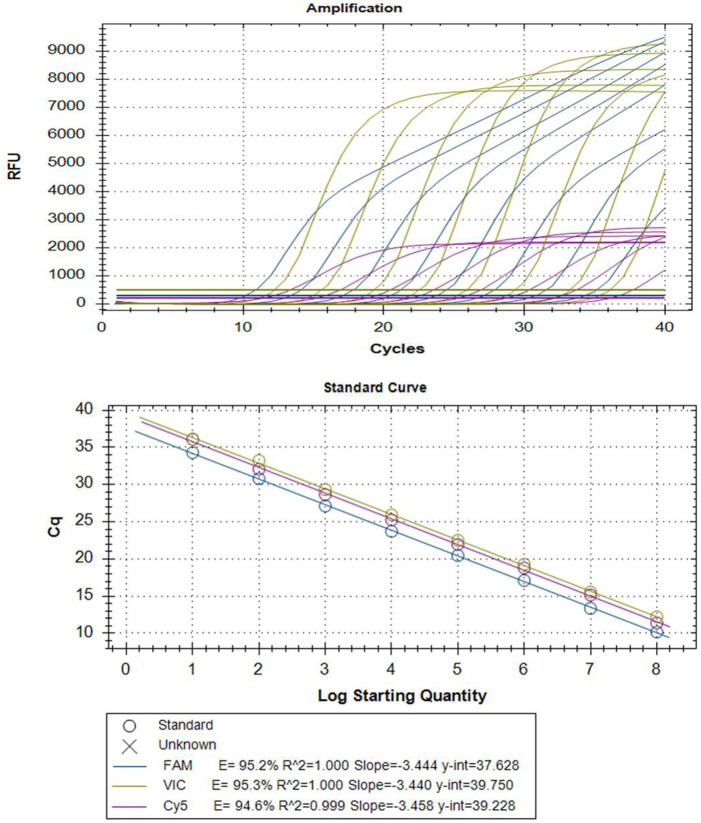 Figure 1
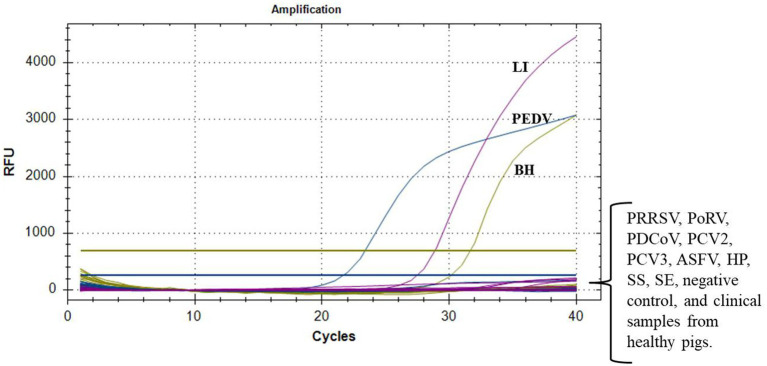 Figure 2
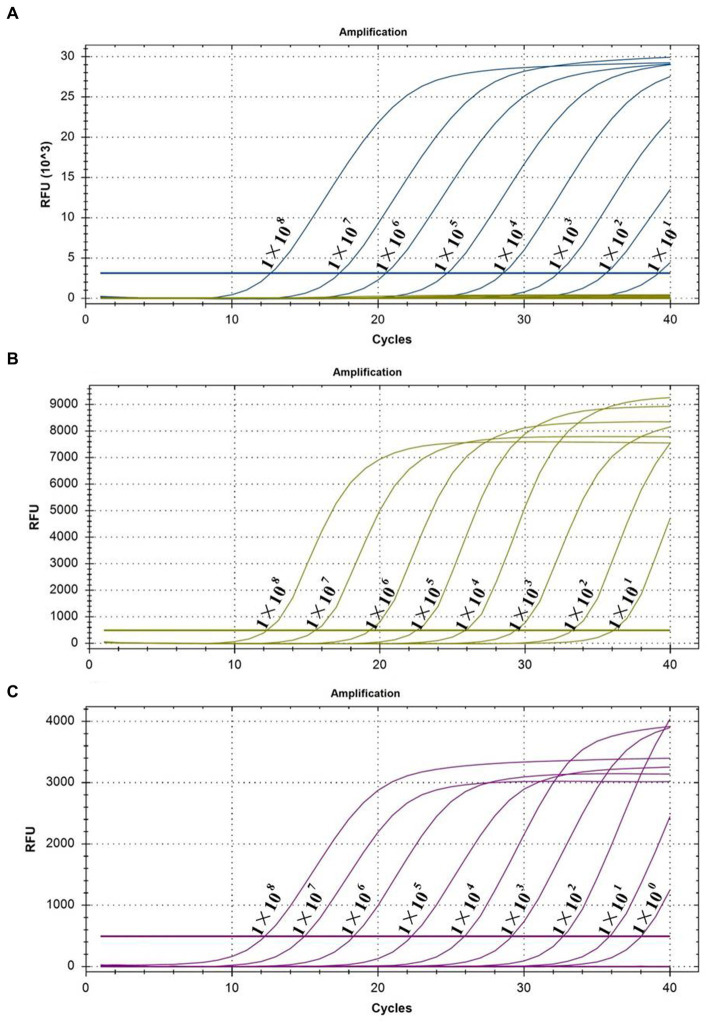 Figure 3
| Virus | Primer/probe | Sequence(5′-3′) | Size (bp) | Target gene |
|---|---|---|---|---|
| PEDV | Forward | CATCTGATTCTGGACAGTTG | 226 | M |
| Reverse | CTATACACCAACACAGGCTC | |||
| Probe | (FAM)TTTCAGAGCAGGCTGCATAT(BHQ1) | |||
|
| Forward | CACCTGGACGATAACTGACACT | 110 | 16 s DNA |
| Reverse | TAACTCCCCAGCACCTAGCAC | |||
| Probe | (CY5) GAGGTGCGAAAGCGTGGGG (BHQ3) | |||
|
| Forward | GTAGGAAGAAGAAATCTGACAATGCA | 142 | NADH oxidase gene |
| Reverse | TATGAAGAAGGCAGCAGACGTTTAT | |||
| Probe | (VIC) GCTTCAGCATGATTGTGT (BHQ1) |
| Templates | Concentrations (copies/μL) | Inter-assay | Intra-assay | ||
|---|---|---|---|---|---|
| Cq values (mean ± SD) | CV% | Cq values (mean ± SD) | CV% | ||
| PEDV | 104 | 29.63 ± 0.47 | 1.57 | 30.42 ± 0.18 | 0.58 |
| 105 | 25.20 ± 0.18 | 0.71 | 25.37 ± 0.07 | 0.29 | |
| 106 | 19.79 ± 0.69 | 3.50 | 20.24 ± 0.03 | 0.15 | |
|
| 104 | 31.95 ± 0.21 | 0.67 | 32.24 ± 0.13 | 0.42 |
| 105 | 27.33 ± 0.06 | 0.20 | 27.20 ± 0.09 | 0.32 | |
| 106 | 22.08 ± 0.31 | 1.40 | 22.30 ± 0.04 | 0.17 | |
|
| 104 | 30.39 ± 0.19 | 0.62 | 30.66 ± 0.11 | 0.36 |
| 105 | 25.44 ± 0.08 | 0.33 | 25.50 ± 0.19 | 0.74 | |
| 106 | 20.71 ± 0.03 | 0.12 | 20.81 ± 0.09 | 0.45 | |
| Pathogens | Number of positive samples | Infection rate (%) |
|---|---|---|
| PEDV | 112 | 31.46 |
|
| 208 | 58.43 |
|
| 351 | 98.60 |
| PEDV+ | 60 | 16.85 |
| PEDV+ | 112 | 31.46 |
| 206 | 57.86 | |
| PEDV+ | 60 | 16.85 |
Peer Reviews
No public reviews on file for this paper yet. If you reviewed it on a platform where reviews are public (OpenReview, ICLR, NeurIPS, ICML), you can paste yours below so the community can read it here.
Videos
No videos yet. Explain this paper in a talk, walkthrough, or lecture? Add one.
Taxonomy
TopicsGambling Behavior and Treatments
Introduction
1
Diarrheal disease is a major threat to the global swine industry, causing significant losses in pig production (1, 2). It is caused by various infectious organisms, such as viral and bacterial pathogens. Numerous causative pathogens have been identified in swine, including porcine epidemic diarrhea virus (PEDV), porcine delta coronavirus (PDCoV), transmissible gastroenteritis virus (TGEV), porcine enteric alpha coronavirus (PEAV), porcine rotavirus (PoRV), Salmonella, Escherichia coli, Brachyspira hyodysenteriae, Lawsonia intracellularis, and so on (3). Among these pathogens, PEDV, B. hyodysenteriae, and L. intracellularis are the most destructive pathogens causing anorexia, diarrhea, dehydration, and vomiting (4–7). With the rapid development of intensive aquaculture, co-infection or secondary infection with these pathogens is prevalent, leading to more severe consequences than single-pathogen infection (4, 8).
Porcine epidemic diarrhea (PED) is a highly contagious diarrheal disease in pigs caused by an enveloped, single-stranded RNA virus belonging to the Alphacoronavirus genus in the Coronaviridae famil (9). It is particularly severe in piglets, often leading to 100% mortality (4, 9). PED was first reported in England in 1971, followed by an outbreak in Belgium in 1977, and subsequently identified in China during the 1980s (1, 10, 11). A highly virulent strain emerged in China in December 2010, resulting in over 1 million piglet deaths (11). These strains have since spread worldwide in the swine industry (1, 11).
B. hyodysenteriae, a gram-negative anaerobic bacterium, is the classical agent of swine dysentery, a severe mucohaemorrhagic diarrheal disease affecting weanling to finishing pigs (12). This widespread disease can lead to significant mortality rates and decreased feed conversion efficiency, resulting in substantial economic losses for intensive pig production systems globally (12, 13). L. intracellularis, a gram-negative obligate intracellular bacterium, is the causative agent of porcine proliferative enteropathy (PPE) (14). PPE is a commonly observed bacterial disease with a high prevalence ranging from 48 to 100% at swine production facilities worldwide (6). Due to the fastidious characteristics of L. intracellularis, the obligate anaerobic bacteria are extremely difficult to culture in vitro (13, 14).
Rapid and accurate diagnostic methods are essential for effective treatment and prevention programs. However, pigs infected with PEDV, B. hyodysenteriae, and L. intracellularis show similar symptoms and pathology, making it hard to differentiate them. The high incidence of co-infection with these pathogens further exacerbates the complexities in clinical diagnosis (13). Hence, developing a highly sensitive diagnostic system is necessary to quickly detect and differentiate these causative pathogens to minimize economic losses from diarrheal disease.
Current diagnostic tests for pathogens, such as immunochromatography, antigen detective enzyme-linked immunosorbent assay, conventional PCR, and singleplex real-time PCR, can only detect one pathogen at a time and cannot confirm co-infections (15, 16). Simultaneous detection of multiple pathogens in clinical diagnostics requires multiple reactions, leading to wasted reagents and increased costs. Conversely, multiplex real-time PCR enables the simultaneous detection of multiple pathogens in a single reaction system, making it a widely utilized method in clinical diagnostics (16–18). While numerous multiplex real-time PCR assays have been employed in clinical detection of viral infectious diseases, the simultaneous detection of viral and bacterial pathogens is rarely reported. In this study, we developed a multiple real-time PCR assay using TaqMan probe to simultaneously and accurately detect PEDV, B. hyodysenteriae, and L. intracellularis. This assay demonstrated high sensitivity and specificity for the target genes, making it a useful tool for rapid pathogen identification.
Materials and methods
2
Viruses, bacteria, and clinical samples
2.1
Positive samples for various swine pathogens, including PEDV, porcine reproductive and respiratory syndrome virus (PRRSV), porcine circovirus (PCV2, PCV3), African swine fever virus (ASFV), PoRV, PDCoV, B. hyodysenteriae, L. intracellularis, Haemophilus parasuis (HP), Streptococcus suis (SS), and Salmonella enteritidis (SE), confirmed by PCR and DNA sequencing, were stored in our laboratory. A total of 356 clinical samples were collected from pig farms in Shandong and Hebei provinces, including 217 fecal samples and 139 rectal swabs.
Nucleic acid extraction from pathogens
2.2
Nucleic acids were extracted from viral and bacterial pathogens, as well as clinical samples, using the NPA-96E Automatic Nucleic Acid Extractors from Bioer Technology Co., Ltd. (Hangzhou, China). The viral nucleic acids were extracted using the VAMNE Virus DNA/RNA Extraction Kit (Nanjing Vazyme Biotech Co.,Ltd.), and bacterial nucleic acids were extracted using the TaKaRa MiniBEST Universal Genomic DNA Extraction Kit (Takara Biomedical Technology (Beijing) Co., Ltd.), following the manufacturer’s guidelines. For RNA viruses, cDNA was synthesized using the TransScript Probe One-Step qRT-PCR SuperMix (Beijing Transgen Biotech Co., Ltd.). The extracted DNA and synthetic cDNA were stored at −80°C until used.
Design of the primers and probes
2.3
Primers and probe for PEDV used in the study were previously designed by Ren et al. (4), while those for B. hyodysenteriae and L. intracellularis were based on at least 30 genome sequences downloaded from NCBI. The primers were designed to target the NADH oxidase gene of B. hyodysenteriae and the 16S rDNA gene of L. intracellularis. Utilizing Primer Premier 5 software (Premier, Canada), primers and probes were designed based on the most conserved regions. TaqMan probes for PEDV, B. hyodysenteriae, and L. intracellularis were fluorescently labeled with FAM, VIC, and Cy5 at the 5′ end, respectively, with all quenchers at the 3′ end being BHQ. Sequences of the primers and probes can be found in Table 1 and were synthesized by Sangon Biotech (Shanghai) Co., Ltd.
Construction of standard plasmids
2.4
The target fragments of PEDV, B. hyodysenteriae, and L. intracellularis were amplified individually by PCR. The PCR fragments were purified and cloned into the pMD18-T vector (Takara Biomedical Technology (Beijing) Co., Ltd.). The transformed clones were then introduced into the Escherichia coli DH5α strain. Positive clones were cultured, and plasmid extraction was done with the TaKaRa MiniBEST Universal Genomic DNA Extraction Kit. The plasmid was confirmed by DNA sequencing and used as the standard positive control. Quantification was done with a UV–visible spectrophotometer, and copy numbers were determined using the following formula (17):
A tenfold serial dilution was performed on each plasmid, with concentrations ranging from 1.0 × 10^8^ copies/μL to 1.0 × 10^1^ copies/μL. For the multiplex standard curves, each plasmid was individually diluted to 3.0 × 10^9^ copies/μL and pooled in equal volumes to achieve a final concentration of 1.0 × 10^9^ copies/μL for each plasmid. The combined plasmid solution was then subjected to a tenfold serial dilution, resulting in concentrations ranging from 1.0 × 10^8^ copies/μL to 1.0 × 10^1^ copies/μL, for the establishment of multiplex standard curves.
Optimization of multiplex real-time PCR assay
2.5
The concentrations of primers and probes were optimized using a matrix method. Different concentrations of primers (10 μM) ranging from 0.2 to 0.8 μL each, as well as probes (10 μM) ranging from 0.1 to 0.4 μL each, were tested at varying annealing temperatures between 48°C and 57°C to optimize the reaction. Given that PEDV is an enveloped RNA virus, the amplification process was conducted using a one-step reaction, where the entire reaction from cDNA synthesis to real-time PCR amplification was performed in a single well. The main objective was to minimize the Cq value and maximize the fluorescence intensity (RFU). Amplification was carried out on a Bio-Rad CFX96™ Real-time System (Bio-Rad, Hercules, CA, United States), with fluorescence signal being automatically recorded at the end of each cycle. All real-time PCR results were analyzed using CFX Manager™ software.
Sensitivity, specificity, and repeatability test of the multiplex real-time PCR assay
2.6
To determine the limit of detection (LOD) for the multiplex real-time PCR method, the aforementioned pooled standard plasmids were diluted in a tenfold serial manner, ranging from 1.0 × 10^8^ copies/μL to 1.0 × 10^−1^ copies/μL in nuclease-free water. These diluted standard plasmids served as templates for the amplification via multiplex real-time PCR, with the reliable LOD being the lowest concentration that achieved a 95% positive detection rate.
To avoid false positives resulting from the presence of other viruses or bacteria in the samples, a specificity test of a multiplex real-time PCR assay was conducted using three RNA viruses (PRRSV, PoRV, and PDCoV), three DNA viruses (PCV2, PCV3, and ASFV), and three bacteria (H. parasuis, S. suis, and S. enteritidis). Standard plasmids of PEDV, B. hyodysenteriae, and L. intracellularis were used as positive controls, with nuclease-free water as the negative control. Three clinical samples from healthy pigs were also tested to confirm specificity.
To test repeatability of the multiplex real-time PCR, pooled standard plasmids with concentrations ranging from 1.0 × 10^6^ copies/μL to 1.0 × 10^4^ copies/μL were used as templates. Each reaction was done in triplicate under identical conditions to assess intra-assay repeatability. Inter-assay repeatability was determined by conducting the assays three times at different time points. The coefficient of variation (CV) of the Cq values was calculated to estimate repeatability, and data analysis was done using Microsoft Excel.
Clinical sample testing
2.7
The standard plasmids and ddH_2_O were utilized as positive and negative controls, respectively, in conjunction with optimized reaction conditions for multiplex real-time PCR analysis aimed at detecting the presence of each pathogen. Infection rates were determined by analyzing results from clinical samples.
Results
3
Optimization of the reaction conditions for the multiplex real-time PCR
3.1
After multiple tests, the optimal reaction conditions for multiplex real-time PCR were determined as follows: 10 μL of 2 × AceQ qPCR Probe Master Mix (Vazyme, Nanjing, China), 1 μL One Step Q Probe Enzyme Mix (Vazyme, Nanjing, China), 0.4 μL each of forward/reverse primers (10 μM), 0.2 μL each of probes (10 μM), 4 μL of template, and ddH_2_O added to a final volume of 20 μL. The reaction program was as follows: 50°C for 5 min, 95°C for 5 min, 40 cycles of 95°C for 10 s, and 52°C for 30 s.
Standard curves of the multiplex real-time PCR
3.2
Serial dilutions of mixed plasmid standards were utilized as templates for multiplex real-time PCR amplification with optimized reaction conditions. Standard curves were automatically generated by the fluorescence quantitative PCR instrument, showing high correlation coefficients and amplification efficiency for each pathogen, for details, PEDV (R^2^ = 1.000; E = 95.2%), B. hyodysenteriae (R^2^ = 1.000; E = 95.3%), and L. intracellularis (R^2^ = 0.999; E = 94.6%) (Figure 1). This result confirms the validity and reliability of the multiplex real-time PCR assay.
Amplification curves (top) and standard curves (bottom) of optimized multiplex real-time PCR for simultaneous detection of PEDV, L. intracellularis, and B. hyodysenteriae. The concentrations of each plasmid standard are from 1 × 10⁸ copies/μL to 1 × 101 copies/μL. TaqMan probes for PEDV, B. hyodysenteriae, and L. intracellularis were fluorescently labeled with FAM, VIC, and Cy5, respectively.
The specificity of the multiplex real-time PCR assay
3.3
The optimized reaction protocol was utilized for the detection of nucleic acids from a range of porcine pathogens, such as PRRSV, PoRV, PDCoV, PCV2, PCV3, ASFV, H. parasuis, S. suis, and S. enteritidis. As shown in Figure 2, successful detection of all target pathogens was achieved, with no positive signal detected from the aforementioned nine pathogens, the negative control, and three clinical samples from healthy pigs. This finding indicated that the multiplex real-time PCR assay was highly specific, without any cross-reactivity with common pathogens.
Specificity tests of multiplex real-time PCR. Only PEDV, L. intracellularis (LI), and B. hyodysenteriae (BH) showed positive fluorescence signals, while other swine pathogens and clinical samples from healthy pigs exhibited no fluorescence signals.
The sensitivity of the multiplex real-time PCR assay
3.4
The sensitivity of the multiplex real-time PCR assay was tested using different concentrations of pooled standard plasmids, ranging from 1.0 × 10^8^ copies/μL to 1.0 × 10^−1^ copies/μL. Figure 3 shows that the lowest detection limits for PEDV (Figure 3A) and B. hyodysenteriae (Figure 3B) were 1.0 × 10^1^ copies/μL, and for L. intracellularis was 1.0 × 10^0^ copies/μL (Figure 3C). However, further experiments revealed that the detection rate for L. intracellularis and PEDV at those levels was less than 95% of replicates (Supplementary Table S1). Therefore, the reliable detection limit for B. hyodysenteriae and L. intracellularis is 1.0 × 10^1^ copies/μL, while it is 1.0 × 10^2^ copies/μL for PEDV.
Sensitivity tests of multiplex real-time PCR. (A) The test for the sensitivity of PEDV; (B) the test for the sensitivity of B. hyodysenteriae; and (C) the test for the sensitivity of L. intracellularis.
Repeatability of the multiplex real-time PCR assay
3.5
The data in Table 2 shows that the variation coefficients of Cq values range from 0.15 to 0.74% in intra-group tests and from 0.12 to 3.5% in inter-group tests. These results suggest the high reproducibility of the multiplex real-time PCR assay developed in this study.
Verification of the multiplex real-time PCR assay by commercial singleplex real-time PCR kit
3.6
Thirty clinical samples were utilized to conduct a comparative analysis between multiplex real-time PCR and a commercial singleplex real-time PCR kit. Results were consistent between the two methods, indicating that the multiplex real-time PCR assay can replace the commercial singleplex real-time PCR kit for detecting PEDV, B. hyodysenteriae, and L. intracellularis simultaneously (Supplementary Table S2).
Clinical application of the multiplex real-time PCR
3.7
A total of 356 clinical samples were tested using the multiplex real-time PCR assay established in this study. As shown in Table 3, the single infection rates for PEDV, B. hyodysenteriae, and L. intracellularis were 31.46% (112/356), 58.43% (208/356), and 98.60% (351/356), respectively. Co-infection rates for PEDV + B. hyodysenteriae, PEDV + L. intracellularis, and B. hyodysenteriae + L. intracellularis were 16.85% (60/356), 31.46% (112/356), and 57.86% (206/356), respectively. The mixed infection rate for PEDV + B. hyodysenteriae + L. intracellularis was 16.85% (60/356).
Discussion
4
PEDV, B. hyodysenteriae, and L. intracellularis are highly contagious diarrheal pathogens that have caused significant harm to the global swine industry (4–7). Previously, antibiotics were extensively utilized in animal husbandry to prevent and treat bacterial infections, as well as to promote growth and enhance feed efficiency, resulting in a reduced incidence of bacterial diarrhea. However, the Chinese government implemented a ban on the inclusion of antibiotics in animal feed in 2020. Since the enactment of this regulation, the prevalence of B. hyodysenteriae and L. intracellularis has been increasing annually. Especially, co-infections with viruses and bacteria are common in some pig herds due to intensive swine production. Distinguishing the specific causative agent based on clinical information alone is difficult due to similarities in symptoms and pathology. Thus, it is essential to develop a reliable method for the differential detection of PEDV, B. hyodysenteriae, and L. intracellularis in the laboratory and diagnose them accurately in clinical settings.
In this study, three pairs of specific primers and corresponding probes were designed for the conserved regions of the PEDV M gene, B. hyodysenteriae NADH oxidase gene, and L. intracellularis 16S rDNA gene. Following multiple optimization iterations, a multiplex TaqMan probe-based real-time PCR assay was successfully established for the simultaneous detection of three predominant diarrheal pathogens, namely PEDV, B. hyodysenteriae, and L. intracellularis, in a single amplification reaction. The method developed in this study is highly sensitive, with a detection limit of 10 copies/μL for B. hyodysenteriae and L. intracellularis, and 100 copies/μL for PEDV. The multiplex real-time PCR assay also demonstrated good repeatability with coefficients of variation ranging from 0.15 to 0.74% for intra-assays and 0.12–3.5% for inter-assays, which proves the stability and reliability of the results. A comparison was made between a commercial singleplex real-time PCR kit and the multiplex real-time PCR method developed in this study for detecting PEDV, B. hyodysenteriae, and L. intracellularis, in thirty clinical samples. Results showed complete agreement between the two methods, indicating that the multiplex assay is a viable alternative for simultaneous differentiation of the pathogens.
The multiplex real-time PCR assay developed in this study has been widely applied for the early detection of pathogens in clinical samples due to its rapid, highly sensitive, and specific characteristic. A total of 356 clinical samples from Shandong and Hebei provinces in China were tested using multiplex real-time PCR assay to investigate the prevalence of PEDV, B. hyodysenteriae, and L. intracellularis. Results showed that L. intracellularis and B. hyodysenteriae are the main pathogens in diarrheal pigs in both provinces. L. intracellularis had the highest infection rate at 98.6%, followed by B. hyodysenteriae at 58.43% and PEDV at 31.46%. The prevalence of B. hyodysenteriae and L. intracellularis infections in Chinese pig herds appears to be higher than previously believed (5, 13). A previous study conducted on 891 fecal samples from 47 farms revealed that 37.3% of the fecal samples and 93.6% of the farms tested positive for L. intracellularis (13). Swine dysentery, mainly caused by B. hyodysenteriae, was a prevalent disease in China in the 1990s. But with the expansion of large-scale aquaculture in China and the use of antibiotic additives in feed, the incidence of these bacterial diseases has gradually decreased since 2010. Consequently, there is a paucity of research on the current prevalence of these infections. The rise in infection rates of L. intracellularis and B. hyodysenteriae may be linked to the comprehensive implementation of the ban on the addition of antibiotics in feed in China since 2020.
Co-infections of bacterial and viral pathogens are common in clinical settings and can impact the severity of each other’s infections (19, 20). Our study found that co-infections account for 72.5% (258/356) of samples, suggesting an increasing prevalence of multiple pathogen co-infections associated with expanding large-scale and intensive swine production. Notably, co-infections involving L. intracellularis and B. hyodysenteriae were found to be prevalent, accounting for 57.86% of cases. Previous study indicated that L. intracellularis infection may facilitate the colonization and establishment of B. hyodysenteriae in the large intestine, potentially by inducing early changes or impairing the host intestinal immune response (8). This suggests that co-infections of L. intracellularis and B. hyodysenteriae are common in Chinese pig farms, and need to be addressed for prevention and control.
In conclusion, we have successfully developed a reliable multiplex real-time PCR assay to differentiate PEDV, L. intracellularis, and B. hyodysenteriae. This assay is highly specific, sensitive, and repeatable, and has shown efficacy in the detection of clinical samples, making it a valuable tool for rapid pathogen identification. Rapid and accurate diagnostics, along with immediate quarantine and treatment, can help prevent and control the spread of infectious diseases.
The reference list from the paper itself. Each links out to its DOI / PubMed record.
- 1Wu X Liu Y Gao L Yan Z Zhao Q Chen F. Development and application of a reverse-transcription recombinase-aided amplification assay for porcine epidemic diarrhea virus. Viruses. (2022) 14:59. doi: 10.3390/v 14030591, PMID: 35336998 PMC 8948910 · doi ↗ · pubmed ↗
- 2Hou W Fan M Zhu Z Li X. Establishment and application of a triplex real-time RT-PCR assay for differentiation of PEDV, Po RV, and PD Co V. Viruses. (2023) 15:1238. doi: 10.3390/v 15061238, PMID: 37376539 PMC 10301752 · doi ↗ · pubmed ↗
- 3Huang X Chen J Yao G Guo Q Wang J Liu G. A Taq Man-probe-based multiplex real-time RT-q PCR for simultaneous detection of porcine enteric coronaviruses. Appl Microbiol Biot. (2019) 103:4943–52. doi: 10.1007/s 00253-019-09835-7, PMID: 31025076 PMC 7080015 · doi ↗ · pubmed ↗
- 4Ren J Zu C Li Y Li M Gu J Chen F. Establishment and application of a Taq Man-based multiplex real-time PCR for simultaneous detection of three porcine diarrhea viruses. Front Microbiol. (2024) 15:1380849. doi: 10.3389/fmicb.2024.1380849, PMID: 38690365 PMC 11058560 · doi ↗ · pubmed ↗
- 5Wang L Wu W Zhao L Zhu Z Yao X Fan J. Fecal PCR survey and genome analysis of Lawsonia intracellularis in China. Front Vet Sci. (2024) 11:1324768. doi: 10.3389/fvets.2024.1324768, PMID: 38384951 PMC 10879436 · doi ↗ · pubmed ↗
- 6Arnold M Crienen A Swam Hvon Berg S Jolie R Nathues H. Prevalence of Lawsonia intracellularis in pig herds in different European countries. Porc Health Manag. (2019) 5:31. doi: 10.1186/s 40813-019-0137-6, PMID: 31890255 PMC 6918559 · doi ↗ · pubmed ↗
- 7Calderaro A Bommezzadri S Piccolo G Zuelli C Dettori G Chezzi C. Rapid isolation of Brachyspira hyodysenteriae and Brachyspira pilosicoli from pigs. Vet Microbiol. (2005) 105:229–34. doi: 10.1016/j.vetmic.2004.10.02115708820 · doi ↗ · pubmed ↗
- 8Daniel AGS Pereira CER Dorella F Pereira FL Laub RP Andrade MR. Synergic effect of Brachyspira hyodysenteriae and Lawsonia intracellularis coinfection: anatomopathological and microbiome evaluation. Animals. (2023) 13:2611. doi: 10.3390/ani 13162611, PMID: 37627402 PMC 10451556 · doi ↗ · pubmed ↗