Journey through tumorverse: Creating models to decode PXA mysteries
George Bukenya, Anthony R. Sloan, Justin D. Lathia

TL;DR
This paper explores the progression of a rare brain tumor in children using a new mouse model to study immune system interactions.
Contribution
The study introduces a novel immunocompetent mouse model for studying BRAF V600E pediatric low-grade glioma.
Findings
The RCAS-BRAF V600E model recapitulates key features of human PXA tumors.
The model enables profiling of immunological dynamics in BRAF V600E pLGG.
It provides insights into tumor progression and immune interactions.
Abstract
Pleomorphic xanthoastrocytoma (PXA) is a rare pediatric low-grade glioma (pLGG), of which 60%–80% exhibit the BRAF V600E mutation, that enhances the aggressiveness and progression to an eventual pediatric high-grade glioma (pHGG). Despite the aggressiveness of this mutational status, the mechanisms underlying the progression of BRAF V600E tumors remain poorly understood, primarily due to limited insights into their in vivo growth dynamics. In this issue, Rajappa and colleagues leverage a novel immunocompetent RCAS-BRAF V600E murine glioma model to profile the immunological dynamics taking place in BRAF V600E pLGG.
Genes, proteins, chemicals, diseases, species, mutations and cell lines named across the full text — each resolved to its canonical identifier and authoritative record.
Click any figure to enlarge with its caption.
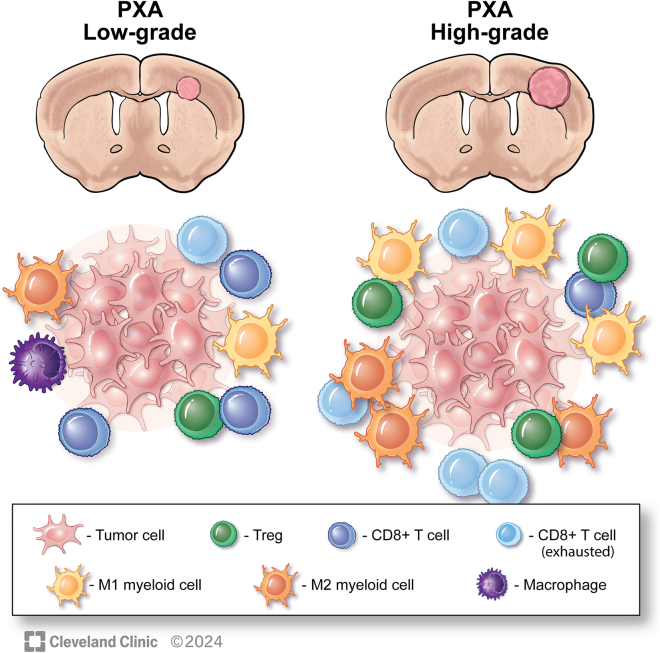 Figure 1
Peer Reviews
No public reviews on file for this paper yet. If you reviewed it on a platform where reviews are public (OpenReview, ICLR, NeurIPS, ICML), you can paste yours below so the community can read it here.
Videos
No videos yet. Explain this paper in a talk, walkthrough, or lecture? Add one.
Taxonomy
TopicsGlioma Diagnosis and Treatment · interferon and immune responses · Ferroptosis and cancer prognosis
Main text
Pediatric low-grade gliomas (pLGGs) are among the most prevalent pediatric brain tumor, accounting for 35% of all central nervous system tumors.1 Genetically, they commonly exhibit alterations in the MAPK/ERK activation pathway, which are not typically seen in adult LGGs.1 Regarding treatment, patients with pLGG are oftentimes tumor free following surgery.2 Of the pediatric patients diagnosed with pleomorphic xanthoastrocytoma (PXA), 60%–70% will carry the BRAF V600E mutation. This mutational status often correlates with progression into more aggressive, high-grade gliomas (HGGs) and subsequent worse overall survival. Studying the characteristics of pLGGs, specifically the tumors with the V600E mutational status, pose significant challenges due to the lack of adequate models to successfully study the low-grade to high-grade transition of these tumors.
Previous studies have extensively investigated immune cell infiltration in adult glioblastoma (GBM) tumors and identified distinct immune cell profiles, categorizing them into three groups: (1) tumors with leukocyte infiltration, (2) tumors enriched with tumor-associated macrophages (TAMs) and neutrophils, and (3) tumors exhibiting a mixed infiltration of TAMs, neutrophils, and T lymphocytes.3 These findings underscore the heterogeneity in immune cell infiltration across GBM tumors. While the BRAF V600E mutation is recognized as a key driver of tumor progression in pLGGs, how these tumors regulate the immune cell infiltration to drive their progression remains underexplored due to adequate models.
It is important to recognize that mouse models provide invaluable insights into the mechanisms of disease and the efficacy of potential therapies. The RCAS-TVA system is a commonly used model that utilizes viral vectors to deliver gene-editing proteins, inducing specific mutations to initiate tumors in mice with known glioma oncogenic drivers. Other in vivo models include carcinogen-induced tumors, xenografts of tumor cell lines, and genetically engineered rodent modes.4 Although these models offer the advantage of developing tumors de novo and maintaining tumor-host interactions, they often produce circumscribed tumors, lack the complex heterogeneity seen clinically, and do not thoroughly give insight into the low-grade to high-grade disease course. The RCAS-BRAF V600E model developed by Rajappa and colleagues represents a significant advancement, providing a valuable tool for exploring the role of immune cell populations in the progression of V600E pLGG to its lethal HGG. The BRAF V600E mutation has been identified in multiple cancers including thyroid, ovarian, lung, and melanoma. BRAF, activated by GTPase proteins, dimerizes—either as homodimers or heterodimers—to activate the MAPK pathway, including MEK1 and MEK2, through phosphorylation.5 Pathologically, the BRAF mutation is perpetually activated due to point mutations, fusions, or in-frame deletions.5
To further elucidate the characteristics of PXA pLGGs, Rajappa and colleagues successfully initiated gliomagenesis, replicating the histological, pathological, and morphological features observed in BRAF V600E PXA. This model will continue to be valuable in investigating the transition from LGGs to HGGs in the context of BRAF V600E mutations. Specifically, this model will allow a mechanistic understanding of immune cell infiltration patterns that take place during the low-grade to high-grade transition. Utilizing this model, Rajappa and colleagues conducted an in-depth analysis of the tumor microenvironment and immune cell infiltration at the end stage (day 50) of their new model. RNA sequencing revealed 8,085 genes with significant differential expression compared to control animals. Notably, there was an upregulation of genes linked to CD8+ T cell activation and exhaustion, as well as both proinflammatory (M1) and immunosuppressive (M2) myeloid cells, antigen presentation, and regulatory T cell activation, highlighting the roles of cytotoxic T cell exhaustion and myeloid cell immunosuppression in the low-grade to high-grade transition (Figure 1).Figure 1. Summary of findings by Rajappa and colleague utilizing their novel PXA BRAF V600E model
Limitations with the RCAS-BRAF V600E model primarily revolve around its median survival time, which is notably short at 46 days. This constraint significantly hampers the scope of pharmacological studies involving BRAF inhibitors, as the limited survival period reduces the window for meaningful intervention and observation. In addition, the rate at which this model progresses from a low-grade to high-grade tumor is variable. Additional limitations of this study stem from the inherent species differences between mouse and human biology, which may affect the translatability of the findings. The tumor heterogeneity observed in human pediatric gliomas may not be fully replicated by the murine model, thereby limiting the model’s ability to capture the complexity of the disease’s pathology. Moreover, the model’s restricted scope of mutations does not reflect the diverse and often concurrent genetic alterations characteristic of pediatric gliomas.
To enhance the utility of this model, it is crucial to delve deeper into several key areas. Firstly, quantifying immune cell infiltration at various stages of disease progression is essential to elucidate the dynamics of the tumor microenvironment and immune cell interactions as well as give a clear understanding of the dynamic disease progression. Secondly, understanding the median survival and low-grade to high-grade transition with respect to sex as a biological variable could yield insights into sex-specific responses and survivability, potentially informing personalized therapeutic approaches. Additionally, it is important to explore the translational potential of this model in the development of BRAF inhibitors for in vivo studies of pLGGs and conduct further testing for potential combinational therapies in pLGGs. Another critical area of exploration is the mechanisms of tumor immune evasion, which could reveal novel targets for immunotherapy. Furthermore, a comprehensive understanding of tumor-host interactions and the intricacies of tumor formation is imperative to ensure that the RCAS-BRAF V600E model accurately mirrors the pathological and biological characteristics of human tumors. With ongoing research and advancements in this area, the RCAS-BRAF V600E model holds great promise for enhancing our understanding of human tumors and paving the way for innovative therapeutic strategies.
The reference list from the paper itself. Each links out to its DOI / PubMed record.
- 1Bergthold G.Bandopadhayay P.Bi W.L.Ramkissoon L.Stiles C.Segal R.A.Beroukhim R.Ligon K.L.Grill J.Kieran M.W.Pediatric low-grade gliomas: how modern biology reshapes the clinical field Biochim. Biophys. Acta 1845201429430710.1016/j.bbcan.2014.02.00424589977 PMC 4082403 · doi ↗ · pubmed ↗
- 2Greuter L.Guzman R.Soleman J.Pediatric and Adult Low-Grade Gliomas: Where Do the Differences Lie?Children 82021107510.3390/children 8111075 PMC 862447334828788 · doi ↗ · pubmed ↗
- 3Gonzalez-Tablas Pimenta M.Otero A.Arandia Guzman D.A.Pascual-Argente D.Martín L.R.Sousa-Casasnovas P.García-Martin A.Roa Montes de Oca J.C.Villaseñor-Ledezma J.Torres Carretero L.Tumor cell and immune cell profiles in primary human glioblastoma: Impact on patient outcome Brain Pathol.31202136538010.1111/bpa.1292733314398 PMC 8018082 · doi ↗ · pubmed ↗
- 4Simeonova I.Huillard E.In vivo models of brain tumors: roles of genetically engineered mouse models in understanding tumor biology and use in preclinical studies Cell. Mol. Life Sci.7120144007402610.1007/s 00018-014-1675-325008045 PMC 4175043 · doi ↗ · pubmed ↗
- 5Di Nunno V.Gatto L.Tosoni A.Bartolini S.Franceschi E.Implications of BRAF V 600E mutation in gliomas: Molecular considerations, prognostic value and treatment evolution Front. Oncol.122022106725210.3389/fonc.2022.1067252 PMC 984608536686797 · doi ↗ · pubmed ↗